I Raised My Daughter Alone, but at Her Wedding the Grooms Family Left a Sign on My Table
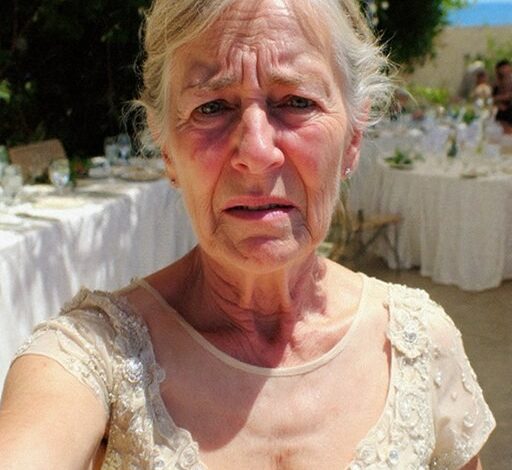
I always thought my daughter’s wedding would be the proudest day of my life. I imagined watching her walk down the aisle, radiant in white, knowing every sacrifice I’d made was worth it. I raised Emily alone. There were nights I skipped dinner so she could eat, days I worked double shifts at the hospital, and years I wondered if I was enough. But I never regretted it. She was my reason for everything.
When she told me she was getting married, I cried. I thought, this is it — the moment I finally get to sit in the front row and watch my little girl begin her own story. I never imagined that on that day, I’d instead be humiliated in front of everyone — not by strangers, but by her new in-laws.
I was twenty-three when Emily was born. Her father, Tom, wasn’t ready to be anyone’s father. He stuck around for six months before walking out. At first, I felt like the floor had dropped out from under me. But Emily’s tiny hands pulled me back. Her laughter, her first steps — they gave me purpose.
I worked as a nurse’s assistant, barely scraping by. My parents had passed before she was born, and Tom’s family wanted nothing to do with us. It was just me and her. Every decision, every paycheck, every prayer — all for Emily.
When she wanted piano lessons, I found a retired teacher willing to barter for housecleaning. When her class went to Washington, D.C., I picked up every extra shift until I could afford it. When she got accepted to college out of state, I cashed out what little savings I had. I wasn’t perfect — I was tired, sometimes short-tempered — but she never lacked love.
Then she met Michael. He was polite, steady, and seemed to genuinely care for her. But from the first time I met his parents, I knew there’d be trouble.
His mother, Cynthia, gave me a once-over that said everything her tight smile didn’t. His father, Richard, asked polite but probing questions about my “career trajectory” and “family background.” I could practically hear them calculating my social worth. They came from money — old, inherited kind. Their home was all marble and chandeliers. My small two-bedroom rental must have looked like another planet to them.
Still, I tried. I baked pies for dinners, complimented Cynthia’s art gallery, offered to help with wedding planning. Every time, she brushed me off with that same brittle politeness. Once, I overheard her whisper to a friend, “Single mothers always dramatize how hard they have it.”
I told myself to ignore it. For Emily’s sake.
When wedding plans began, Emily said Michael’s parents wanted to cover most of the costs. I was embarrassed but relieved. I offered to buy her dress — it was all I could afford. Over time, though, I noticed my name disappearing from every conversation. The wedding planner emailed Cynthia instead of me. I wasn’t invited to tastings or fittings. When I asked Emily about it, she said, “Mom, they’re just excited. Don’t take it personally.”
So I smiled and pretended it didn’t hurt.
On the morning of the wedding, I woke early, my stomach in knots. I’d saved for months for my dress — soft blue, simple but elegant. I got my hair done, bought a secondhand clutch, and told myself this was my moment to be proud.
The vineyard was breathtaking — rolling hills, twinkling lights, champagne laughter everywhere. I scanned the tables for my seat. I expected to be near the front, where the bride’s family usually sits. Instead, my name was halfway back, tucked between distant relatives.
But that wasn’t the worst part.
On my plate was a folded card. In thick, black ink, it read:
“Horrible and Fake Mom.”
My breath caught. I thought it was a mistake, some cruel prank. But as I lifted it, I noticed Cynthia watching me from across the room — her smirk unmistakable.
A few guests nearby glanced my way, whispering. My hands shook. I felt like the air had vanished from the room.
I stood, heart pounding, and walked straight toward the bridal suite. A bridesmaid tried to stop me, but one look at my face, and she stepped aside.
Emily was adjusting her veil when I burst in. “Mom, what’s wrong?”
I held up the card. “This. What is this supposed to mean?”
Her smile fell. “Where did you get that?”
“It was on my table. For everyone to see.” My voice cracked. “Emily, did you know?”
She shook her head, horrified. “No! I swear I didn’t. I would never—”
Before she could finish, Cynthia appeared in the doorway, her tone cool. “Oh, that. It was a harmless little joke. Don’t take everything so seriously.”
“A joke?” I snapped. “Humiliating me in front of hundreds of people is your idea of a joke? I raised Emily alone while your son was still learning to shave.”
Emily turned on her. “Mother, how could you do that?”
Cynthia’s face didn’t move. “I was simply being honest. Motherhood isn’t about playing martyr. Anyone can pay bills. Not everyone can raise a lady.”
Silence fell.
I looked at Emily — my daughter, my life’s work. Her eyes were full of tears. She grabbed my hand. “Mom, please. Don’t let her ruin this. You’re my mother. You always will be.”
The ceremony went on. I sat where they placed me, shoulders straight, pretending not to hear the murmurs. I watched Emily walk down the aisle, glowing. My heart swelled with pride — and hurt. Because while she was vowing to love her new husband, his family had already decided to despise me.
At the reception, I smiled through it. Danced once with Emily. Told her she was beautiful. Then, before dessert, I slipped away into the night.
For days afterward, I replayed it all — that cruel card, Cynthia’s smirk, my silence. I wondered if I should’ve made a scene, shouted the truth in front of everyone. But deep down, I knew that’s what she wanted.
A week later, Emily showed up at my door, her mascara smudged. “Mom, I’m so sorry,” she said, collapsing into my arms. “I confronted them. They admitted it was a joke — a way to ‘put you in your place.’ I told them I’d never forgive them.”
I held her close, brushing her hair back. “It’s not your fault, sweetheart. You didn’t choose them.”
She pulled back, eyes fierce. “I did choose you. And I’ll never let them treat you like that again.”
In that moment, I felt something shift — not in them, but in us.
Over the months that followed, Emily kept her word. She set boundaries, defended me when her in-laws made snide remarks, and made sure I was included in every holiday and milestone. Slowly, the shame I’d carried began to fade.
I stopped thinking about the words on that card. Instead, I thought about the life I’d built from nothing, the child I’d raised into a woman brave enough to stand up for me.
They could call me fake. They could call me horrible. But I knew better.
I was the mother who stayed. The mother who worked, fought, and loved when no one else would.
And no card — no insult — could ever take that away.