A Single Word at AmericaFest Sparked a Heated Online Debate!
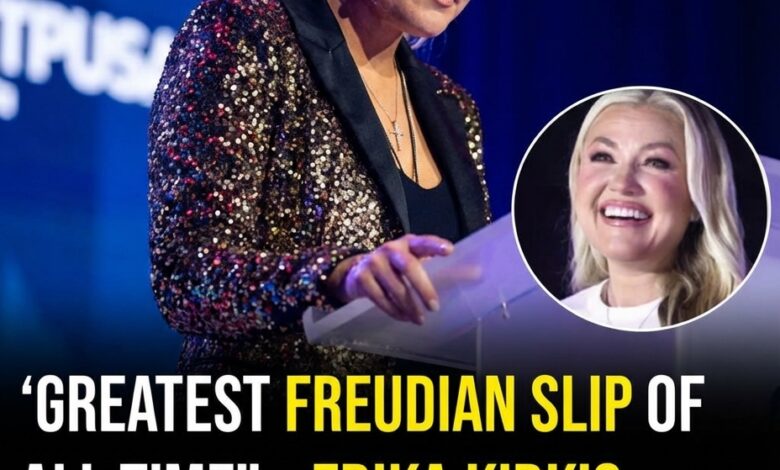
In the high-voltage atmosphere of modern political conventions, every syllable is monitored, every gesture is cataloged, and every unscripted breath has the potential to become a digital wildfire. At the recent AmericaFest gathering in Phoenix, Arizona, a single, flickering verbal stumble by Erika Kirk demonstrated just how volatile the intersection of public speaking and social media has become. What began as a standard address to a crowd of thousands quickly transformed into a case study in linguistic scrutiny, proving that in the year 2025, the distance between a “slip of the tongue” and a “national controversy” is measured in mere seconds.
AmericaFest, the flagship annual event for Turning Point USA, is known for its polished production, high-energy speakers, and a carefully curated message of American exceptionalism. Erika Kirk, a prominent figure within the organization’s leadership hierarchy, took the stage to deliver a speech centered on the traditional virtues of the American spirit. She spoke of resilience, the importance of hard work, and the relentless drive required to succeed in a modern economy. However, as she reached the crescendo of her remarks—a passage intended to celebrate the “American grit” that defines the nation—the gears of speech momentarily misaligned.
Instead of “grit,” the word that left the microphone was “grift.”
The error was instantaneous, and Kirk’s reaction was immediate. She caught the slip the moment it hung in the air, quickly correcting herself to “grit” with a sheepish smile. She paused, taking a breath to acknowledge the fatigue of a marathon event, jokingly telling the audience and her colleagues on stage that it had been an incredibly long day. The crowd in the arena responded in kind, offering a wave of supportive laughter and applause that allowed the speech to proceed without further interruption. In the physical space of the Phoenix Convention Center, the moment was a humanizing blip—a relatable instance of a tired professional losing their footing for a fraction of a second.
However, the reality of the physical room is no longer the primary reality of public life. As the speech continued in person, the “grift” clip was already being digitized, sliced, and distributed across the global network. Within minutes, the five-second snippet had bypassed the context of the hour-long program and was trending across major social media platforms. The digital landscape did not share the live audience’s forgiving laughter; instead, it became a battleground for interpretation, where a single phoneme was dissected with the intensity of a forensic investigation.
The online reaction highlighted the profound tribalism that defines modern discourse. For Kirk’s critics, the slip was framed as a “Freudian slip” of tectonic proportions. They seized upon the word “grift”—a term often used to describe political or financial opportunism—as a symbolic revelation of the speaker’s subconscious or the true nature of the organization she represents. To this faction, the mistake wasn’t a product of exhaustion, but a rare moment of accidental honesty, a “mask-off” moment captured in high definition. Headlines from opposing political commentators began to frame the incident not as a mistake, but as a “telling admission” that cast a shadow over the entire festival.
Conversely, Kirk’s supporters and defenders viewed the obsession with the slip as a quintessential example of “gotcha” journalism and social media pettiness. They pointed to the grueling nature of multi-day conferences, where speakers are often operating on minimal sleep and maximum adrenaline. To them, the focus on a one-syllable error was a desperate attempt by detractors to ignore the actual content of the speech. They argued that if every public figure were held to a standard of verbal perfection over hours of live broadcasting, no one would be left standing. The defense was simple: humans make mistakes, and to suggest that a tired person saying “grift” instead of “grit” is a window into their soul is a reach of astronomical proportions.
This incident underscores a broader, more unsettling truth about the current state of public communication: the death of the “routine address.” In the past, a speaker might flub a line, recover, and the error would live only in the hazy memories of those in the room. Today, the “unscripted moment” has become the primary currency of political engagement. We live in an attention economy that prioritizes the glitch over the program. For many people who did not watch a single minute of AmericaFest, the only thing they know about the event is this specific verbal stumble. The slip didn’t just overshadow the speech; for the digital public, the slip was the speech.
Furthermore, the Kirk incident highlights the evolving role of AI and algorithmic amplification. Once the clip began to gain traction, algorithms optimized for “engagement”—which often translates to “outrage” or “conflict”—pushed the video into the feeds of millions who had no prior interest in Turning Point USA. This created a secondary wave of debate among people who lacked the context of Kirk’s career or the themes of the convention, further stripping the moment of its original human nuance and turning it into a flat, political Rorschach test.
As Kirk concludes her responsibilities at AmericaFest and the news cycle moves toward the next viral sensation, the “grift/grit” debate serves as a cautionary tale for any public figure in the digital age. It is a reminder that the microphone is always live, the camera is always recording, and the internet never sleeps. The scrutiny applied to public figures has reached a microscopic level, where the physical mechanics of speaking are now a source of political risk.
Ultimately, Erika Kirk’s stumble reveals more about our collective culture than it does about her personal character. It exposes a society that is increasingly unwilling to grant the “grace of the mistake,” preferring instead to weaponize every imperfection in service of a pre-existing narrative. Whether the slip was humorous, symbolic, or entirely meaningless depends entirely on the eyes—and the politics—of the beholder. In the end, the most significant takeaway from AmericaFest 2025 may not be found in the prepared speeches or the policy proposals, but in the realization that in our current world, a single letter can ignite a national firestorm.