My Grandkids Only Visited at Christmas for the Money – Last Year, I Finally Learned Who Truly Loved Me!
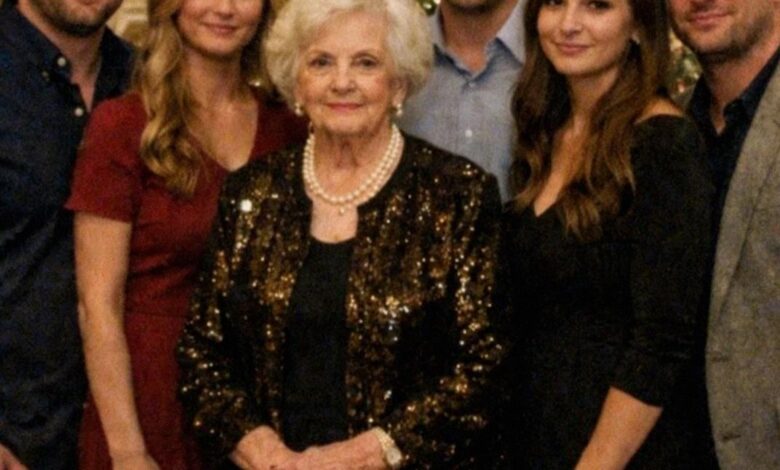
At eighty-seven years old, I realized that I had spent decades participating in a transaction I mistook for a tradition. I have always prided myself on my independence, a trait forged in the years following my husband’s death when I chose not to remarry. I worked hard, saved diligently, and built a life that was comfortable enough to ensure I would never have to ask for help. In fact, my greatest joy was being the one to offer it. But there is a peculiar danger in being the matriarch with a full purse; you can inadvertently begin to substitute capital for connection, and by the time you realize the exchange is hollow, the people you love have already become accustomed to the price of their presence.
Every Christmas Eve, my five grandchildren would arrive like clockwork. The house would fill with the scents of pine and roasted turkey, and we would play the part of a close-knit family. After dinner, I would perform the ritual they were all waiting for: I would hand each of them an envelope containing a check for $10,000. It was a staggering amount, I know, but I told myself it was a way to jumpstart their lives. In reality, it was a way to ensure they would keep coming back.
However, over the last few years, the atmosphere had begun to sour. The veneer of affection was wearing thin, revealing a mercenary spirit that broke my heart. Jake, my youngest, would kiss my cheek while his eyes remained glued to his phone, his mind already at the party he planned to attend the moment he could politely flee. Christy, perpetually exhausted and draped in designer labels, would sigh through dinner as if my company were a chore. Carl, the aspiring lawyer, treated our meal like a deposition, constantly checking his watch and lamenting the “big case” that required his genius. Mike made frequent “work calls” on the porch, and Julian, the traveler, would show me photos of distant horizons without ever asking a single question about the world within my four walls.
They were all there physically, but they were absent in every way that mattered. They were waiting for the envelopes. And so, last year, I decided to play a game—a psychological experiment to see what remained of my family once the financial incentive was stripped away.
When the time came to distribute the gifts, I handed out the envelopes with the same practiced smile. Jake tore his open first, his face falling as he looked inside. Instead of the usual five-figure sum, he found a single fifty-dollar bill. I watched as the disappointment rippled across the table. I lied and told them that my savings weren’t what they used to be, and that fifty dollars was all I could afford. The shift in energy was instantaneous. Christy offered a tight, pitying smile; Carl checked his watch with renewed urgency; and Mike stuffed the bill into his pocket with a curt nod of obligation. The “price” of their Christmas had dropped, and so had their interest.
The true results of the test, however, didn’t manifest until this year. As Christmas Eve approached, the excuses began to flood my inbox and voicemail like a coordinated retreat. One grandson sent a business-like email titled “Christmas Regrets.” Another sent a generic animated GIF of a Christmas tree with a brief “can’t make it” text. One by one, the people I had supported for years vanished into the “busyness” of their lives the moment the $10,000 incentive was removed.
I was standing at the kitchen window, watching the snow fall on my empty driveway, prepared to spend the night in total solitude. Then, a single pair of headlights turned the corner.
It was Julian. She stepped out of her car carrying a small paper bag, looking hesitant as she peered at the dark house. When I opened the door, she looked confused. “Am I early? Where is everyone?” When I told her that the others couldn’t make it, she paused for a beat, her expression shifting as she realized exactly why the driveway was empty. She didn’t turn around. Instead, she smiled and said, “Well, I guess it’s just us then.”
That dinner was the most honest Christmas I’ve had in a decade. There was no checking of watches, no “work calls,” and no distracted scrolling. Julian asked about my life with genuine curiosity. We laughed until our sides ached when I recounted the story of how I accidentally set off the smoke alarm making toast. She showed me her travel photos, but this time, she shared the stories behind them, connecting her world to mine.
When the meal ended, I slid a thick envelope across the table. Julian started to tuck it away, but I insisted she open it. When she saw the check inside—this time for $50,000—she gasped. “Grandma, I don’t understand. You said your savings were gone.”
“I lied, Julian,” I said softly. “I needed to know who would show up when the well ran dry. I needed to know who loved me when there was nothing to gain.”
I expected her to be delighted. I expected her to thank me and tell me how much this would help her travels. Instead, Julian did something that completely changed my perspective on the test I had created. She slid the check back across the table.
“You don’t owe me anything for being here,” she said, her voice firm. “I’m sorry the others didn’t come, and I’m sorry you felt the need to test us. But I don’t need a prize for loving my grandmother. Keep your money.”
In that moment, I realized that I had been just as guilty as my other grandchildren. By “testing” them with money, I was still acting as if love were a commodity that could be measured and rewarded. Julian showed me that true affection has no business being mixed with checks and balances. It is either there, or it isn’t.
Following her suggestion, we spent the evening researching local charities. We decided to split that $50,000 between a hospice care center, a children’s literacy program, and a meals-on-wheels service. It was the first time my money felt like it was doing something purely good, unburdened by the expectations of family dynamics.
Julian didn’t stop visiting after that night. In the months that followed, she started coming over on random Wednesdays just to have tea. She came for Easter without being asked. She became the constant presence I had tried to buy for so many years. I wish I had learned this lesson when I was sixty, or forty, or even twenty. I wish I hadn’t spent so long believing that generosity was a substitute for vulnerability.
Love isn’t a trade. It isn’t something you can test into existence or secure with a contract. It is the person who drives through the snow when they think you have nothing left to give. It is the granddaughter who pushes a life-changing sum of money back to you because the dinner and the conversation were already enough. I finally understood that at eighty-seven, and while the house is quieter now with only one grandchild visiting, the silence is no longer filled with the sound of ticking watches and waiting hearts. It is filled with the peace of knowing who truly loves me.