Crunchy Pink Surprise on Wall, What is Really Going on Inside Your Home?
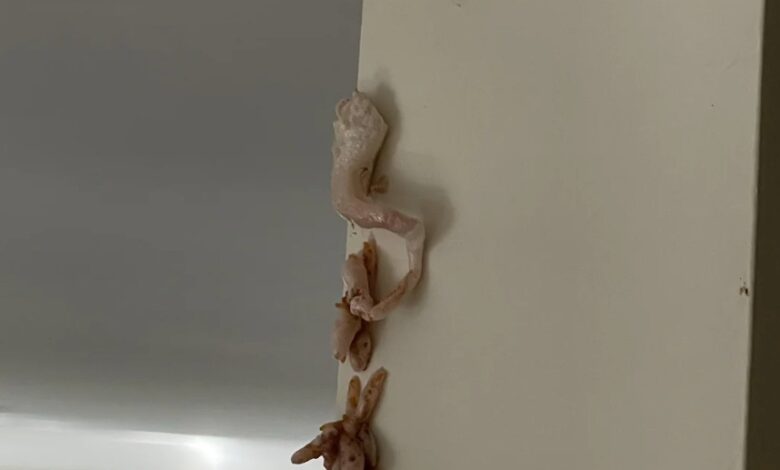
The sensation of living in a home is often built upon the illusion of total familiarity. We believe we know every floorboard that groans underfoot, every shadow that stretches across the hallway at dusk, and every imperfection in the plaster. We treat our dwellings as static environments, curated and controlled, but the reality of an aging structure is far more fluid. Buildings are living histories, and sometimes, those histories manifest in ways that are deeply unsettling. Such was the case when a strange, crunchy pink growth appeared on my wall, a small anomaly that shattered the comfort of my routine and replaced it with a lingering, unresolved dread.
It began on a quiet morning, the kind where the world feels small and manageable. By the time the coffee had finished brewing, filling the kitchen with its grounded, earthy aroma, the physical evidence of the mystery was already gone. It had been reduced to a nondescript gray smear on a disinfectant wipe, tossed into the trash with a casual, dismissive shrug from the landlord. He had looked at the protrusion—a vibrant, textured cluster that looked like a cross between sea coral and crystallized sugar—and called it “probably just sealing foam.” He said it with the practiced nonchalance of a man who makes a living explaining away the decay of old houses. To him, it was mundane; to me, it felt like an erasure of something significant.
The way he dismissed it was perhaps more disturbing than the object itself. He spoke with the same hollow certainty one uses to tell a child that a bump in the night is “just the wind.” It was a redirection meant to pacify, but it only served to heighten the unease. The sound it made when it was scraped from the wall—a sharp, brittle crunch that echoed in the small room—still resonates in my memory. It wasn’t the sound of plaster or dust. It was a sound of structure, of something that had achieved a certain density and intent before being forcibly removed.
That texture is what haunts the periphery of my thoughts. It wasn’t smooth like a spill or crumbly like ancient mortar. It possessed an organic complexity, a geometric intentionality that suggested it hadn’t just happened; it had grown. It clung to the drywall with a desperate tenacity, appearing less like an accidental chemical leak and more like evidence of a hidden process occurring behind the surfaces I trusted. In the minutes before the disinfectant wipe made the corner spotless again, the growth felt like a message from the internal machinery of the house, a symptom of a condition that remained undiagnosed.
Logic offers several pathways to peace of mind, though none of them quite reach the destination. Perhaps it truly was ancient insulation, a volatile foam from a bygone era of construction that had finally been pushed through a microscopic hairline crack by decades of structural shifting and seasonal pressure. Materials behave erratically as they age; they expand, contract, and degrade into new, unrecognizable forms. It is possible it was the calcified remains of an abandoned nest, a relic of a creature that had long since departed, leaving behind a tomb of hardened secretions. Or, most likely, it was the “fossil” of a forgotten repair—a haphazard solution layered over a previous failure, a sedimentary record of neglect that finally reached the surface.
All of these explanations are reasonable, yet they fail to provide comfort because they lack the weight of certainty. The unsettling nature of the event lies in the speed with which it was vanished. Within seconds, the anomaly was gone, the wall was bleached clean, and the space returned to its state of artificial perfection. There was no trace, no analysis, and no investigation. Just a clean corner and the persistent feeling that something had been silenced before it could be understood.
This reaction highlights a fundamental aspect of the human psyche: we are far more disturbed by the unknown than we are by the unpleasant. Had a professional identified the growth as a specific mold, a known chemical reaction, or a common pest, it would have been categorized and stripped of its power. Once a thing is named, it can be dealt with; it becomes a task on a to-do list. But when it remains an unidentified “probably,” it expands within the imagination. It fills the gaps that logic cannot seal, morphing into a representative of every hidden rot and secret failure tucked behind the walls of our lives.
The truth is that I will never know what I was living with, or for how long that pink crystallization had been reaching toward the light. That uncertainty creates a subtle, vibrating tension. It serves as a reminder that our homes, no matter how much we polish and decorate them, are merely shells over complex, hidden systems. We inhabit the surface, but beneath the paint and behind the studs, there is a world of plumbing, wiring, insulation, and occasionally, life—or its remnants—that we rarely question until it forces its way into our view.
This experience has fundamentally altered the way I view my environment. I no longer look at a clean wall as a sign of a healthy home; I see it as a potential mask. I find myself glancing at that particular corner, half-expecting to see the pink texture blooming once more, asserting its right to exist in the open air. The landlord’s shrug was a temporary fix for a permanent curiosity. He saw a nuisance to be cleaned; I saw a mystery that demanded an answer.
For those who find themselves facing similar anomalies in their own tiny houses or apartments, the lesson is clear: do not be so quick to reach for the disinfectant. When the house begins to grow new textures, or when the surfaces start to speak in colors and crunches you don’t recognize, document the intrusion. Take high-resolution photographs, capture the sound of its removal, and seek a second opinion. Knowledge is the only true antimicrobial for the fear of the unknown. Ask questions of people who don’t have a financial interest in the answer being “nothing.”
In the digital age, we have the unique advantage of collective observation. If you cannot identify the stranger on your wall, let the internet help you investigate. Sometimes, a thousand eyes can see what one shrug tries to hide. Shared alarm can be a gateway to shared knowledge, and even if the answer is unpleasant, it is infinitely better than a spotless wall and a mind full of questions. We build our lives within these four walls, and the least we deserve is to know exactly what is living in them with us. Until then, I will continue to listen to the house, waiting for the next crunch, the next color, and the next reminder that the places we call home are never truly as empty or as silent as they appear to be.