Donald Trump slammed after hanging plaques mocking Obama and Biden in White House!
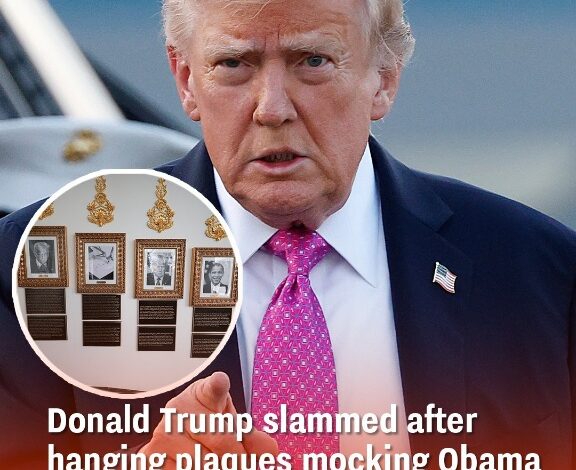
The hallowed halls of the White House, traditionally a space defined by solemnity, historical continuity, and bipartisan reverence, have recently become the centerpiece of a fierce national controversy. The cause of this upheaval is a series of newly installed plaques positioned beneath the presidential portraits in what is being called the “Walk of Fame.”1 Unlike the neutral, fact-based biographical sketches that have historically accompanied such galleries, these new additions offer sharply partisan and often derogatory assessments of former leaders. According to the White House Press Secretary, the text for these plaques was personally authored by Donald Trump, marking a radical departure from the decorum typically associated with the Executive Mansion.2+1
The most vitriolic descriptions are reserved for Trump’s immediate Democratic predecessors. The plaque situated beneath the portrait of Barack Obama serves as a direct indictment of his two terms in office.3 It labels the 44th president as “one of the most divisive political figures” in American history.4 The text goes on to offer a scathing critique of the Affordable Care Act, characterizes the Obama-era economy as stagnant, and condemns the Iran Nuclear Deal as a failure of diplomacy. Furthermore, it accuses Obama of projecting a “weakness” on the global stage that allegedly allowed for the rise of ISIS and the Russian annexation of Crimea. By enshrining these critiques in metal within the White House, the current administration has effectively turned a historical exhibit into a permanent campaign attack.+1
However, the rhetoric reaches a new level of personal animosity with the plaque dedicated to Joe Biden. Breaking with all precedents of presidential etiquette, the plaque employs Trump’s campaign-trail derogatory nickname, “Sleepy Joe,” and flatly declares him the “worst President” in the nation’s history.5 The inscription repeats unproven allegations regarding a “corrupt” 2020 election and assigns Biden sole responsibility for a host of national and international crises. It cites high inflation, a “lost” southern border, and the chaotic withdrawal from Afghanistan as defining failures of his tenure. Additionally, the plaque alleges that Biden’s policies emboldened foreign adversaries, specifically linking his administration to the actions of Russia and Hamas.
This aggressive revisionism stands in stark contrast to the way Republican figures are presented in the gallery. The plaques for GOP leaders are notably hagiographic, designed to align their legacies with Trump’s own political brand. Ronald Reagan is celebrated as the “Great Communicator,” with the text taking care to note his status as an early “fan” of Trump, thereby retroactively claiming Reagan’s endorsement. Even Richard Nixon, a figure often treated with historical caution, receives a glowing review. His plaque focuses exclusively on his “great political comeback” and his landslide electoral victories, omitting any mention of the Watergate scandal or his eventual resignation.
Unsurprisingly, the plaque dedicated to Donald Trump himself is the most expansive. It reads more like a manifesto than a biographical summary, framing his time in office as a heroic struggle against a “Deep State.” The text boasts of his ability to overcome the “unprecedented weaponization of law enforcement” and references survived assassination attempts as proof of his divine or historical destiny.6 It boldly claims that he has ushered in a new “Golden Age” for America, characterized by the end of foreign wars, the total security of the border, and the mass deportation of criminal gang members.
The reaction to this unprecedented display has been swift and overwhelmingly negative from across the political and academic spectrum. Critics argue that the White House belongs to the American people, not to any single occupant, and that using it to defame rivals is an abuse of public space. California Governor Gavin Newsom emerged as a prominent voice of dissent, labeling the move as “petty” and a “desperate distraction” from pressing national issues. Historians have voiced concerns that this represents a dangerous “partisan revisionism,” where the official record of the United States is being altered to suit the personal grievances of the sitting president.
Many observers see the plaques as a physical manifestation of Trump’s unique brand of politics, which thrives on the blurring of lines between official government action and personal brand management. By placing these “insult plaques” in a gallery frequented by foreign dignitaries and visiting citizens, the administration is signaling that the era of the “peaceful transfer of respect” is over. Scholars of the presidency suggest that this move undermines the dignity of the office, turning the White House into a venue for juvenile “internet-style” trolling.
Beyond the immediate political fallout, there are concerns about the long-term impact on the institution of the presidency. Traditionally, the White House collection of portraits serves as a symbol of the endurance of the Republic—a reminder that while leaders change, the office remains a constant. By injecting vitriol into this space, the administration risks turning every subsequent change in power into an opportunity for “retaliatory history,” where each new president replaces the plaques of their predecessor with new insults.
The legal and ethical implications are also being debated. While a president has significant latitude over the decoration of the White House interior, the use of federal funds to create and install materials that are essentially campaign literature or personal defamation raises questions about the Hatch Act and other ethics regulations. However, in the current political climate, such technicalities are often overshadowed by the sheer audacity of the act itself.
Ultimately, the controversy over the “Walk of Fame” plaques is about more than just metal and wood; it is about who controls the American narrative. For supporters of the move, the plaques represent a refreshing “truth-telling” that breaks through the “polite lies” of the establishment. For detractors, they are a sign of a deep-seated insecurity and a rejection of the humility required of a national leader. As the debate rages on, the plaques remain, a jarring and divisive addition to a house that was once meant to be a symbol of “E Pluribus Unum”—out of many, one. The “Golden Age” Trump describes on his own plaque remains a matter of fierce debate, but the “Age of Grievance” he has etched into the walls of the White House is now a matter of historical record.