Heiress dies at her Boston home at age of 89!
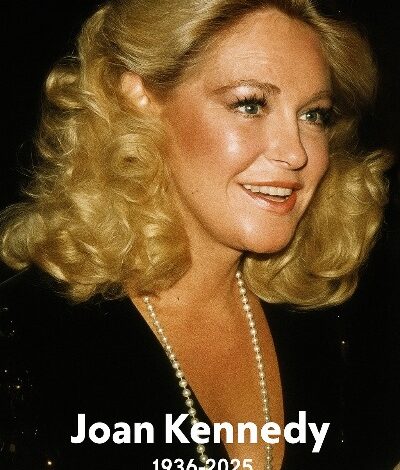
Joan Bennett Kennedy, the accomplished pianist, philanthropist, and former wife of Senator Edward M. “Ted” Kennedy, passed away peacefully at her Boston home on Wednesday morning. She was 89.
A family spokesperson confirmed that she died in her sleep surrounded by loved ones. “She lived with grace and courage until the end,” the statement read. “Her family takes comfort in knowing she is finally at peace.”
Known to the public for decades as one of America’s most elegant political spouses, Joan Kennedy’s life was defined by both privilege and profound struggle. She was not merely a figure in the background of Camelot’s second generation — she was a woman of remarkable intelligence, artistry, and resilience, whose personal battles unfolded under the harsh glare of public scrutiny.
Born Virginia Joan Bennett on September 2, 1936, in Manhattan and raised in suburban Bronxville, New York, she came from a respected middle-class family that prized education and the arts. Her father was a businessman; her mother, a homemaker who encouraged her daughter’s musical talent. Joan began playing piano as a child and would go on to study music at Manhattanville College, where her poise and warmth quickly made her a campus favorite.
It was during her college years that she met Ted Kennedy, the youngest brother of then-Senator John F. Kennedy. Their courtship was swift, their union celebrated as another chapter in the Kennedy dynasty’s expanding legend. When they married in 1958, she was 22, radiant in a gown of satin and lace, stepping into a world few could imagine — one of political ambition, public adoration, and relentless expectation.
For the next two decades, Joan Kennedy’s life played out on a national stage. As her husband rose to prominence in the U.S. Senate, she became a fixture in Washington society — admired for her grace, her intellect, and her steadfast support during moments of triumph and tragedy alike. The Kennedys’ marriage produced three children: Kara, Edward Jr., and Patrick, each of whom inherited their mother’s sensitivity and empathy.
But behind the polished photographs and campaign smiles, Joan’s life was increasingly shadowed by loneliness and pressure. Her husband’s political commitments often kept him away, and the tragedies that marked the Kennedy family — including the assassinations of President John F. Kennedy in 1963 and Senator Robert F. Kennedy in 1968 — left lasting emotional scars.
Friends later recalled that Joan struggled to reconcile the public’s expectations of her as the perfect political wife with her private need for stability and peace. She found solace in music, often retreating to the piano when the pressures of life in the public eye became too great.
By the early 1970s, her struggles with depression and alcohol had become visible. She was candid about her illness at a time when few public figures dared to speak about addiction or mental health. That honesty — coupled with her refusal to hide behind her last name — made her one of the first women in American public life to break the silence around these issues.
In interviews, she spoke about her efforts to seek treatment, not as a confession but as a call for compassion and reform. “Addiction is not a moral failure,” she once said. “It’s an illness, and it needs to be treated as one.”
Her openness would later inspire advocacy work on behalf of mental health and addiction awareness. Though she rarely sought the spotlight after her divorce, she used her influence quietly, helping to fund programs in Massachusetts that supported recovery and counseling services.
Joan and Ted Kennedy divorced in 1983 after 24 years of marriage. Despite their separation, the two maintained a bond rooted in mutual respect and shared concern for their children. Ted, who died in 2009, often described her as “a woman of extraordinary grace and kindness.”
Their eldest daughter, Kara, passed away in 2011 at the age of 51 after a heart attack — a loss that friends said devastated Joan. Yet even in grief, she continued to find strength in family. She remained close to her sons, Edward Jr. and Patrick, both of whom followed their father into public service and advocacy.
Edward Kennedy Jr., who lost his leg to bone cancer at age 12, has credited his mother with teaching him resilience. “My mother never stopped believing in me,” he once said. “Her love was quiet, but it was unwavering.”
Patrick J. Kennedy, a former congressman and mental health advocate, often spoke about how his mother’s struggles shaped his life’s mission. “My mother’s courage in confronting her illness — and the shame that came with it — taught me empathy,” he said in a statement after her passing. “She showed me that vulnerability is not weakness. It’s humanity.”
Over the years, Joan’s relationship with the public evolved from one of curiosity to compassion. While tabloids often chronicled her battles with addiction, those who knew her best remember her for her humor, her warmth, and her devotion to her family. “Joan was never bitter,” said one longtime friend. “She had every reason to be, but she chose forgiveness over anger. She loved deeply — her children, her music, and even the family name that brought her both joy and pain.”
Though her public appearances grew rarer in later years, she remained an enduring figure in Boston, occasionally seen walking near her home or attending small community concerts. Her friends said she continued to play piano almost daily — a lifelong source of comfort and identity. “Music was her sanctuary,” said a neighbor. “Even when her memory began to fade, her hands remembered every note.”
Joan Kennedy’s life mirrored the story of the Kennedy family itself — dazzling, complicated, touched by both privilege and heartbreak. Yet, in many ways, her story stands apart. She was not a politician, nor a power broker. She was a woman who faced her demons in public and, through vulnerability, helped destigmatize struggles that millions endure in silence.
In her final years, she lived quietly in Boston, near the Charles River she once gazed across as a young bride at Harvard. Her home was filled with photos of her children and grandchildren, her piano polished and ready, always.
“Joan Kennedy’s legacy is not in politics,” said a family friend. “It’s in her humanity. She showed that grace isn’t about perfection. It’s about perseverance.”
She is survived by her sons, Edward Kennedy Jr. and Patrick Kennedy, and by several grandchildren who adored her. Her daughter, Kara, predeceased her.
Funeral services will be held next week in Boston, with a private burial to follow. In lieu of flowers, the family has requested donations be made to organizations supporting addiction recovery and mental health awareness — causes Joan championed long before they became part of the national conversation.