He was in his cell, waiting to be executed, and he asked as a last!
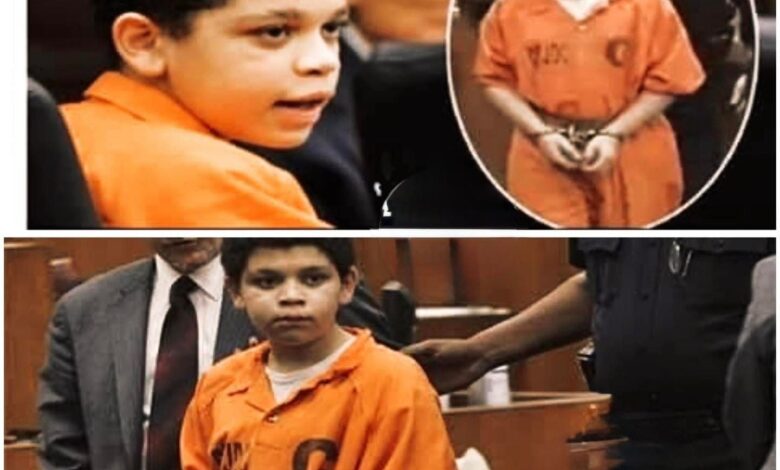
In a country that prides itself on justice and second chances, at least 79 minors under the age of 14 are serving life sentences without the possibility of parole. Seventy-nine children — some barely out of elementary school — condemned to die in prison. It is one of the harshest realities of the American justice system, and one that continues to spark outrage at home and abroad.
Human rights advocates argue that such sentences violate the most basic principles of fairness and decency. Groups like Human Rights Watch and the Equal Justice Initiative (EJI) have spent years documenting these cases, calling them a failure of both morality and logic. Their argument is simple: children are not fully formed adults. They are impulsive, malleable, and deeply shaped by the environments they grow up in. Punishing them as if they were irredeemable monsters, they say, betrays the very concept of justice.
Behind the statistics are stories — often tragic, always complicated. Many of these children come from broken homes, marked by poverty, abuse, addiction, or neglect. Some acted out of fear or confusion. Others were swept into crimes they didn’t fully understand. But under the law in many U.S. states, none of that mattered. Once a prosecutor decided to try them as adults, their childhoods effectively ended the moment they stepped into court.
One case changed the national conversation — the story of Lionel Tate.
In 1999, Tate was 12 years old when he accidentally killed a 6-year-old girl during what he claimed was play that imitated professional wrestling moves he had seen on TV. Despite his age and the lack of clear intent, a Florida court tried him as an adult and sentenced him to life in prison without parole. He was the youngest American ever to receive that punishment.
Public outrage followed. The idea that a sixth-grader could be condemned to die in prison struck many as obscene. After appeals and international attention, Tate’s sentence was eventually reduced, and he was released on probation in 2004. But his case exposed a grim truth: his story was not unique.
Across the country, hundreds of minors have faced similar fates. Many were tried in adult courts for crimes committed between the ages of 10 and 14. Prosecutors often argue that certain crimes are so severe — murder, armed robbery, aggravated assault — that age shouldn’t matter. Victims’ families, understandably consumed by grief, sometimes agree.
But developmental psychologists and neuroscientists say otherwise. Studies show that the human brain — especially the prefrontal cortex, which governs impulse control, empathy, and long-term reasoning — isn’t fully developed until well into the mid-twenties. That science became the cornerstone of several landmark Supreme Court decisions over the past two decades.
In Miller v. Alabama (2012), the Court ruled that mandatory life sentences without parole for juveniles were unconstitutional, emphasizing that children are “constitutionally different from adults” in their capacity for change. Four years later, in Montgomery v. Louisiana (2016), the Court made that ruling retroactive, giving thousands of inmates a chance at resentencing.
Theoretically, those rulings marked a turning point. In practice, progress has been uneven. Some states quickly passed laws eliminating life without parole for minors. Others found loopholes or resisted retroactive reviews altogether. Thousands of cases remain mired in bureaucracy, awaiting reconsideration that may never come.
Advocates like Bryan Stevenson, founder of the Equal Justice Initiative, have fought to keep attention on these forgotten children. “When we condemn a child to die in prison,” Stevenson has said, “we’re denying the very possibility of change. We’re saying a 13-year-old is beyond redemption — and that’s something no civilized society should believe.”
His argument isn’t abstract. At EJI’s offices in Montgomery, Alabama, walls are lined with portraits and case files of juveniles once sentenced to life without parole. Many of them grew up in violent homes. Some endured severe physical or sexual abuse. Most came from poor, predominantly Black neighborhoods disproportionately targeted by aggressive policing and sentencing laws during the 1990s “tough on crime” era.
That period reshaped the American justice landscape. Fueled by media hysteria about “superpredators” — a now-debunked theory claiming a wave of remorseless youth criminals was coming — lawmakers across states passed legislation making it easier to try minors as adults. The fear-driven policy led to children as young as 10 being sent to adult prisons, where they were often subjected to violence and trauma far beyond what any child could process.
In recent years, a growing number of states have begun to back away from those policies. California, New Jersey, Illinois, and Vermont have abolished life without parole for juveniles altogether. Others now require parole eligibility after a set number of years — often 25. Yet in many states, children sentenced before those reforms remain stuck, serving what are effectively life terms.
The debate now extends beyond the courts. Restorative justice programs — which bring victims’ families and offenders together for dialogue, accountability, and potential forgiveness — have shown promising results in states that embrace them. In some communities, these programs have helped victims’ relatives find peace while giving young offenders a path to rehabilitation.
Still, resistance remains fierce. Critics argue that certain crimes — particularly those involving premeditated murder — demand permanent punishment, regardless of age. They claim parole eligibility risks retraumatizing victims’ families and undermines justice.
But to advocates like Stevenson, that argument misses the point. “Justice isn’t just about punishment,” he says. “It’s about fairness. It’s about acknowledging that even the worst decision made by a child doesn’t define the rest of their life.”
For many of the children sentenced in the 1990s and early 2000s, the question now isn’t guilt or innocence — it’s time. Time to grow, to change, to prove they are more than the worst thing they ever did. Some have already done so. Dozens of former juvenile lifers released under new laws have gone on to earn college degrees, start families, and mentor other at-risk youth. Their stories challenge the assumption that harsh punishment equals safety.
One such man, now in his forties, once described his transformation in a letter to Human Rights Watch: “I was 13 when I came here. I didn’t even know how to shave. I made a terrible mistake — one I’ll regret for the rest of my life. But I’ve spent 25 years trying to make amends. The boy who came in here is gone. I wish the system believed that.”
The United States remains the only country in the world that sentences children to life without parole. Other nations — even those with higher violent crime rates — have long outlawed the practice, viewing it as a violation of basic human rights. The United Nations Convention on the Rights of the Child, which nearly every country on earth has ratified, explicitly forbids life imprisonment for minors. The U.S. signed the treaty but never ratified it.
Change, when it comes, is slow. But it’s happening. Every year, more states reconsider their juvenile sentencing laws. More courts acknowledge the humanity of the children standing before them. And more citizens are beginning to question whether “justice” should mean extinguishing hope forever.
Because at the end of the day, these aren’t just statistics or case numbers. They are children — scared, impulsive, imperfect — who made choices they didn’t yet have the tools to understand. Some caused unimaginable harm. But if society refuses to believe in their potential for redemption, then it’s not just their lives that are condemned. It’s our conscience, too.