My Mothers Smile!
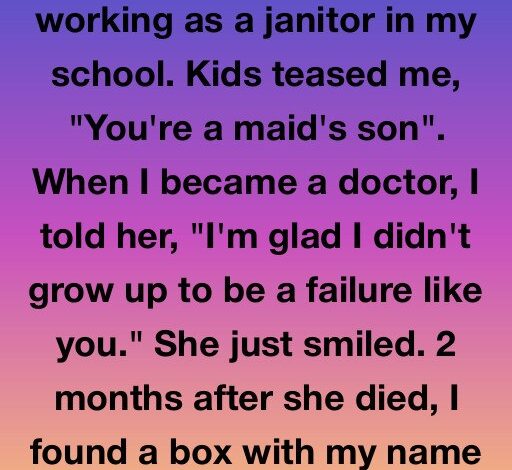
I used to hate my mother for being the janitor at my school. Kids would laugh and call me “the maid’s son,” and every time I saw her pushing that heavy cleaning cart down the hallway, humiliation hit me like a punch. I avoided her like my life depended on it—turning away when she waved, changing direction the second I spotted her mop bucket, pretending I didn’t know her when my classmates snickered. Shame settled into my bones so deeply that school stopped being a place to learn and became a daily battlefield.
When I got accepted into medical school, the pride I felt wasn’t just about the accomplishment—it was about escape. Escape from poverty, from embarrassment, from the memory of her worn shoes squeaking across my school floors. Studying became an obsession. Every exam, every sleepless night, every shift I picked up felt like another brick between me and the life she lived. I was determined to prove I would never end up scrubbing floors for people who didn’t know my name.
The day I became a licensed doctor felt like the peak of everything I’d fought for. I stood there in my white coat, surrounded by my colleagues, and felt invincible. My mother came to the small ceremony wearing her best dress, a little faded, a little old-fashioned, but ironed to perfection. She radiated pride. And like the ungrateful son I was, I ruined it.
“I’m glad I didn’t grow up to be a failure like you,” I told her that night.
I can still hear my own voice—sharp, ugly. She didn’t get angry. She didn’t defend herself. She just smiled with that gentle, steady expression she always had and said, “I’m proud of the man you’ve become, Julian.” That smile made me even angrier. I mistook grace for weakness.
Two months after she died, I found a box with my name on it in the back of her closet. Inside were items wrapped carefully in tissue paper. My first-grade drawing of a doctor, the stick figure with a giant stethoscope. A small velvet pouch containing two hundred-dollar bills. And a silver locket I’d never seen before. My throat tightened. She had saved money for me even after I became successful.
Beneath the objects was a thick journal tied with rough twine. Her diary. She had started writing it the year I was born. The cover was worn, the pages soft from years of turning. I hesitated—reading it felt like trespassing—but curiosity and guilt overpowered everything else.
The first entry described her joy when I was born, how tiny my hands were, how she cried when she held me for the first time. She wrote about wanting just one thing: for me to know I was loved. Her words shredded the cold distance I had built between us.
I flipped ahead to the years she worked at my school. The diary detailed the long nights, the aching back, the endless double shifts. She cleaned the school until nearly midnight, then took a bus to another job at an office building for a few more hours. She slept maybe three hours a night. Not once did she complain about the labor. Her only regret was the time she missed with me.
She wrote, “Every dollar is a step up for Julian. He will have choices I never had.” I had built my resentment on nothing but my own ignorance.
Then I reached the entries about the teasing. She described watching me across the cafeteria, seeing my shoulders tense when kids made fun of her job. It broke her heart. She wrote about using a pseudonym for months so no one would connect her to me. Even that wasn’t enough. But she kept working because the school offered slightly better pay and she needed the money for my future.
One entry from high school hit me so hard I had to put the journal down. I needed an expensive medical textbook for an AP science class. Over three hundred dollars. Money she didn’t have.
The entry read: “Julian needs this book. It will open the next door for him. I’ve sold the only thing of value I have left. I won’t tell him. He needs to believe he earns everything on his own.”
I opened the velvet pouch again and looked at the silver locket. Inside was a tiny black-and-white photo of a young woman—I realized it was my grandmother. I turned it over. The inscription read: “M.J. to E.C. – Forever.” It was the only heirloom she ever had. She sold it for me. The leftover money was the two hundred dollars in the pouch.
I kept reading.
She wrote about Mr. Harrison, the head custodian, who noticed how exhausted she was. He arranged for her to get extra office-cleaning jobs so she could be home when I woke up for school, even if it meant she went 24 hours without sleep. She hid all of this from me so I wouldn’t worry.
Then I discovered something else. I had always assumed I paid my medical school application fees with small scholarships and loans. I was wrong. She had taken on secret weekend cleaning jobs at a prestigious law firm. The diary described crawling on her hands and knees to scrub marble floors, carefully preserving her hands from chemical burns so she wouldn’t scare me with the damage.
The final entry, written a week before she died, was short:
“Julian saved a life today. I saw it on the news. My life was not a failure. My purpose is complete. I was never a failure—just a foundation.”
I don’t remember how long I cried.
The next morning, I drove to the school district office. An elderly administrator remembered my mother immediately. When I asked about her health insurance—the reason she’d supposedly needed the job—the woman frowned and checked the files.
“She never needed our insurance,” she said. “Her primary policy was through the law firm. She told us she wanted to work here because it let her be close to the school where her son’s future was unfolding.”
The truth hit me so hard I had to sit down. She had chosen the job I despised, not out of desperation, but out of devotion. She wanted to be near me. She wanted to contribute to my future in every way she could. Every mop stroke, every late-night shift, every quiet smile—she had built the life I now lived.
I drove home holding the box like it was the most fragile thing in the world. I had become a doctor, a man respected by strangers, but I had failed to see the greatness in the woman who raised me.
Now I mentor students from low-income families. I never mention my story, but I always tell them this: greatness doesn’t come from standing alone—it comes from the people who lift you before you can stand at all.
I made an anonymous donation to the medical school in her name to support students whose parents work in service jobs. It’s the smallest repayment for the life built from her sacrifice.
I think of her every day now. Not with shame. Not with resentment. But with a gratitude so deep it aches. And whenever I remember her smile—the quiet, knowing one—I finally understand it.
She wasn’t accepting my cruelty. She was celebrating the success she had spent her entire life building.
Her success. Through me.