If you meet this single requirement, you qualify for Trumps $2,000 tariff dividends!
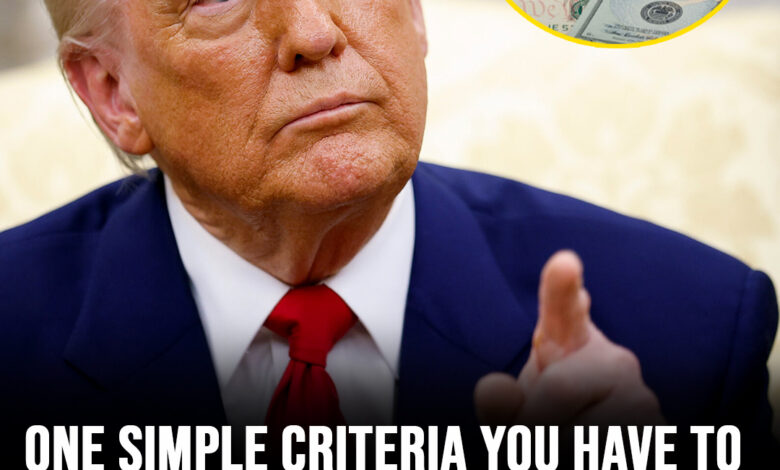
President Donald Trump’s talk of a “$2,000 tariff dividend” dropped into the national conversation like a spark in dry grass—fast, loud, and instantly polarizing. The promise sounded simple: Americans would get a financial bonus drawn from years of tariff revenue collected under his administration. But simplicity ended there. The moment he floated the idea, people wanted answers. When would payments go out? Who qualifies? Is this real, or just another campaign-season headline?
Trump framed the dividend as a reward funded by tariff money accumulated over multiple years. In his words, “hundreds of billions” had been taken in from tariffs on foreign goods, creating what he pitched as a pool of money ready to be redistributed. The concept stirred up a mix of excitement and suspicion because, despite the bold presentation, practically nothing concrete supported it. No legislation. No IRS planning documents. No Treasury guidance. Not even a formal proposal on Capitol Hill. Just the promise.
He suggested the checks might roll out “by the middle of next year, maybe a little later,” but the lack of details only deepened public confusion. The only solid description he offered was that the dividend would target “low, moderate and middle incomes.” That’s a wide range, and without legislation behind it, the phrase meant almost nothing. It didn’t stop commentators, analysts, and political influencers from filling in the blanks.
One of the most discussed guesses came from Blind to Billionaire, a Social Security analyst on YouTube who argued that eligibility might hinge on just one requirement: an annual income below $75,000 for individuals. It’s a familiar threshold used in previous stimulus rounds, including COVID-era relief. Married couples under $150,000 could qualify under the same logic. According to that theory, millions of people—unemployed workers, gig workers, independent contractors, and retirees—might meet the requirement. But even he emphasized that all of this was speculation. There is no approved plan. Congress has not signed off on anything. The IRS has not greenlit any payments for 2025.
And that’s where the idea hits its biggest wall. Congress, not the president, controls federal spending. Without a passed bill, the “tariff dividend” remains nothing more than a talking point. Treasury Secretary Scott Bessent didn’t try to gloss over that reality. Pressed on whether the government could actually distribute $2,000 checks, he gave a blunt “We will see,” followed by the key phrase: “We need legislation for that.” Translation: if Congress doesn’t fund it, it does not exist.
Some lawmakers immediately raised red flags. Senator Ron Johnson, a fiscal conservative, was one of the loudest skeptics. He argued that tariff revenue should go toward shrinking the country’s massive $1.8 trillion deficit, not toward what he called unaffordable handouts. “Look, we can’t afford it,” he said. “I wish we were in a position to return the American public their money, but we’re not.” For him, the numbers didn’t just look tight—they looked impossible.
And the cost projections back that up. The Committee for a Responsible Federal Budget estimated that the plan could cost around $600 billion per year. That’s more than triple the total tariff revenue currently available. Even narrowing eligibility to households under $100,000 doesn’t put a dent in the problem. The Tax Foundation’s Erica York estimated that even a more targeted version would still cost upward of $300 billion—still far beyond what tariffs have ever brought in.
Right now, total tariff revenue stands at about $195.9 billion. Not even close to covering the scale of checks being proposed. That number doesn’t stop Trump from insisting the plan is viable, but the math is stubborn. Without massive new tariff increases or deep spending cuts from Congress—which neither party seems ready to embrace—the numbers do not work.
Bessent hinted that even if some version of the idea moves forward, the payout might not arrive as a straightforward check. He floated alternatives like tax credits or benefits tied to Trump’s “One Big Beautiful Bill Act,” a sweeping legislative vision he has teased but not fully outlined. Those options would stretch the definition of “dividend,” but they would also sidestep the enormous upfront cost of sending cash directly to Americans.
Meanwhile, ordinary people remember the last time checks actually came. In 2021, under the American Rescue Plan, the federal government sent out $1,400 payments to millions of households. Those checks had clear legal authority, a passed bill, and an implementation plan from the IRS. The tariff dividend, in contrast, has none of those things. It sits in limbo, stuck between political aspiration and fiscal reality.
Still, Trump appears determined to keep the idea alive. Speaking aboard Air Force One, he doubled down: “It will be next year. The tariffs allow us to give a dividend. We’re going to do a dividend, and we’re also going to be reducing debt.” That final promise—giving out money while also reducing the deficit—lands somewhere between ambitious and impossible, given the current numbers.
For now, the tariff dividend is more campaign fuel than imminent financial policy. A headline-maker, not a wallet-filler. People who hope to see extra money next year won’t know anything definitive until Congress either drafts a bill or rejects the idea outright. Until then, it exists in a political gray zone—talked about loudly, supported vaguely, and understood by almost no one.
The bottom line: if your income is under $75,000, you might qualify if the checks ever materialize. But they won’t materialize without legislation, and right now, that legislation does not exist. The country will have to wait and see whether this proposal becomes real money—or another political promise that never makes it past the microphone.