President Donald Trump Gives Direct 5-Word Answer To Whether $2,000 Checks He Promised To Almost Everyone In America Will Arrive Before Christmas
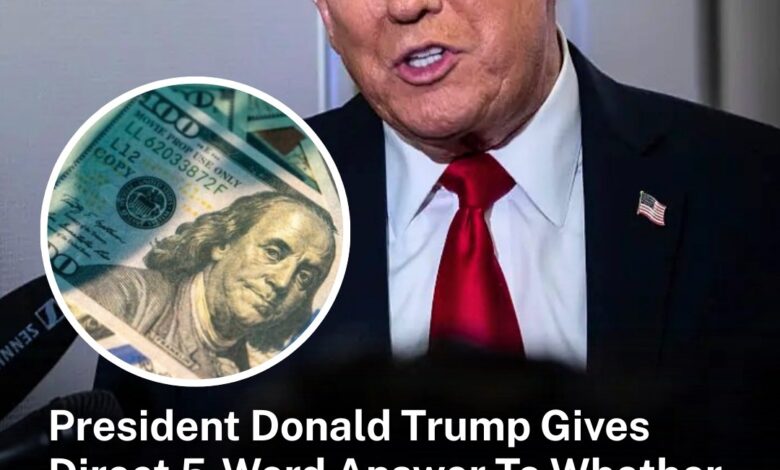
President Donald Trump’s latest economic pitch has stirred up another round of national debate — this time over a proposed “tariff dividend,” a one-time $2,000 payment he says would go to what he calls “moderate-income earners.” The idea has ricocheted across social media with the usual mix of excitement, confusion, and flat-out misinformation. But when pressed directly on whether Americans would see these checks before Christmas, Trump gave a blunt five-word answer that shut the door on any holiday hopes: “It’ll be next year sometime.”
That’s the reality. Interesting idea or not, no one is getting a $2,000 check in 2025.
The concept behind the “tariff dividend” is straightforward on paper. Instead of funding stimulus payments through increased federal spending — the way pandemic-era checks worked — Trump says the government could use revenue collected from tariffs on imported goods. According to him, the U.S. has taken in “hundreds of millions of dollars” from tariff policy, money he believes could be split between reducing national debt and providing a financial boost to millions of households.
In theory, it sounds like a clever workaround: avoid new spending, avoid new debt, return tariff money directly to the taxpayers. But as always, the math tells the real story, and the math is where this proposal starts wobbling.
Economists across the board have pointed out the glaring numbers problem. Tariff revenue collected by the federal government — as of late 2025 — sits around $195 billion. That’s total. Not annual. Not earmarked for uses. Total. And if you run the numbers on even a limited payout, the gap becomes obvious. If eligibility cuts off at roughly $100,000 in annual income, financial analysts estimate that about 150 million adults would qualify. Multiply that by $2,000 and you’re staring at a $300 billion price tag. That’s already more than all existing tariff revenue combined, before anyone even debates logistics or political feasibility.
Supporters of the idea point to Treasury projections that estimate as much as $3 trillion in tariff revenue could accumulate over the next decade. But projections are just that — projections. Trade disputes, market changes, supply chain shifts, and global economic friction can punch holes in even the most confident estimates. Banking on future tariff money to fund current checks is the kind of move economists describe politely as “optimistic” and privately as “delusional.”
Still, Trump has been clear about who the payments would target: middle- and lower-income families, not high earners. While no official thresholds have been outlined, the categories are generally defined this way:
• Lower-income: under $55,820
• Middle-income: $55,820–$167,460
• High-income: above $167,460
If the plan mirrors anything from his previous administration, the cutoff might look similar to the pandemic stimulus rounds, which phased out at $75,000 for individuals and $150,000 for married couples. But without legislation, all of this amounts to educated guessing.
And legislation is the one thing this proposal does not have.
There’s no bill. No congressional approval. No Treasury framework. No infrastructure to deliver anything. Right now, the “tariff dividend” exists only in speeches, interviews, and campaign talking points. When Trump was asked directly — no wiggle room, no vague phrasing — whether the money would reach Americans before Christmas, he didn’t spin or stall. He simply said it wouldn’t. If anything happens, it will be sometime next year, likely edging toward the 2026 midterms, when political timing becomes just as important as economic strategy.
That gap between promise and policy has fueled speculation, conspiracy theories, and misleading viral posts claiming early sign-ups, pre-approval portals, and “priority lists” for the checks. The truth is simpler: there is absolutely nothing to apply for because the program does not exist yet. Any website claiming otherwise is a scam.
The broader debate here is less about the mechanics of tariffs and more about public trust. Americans have heard versions of this promise before — relief checks, tax credits, rebates, refunds, rebates funded by savings, and now dividends funded by tariffs. Politicians across the spectrum know how deeply people crave financial breathing room. A plan like this taps into that desire quickly and effectively. But until it becomes law, it’s a possibility, not a payment.
Whether a tariff-funded check is even realistic depends on several unresolved questions. Would returning tariff revenue to households impact consumer prices? Tariffs often push costs upward, so critics argue the check might recycle money people already paid through higher-priced goods. Others worry that continuing aggressive tariff strategies could strain global trade relationships. Supporters counter that a dividend could soften the impact of tariffs while strengthening domestic industry, creating a new model for redistribution that doesn’t rely on deficit spending.
The truth lies somewhere between ambition and arithmetic, and right now, the arithmetic isn’t close.
Still, the idea reveals something significant about the current political moment. Americans are hungry for economic policies that feel direct and personal. They want relief that bypasses bureaucracy and lands in their bank account in a way they can actually feel. Whether tariff dividends can deliver that — or whether they’re simply another campaign-season promise — remains to be seen.
For now, all anyone can say with certainty is what Trump already admitted: no one should expect a $2,000 check in 2025. The holidays will come and go without any economic surprise wrapped in the mail. Anything beyond that will depend on Congress, on the budget, on future revenue, and on whether this concept survives beyond speeches and makes it into actual legislation.
Until that happens, the “tariff dividend” remains exactly what it is — an idea waiting for a political path, a budget, and a law to give it teeth.