Qanon Shaman Files $40 Trillion Lawsuit Against Trump!
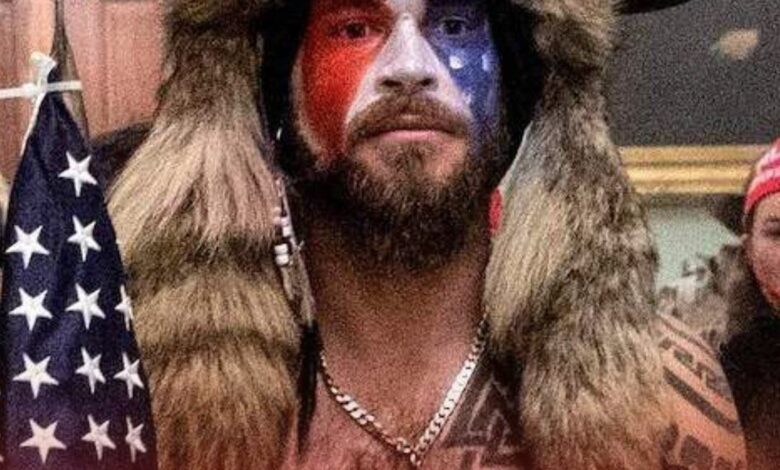
Jacob Chansley—best known across the world as the “QAnon Shaman”—has resurfaced in the national spotlight with a lawsuit that is as staggering in scale as it is bizarre in its construction. Filed in Arizona, the 26-page document is written as a single, uninterrupted paragraph, reading more like a manifesto than a legal brief. And at the center of this chaotic filing sits one extraordinary demand: $40 trillion in damages.
Chansley, who became infamous after the January 6 Capitol riot for his horned helmet, face paint, and spear-topped flagpole, now claims he is the rightful leader of a new “constitutional republic.” His lawsuit names a wide, almost surreal list of defendants—Donald Trump, the U.S. Federal Reserve, Israel, Elon Musk’s X Corp, and several federal agencies among them. No corner of power seems spared, and the allegations he lays out stretch far beyond anything remotely verifiable.
Instead of a traditional breakdown of grievances, the lawsuit outlines an economic wish list. According to Chansley, the $40 trillion he seeks should be distributed in three parts: $38 trillion to erase government debt entirely, $1 trillion for national rebuilding, and another $1 trillion as compensation for his personal suffering. In effect, he is attempting to recast the entire financial structure of the United States through a single civil filing—one that no legal expert expects to survive even the earliest stages of review.
But the numbers are only part of the strangeness. Chansley also alleges that the National Security Agency impersonated actress Michelle Rodriguez online in order to deceive him. He claims Donald Trump himself emailed him personally after the January 6 riot. He suggests shadowy actors manipulated his life from behind the scenes. None of these claims are supported by evidence. Court observers say the filing is so chaotic and disorganized that it is unclear whether a judge will even consider it a functional legal complaint.
This lawsuit marks yet another dramatic shift in Chansley’s erratic relationship with Donald Trump. After his role in the January 6 insurrection, Chansley was sentenced to 41 months in federal prison. For a time, he blamed Trump for abandoning him and other rioters. Later, when he received a presidential pardon in 2025, he expressed gratitude and loyalty again. And yet in recent months, he has turned sharply against Trump, calling him a “fraud” in online posts. The lawsuit reflects this latest phase: Trump listed as a defendant alongside governments and institutions, treated as one more actor in a vast conspiracy.
Legal analysts who have reviewed the filing have been blunt in their assessments. Words like “baseless,” “delusional,” and “legally incoherent” have been used repeatedly. The structure alone—twenty-six pages without paragraphs, section breaks, or supporting citations—virtually guarantees that the court will question whether it meets even minimal legal requirements. Before anything else, the judge must decide whether the court even has jurisdiction and whether the complaint counts as a viable legal argument.
Then there’s the matter of the defendants. Trump. The Federal Reserve. Elon Musk’s corporation. A foreign government. Multiple U.S. agencies. These entities are not typically sued together under a single umbrella, nor can they be compelled to answer claims that lack factual grounding. Some may not respond at all. Others may file motions to dismiss immediately. And if the court determines that the complaint does not meet legal standards, it may be rejected outright without ever reaching the defendants.
The lawsuit’s timing is also notable. Chansley’s public presence has grown again in the years since his release, as he tries to reshape his image from the costumed symbol of January 6 to a self-proclaimed political philosopher and spokesman for “patriotic renewal.” This filing may be another attempt to inject himself into the national conversation, using shock value and spectacle to regain attention.
Still, beneath the theatrics, the details of the lawsuit raise uncomfortable questions about Chansley’s mental and emotional state. His filing blends political jargon with conspiracy rhetoric, personal grievances with grandiose visions of national transformation. It is difficult to determine how much is performance and how much is genuine belief. For many who watched the events of January 6 unfold, Chansley became an icon of the extreme, conspiratorial fringe. This lawsuit reinforces that image, showing that his worldview has not moderated with time—it has intensified.
For legal scholars, the case now becomes a test of process. The court must evaluate whether it can proceed at all. If it is dismissed, as most expect, Chansley may attempt to appeal or file additional claims. If it is allowed to move forward even slightly, it could force responses from powerful institutions—responses that might further fuel the narrative Chansley is attempting to build.
Meanwhile, the public watches with a familiar mix of shock, frustration, and dark amusement. The man once photographed shirtless in the Senate chamber now seeks trillions of dollars and claims fraudulent digital impersonation by government agencies and Hollywood actresses. The lawsuit reads like a symbol of something deeper—a reflection of the paranoia, political volatility, and distrust that have taken hold in parts of the country.
Whatever happens next, this filing ensures one thing: Jacob Chansley, the “QAnon Shaman,” has no intention of fading quietly into the background. Whether the courts entertain his lawsuit or shut it down swiftly, the spectacle of it has already reignited debate about extremism, accountability, and the lingering aftershocks of January 6.
And as the case now sits in the hands of the court, legal experts agree on one point: the outcome is almost certain, but the noise surrounding it is far from over.