The Meaning Behind Shoes Strung Up On A Power Line!
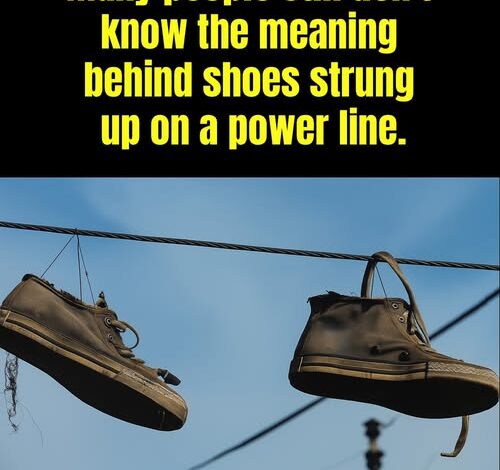
You’ve probably seen it before—two sneakers tied together by their laces, slung over a power line and left dangling high above the street. It’s one of those strange, fleeting urban images you might pass by without thinking twice. But for decades, those hanging shoes have sparked curiosity, confusion, and more than a few rumors about what they mean.
As it turns out, the answer isn’t simple. The tradition—or habit, depending on who you ask—has appeared in cities and small towns across the world. And depending on where you are, those shoes might mean something sentimental, rebellious, or symbolic.
Let’s unpack what’s really going on behind this odd, iconic sight.
From the Military to Main Street
One of the earliest and most grounded explanations traces the practice back to military roots. According to this theory, the tradition began when soldiers finished training or completed a tour of duty. To mark the end of that grueling chapter, they’d tie their boots together and toss them over the nearest power line or telephone wire—a symbolic goodbye to the hardships they’d endured.
It was a personal ritual, not a public message. A small, physical way to say I made it through. For many, it represented survival, transformation, and moving forward. Over time, the practice made its way into civilian life, spreading quietly through generations of returning servicemen and their communities.
In that context, shoes hanging in the air weren’t random or rebellious—they were an unspoken monument to resilience.
The Urban Legend of Gang Territory
Of course, not every story surrounding power-line shoes has such a wholesome origin. A darker theory, popularized by urban legends and crime dramas, suggests that shoes hanging from power lines mark gang territory or drug-dealing spots.
The claim goes like this: if you see sneakers hanging over the street, that corner belongs to a particular gang or serves as a signal for illicit activity. In some variations, they’re said to commemorate a fallen member—a street-level memorial that blends into the neighborhood landscape.
But while this explanation persists in pop culture, police departments in major cities have repeatedly said there’s little evidence connecting shoe tossing to organized crime. Law enforcement agencies from Los Angeles to Chicago have gone on record saying it’s more myth than reality.
Still, the association sticks, largely because of how easily people project meaning onto the unexplained. An eerie image—a pair of empty shoes swaying above the street—invites speculation. And once that idea spreads, it becomes folklore.
The Playground Version
Then there’s the version everyone’s probably seen play out firsthand: the bully prank.
In countless coming-of-age movies and old-school playground stories, tossing someone’s shoes onto a wire or rooftop is the ultimate act of humiliation. A kid gets picked on, their shoes are stolen, tied together, and thrown somewhere unreachable. It’s childish cruelty mixed with a hint of ritual—part dominance, part spectacle.
In this context, the shoes are a mark of embarrassment, not power. They represent a moment someone got singled out, laughed at, or defeated. For those who grew up seeing it happen near schools, parks, or back alleys, the sight carries that sting of memory. It’s nostalgia mixed with unease.
Harmless Pranks and Late-Night Dares
Not every pair of hanging shoes hides a backstory. For many, it’s just a prank—a burst of mischief with no message behind it.
Teenagers and college students have long been known to toss shoes over wires to commemorate something: the end of exams, a graduation, a party that got out of hand. Sometimes it’s part of a dare. Sometimes it’s a celebration. And sometimes, it’s just boredom—proof that humans can’t resist leaving their mark on their surroundings, even in the most inconvenient places.
In small towns, kids might do it at the end of the school year, turning a dull evening into a shared joke. In college areas, it’s not uncommon to see clusters of shoes appear after big events, like a sports victory or a campus festival. Each pair tells a story, even if that story starts and ends with laughter.
Street Art and Symbolism
In more recent years, artists and photographers have embraced the image of shoes on power lines as a piece of visual storytelling. It’s shown up in film, graffiti, and photography projects as a symbol of urban identity—something gritty, nostalgic, and strangely poetic.
In some neighborhoods, residents have even turned the act into intentional art installations, transforming what was once random vandalism into street-level expression. To them, the dangling shoes symbolize memory: who came through this place, who grew up here, who moved on.
There’s something hauntingly human about that—leaving behind a trace, a personal object, a small piece of evidence that you existed here once.
Memorials in Disguise
In some communities, the shoes hanging from wires carry a deeper emotional weight. They serve as memorials for people who’ve died—especially young people taken too soon. Friends or family members might throw up a pair of the person’s shoes near a favorite hangout or the spot where they passed.
Unlike traditional memorials, these aren’t labeled or explained. To outsiders, they’re just shoes. To those who know, they’re a quiet message of love and remembrance.
This interpretation adds a layer of melancholy to the image. What looks like a prank to one person could be a grieving family’s way of marking loss in a public, enduring way.
The Common Thread
Across all these theories—military ritual, prank, memorial, or myth—one thing remains consistent: the act of throwing shoes over a wire is about leaving something behind. It’s an ending, a transition, or a statement.
Shoes are personal. They carry the imprint of where someone has been. Hanging them up in a public place makes them visible, but untouchable—suspended between the ground and the sky, between presence and absence.
That’s why the image feels so powerful, even if its meaning changes from street to street. It’s a universal symbol of movement and memory.
The Practical Side
For all the cultural and symbolic interpretations, there’s also a simple, practical reality: utility companies hate it.
Shoes can damage power lines, interfere with maintenance, or pose hazards if they strike transformers. Many cities now remove hanging shoes as part of routine maintenance, especially in high-traffic areas. Some neighborhoods even run cleanup campaigns to take down pairs before they cause electrical issues.
So while the mystery remains alive, the practice itself is fading. Fewer shoes are tossed these days, replaced by digital footprints instead of physical ones.
What Those Shoes Still Say
In the end, the meaning behind sneakers hanging from a wire depends on who you ask—and where you stand when you look up at them. To some, they’re a symbol of rebellion. To others, remembrance. To most, just another piece of urban scenery that makes you pause for a second and wonder.
That’s the beauty of it. Something so small, so simple, can hold a thousand stories without saying a single word.
The next time you see a pair of shoes swinging in the breeze above a quiet street, don’t just pass them by. Look up. Take a moment. Maybe someone was celebrating. Maybe someone was grieving. Or maybe someone just wanted to see if they could reach that high.
Either way, those shoes tell you one thing for sure: someone was here, and they wanted you to notice.