My 7-Year-Old Went Trick-or-Treating at a Nursing Home to Brighten Elderly Peoples Day, the Next Day, Someone Knocked on Our Door
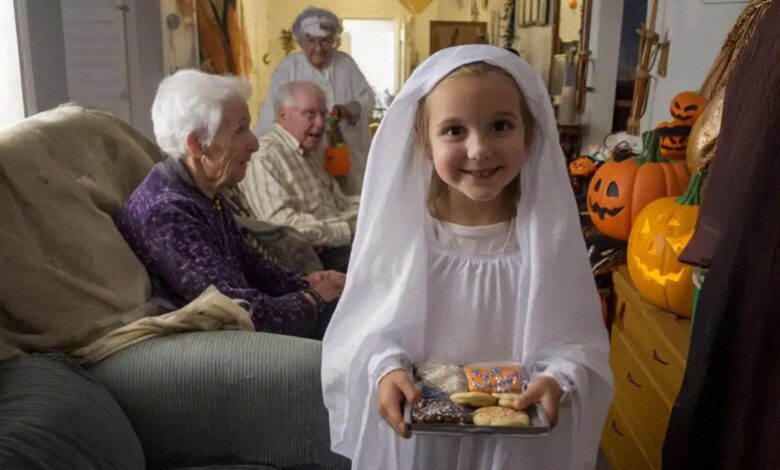
When my daughter told me she wanted to do something different for Halloween, I thought she meant a new costume. I had no idea she was about to change lives — and that someone would show up on our doorstep the next morning with a box that made me cry.
I’m Elena, 33, a nurse in a small Ohio town that always smells like freshly cut grass in summer and smoke from backyard fires in fall. I’ve been working nights for years. It’s not glamorous, but it’s honest. The paycheck stretches just enough to cover rent, bills, and a few small treats for my daughter, Lily.
Her father’s been out of the picture since she was two. One day he said he wasn’t ready to be a dad and left like it was a bad date. We moved on. We built our own life — simple, but ours.
Lily’s seven now, with wild brown hair and hazel eyes that seem to light up every room she walks into. People call her an old soul. She’s funny, thoughtful, and has this knack for seeing things most adults miss. Our little rental is small, the floors creak, and the kitchen always smells faintly like cinnamon — but it’s filled with warmth because of her.
Halloween is her favorite holiday. Every year, we plan her costume months ahead, carve pumpkins, and hang up string lights shaped like ghosts. So when she told me, a week before Halloween, that she didn’t want to go trick-or-treating, I froze mid-stir at the stove.
“What do you mean you don’t want to go?” I asked.
She looked up from her coloring book. “I was thinking… maybe we could go to the nursing home instead.”
“The one down the street?” I said, surprised.
She nodded. “They don’t get to go trick-or-treating. I could bring them treats.”
“You want to give candy instead of getting it?”
“Yeah. And maybe decorate a little. Make it spooky but happy. So they feel important.”
That word — important — hit hard. At seven, I was hoarding chocolate and trading for better candy. My kid wanted to make lonely strangers feel seen. I swallowed the lump in my throat. “Okay,” I said. “Let’s do it.”
The night before Halloween, our kitchen turned into a battlefield of flour, frosting, and chaos. We baked until nearly midnight — pumpkin cookies, chocolate chip bats, sugar ghosts. Lily wrote notes for each bag: You are loved. Happy Halloween from your tiny ghost friend. You’re special.
She packed them into her purple bucket with the precision of a jeweler setting gems. Her costume was simple: an old white sheet with black felt eyes and pink cheeks. “Do I look spooky?” she asked, spinning in the hallway. “You look like a marshmallow with confidence,” I told her.
Halloween arrived gray and chilly. The kind of day that smells like wood smoke and wet leaves. We loaded up the cookies and drove to Maplewood Assisted Living. The nurse at the front desk looked puzzled when Lily announced, “I’m here to treat, not trick.” A few minutes later, we were in the recreation room — dimly lit, half-decorated, a handful of residents staring blankly at the TV.
Lily didn’t hesitate. She walked right in. “Hi!” she said brightly. “I’m a friendly ghost, and I brought cookies!”
She went from chair to chair, handing out treats, complimenting cardigans, and cracking terrible jokes. One man with an oxygen tank smiled faintly when she stopped beside him. “My wife used to make cookies like that,” he said. Lily took his hand gently. “Then I’ll make them for you now, so you don’t miss her too much.”
Something in the room shifted after that. The silence lifted. People started talking, laughing, reaching for cookies. One woman tried on a plastic tiara Lily brought. Another man declared himself “King of Halloween” and demanded a second cookie. I stood by the door, watching her light up a room full of forgotten people. She wasn’t performing kindness — she was kindness.
When we got home that night, she collapsed on the couch, still wearing her ghost sheet. “Mom,” she murmured, half-asleep, “that was my favorite Halloween ever.” I kissed her forehead. “Mine too.”
The next morning, I was pouring coffee when someone knocked on our door. Not a friendly tap — a firm, deliberate knock. My stomach tightened. A tall man in a dark coat stood on the porch holding a cardboard box. “Ma’am,” he said, “are you Lily’s mother?”
My pulse spiked. “Yes. Did something happen?”
He gave a small smile. “Actually, something did. I’m the director at Maplewood. I came to bring you this — from the residents.”
I took the box, confused. Inside were dozens of handmade cards — some messy, some neat, all heartfelt. One read, Thank you for reminding me I still matter. Another said, I hadn’t smiled in months. Your daughter made my day.
I couldn’t speak. Tears blurred my vision. The man waited, then said softly, “There’s one more thing.” He handed me a white envelope. Inside was a check. “The residents pooled part of their holiday fund,” he said. “They wanted Lily to have something special — for college, or maybe just for more cookies.”
I shook my head. “We can’t accept this.”
“They insisted,” he said gently. Then his tone shifted. “One of our residents — Mr. Jacobs, the man with the oxygen tank — passed away last night. Peacefully. Before he did, he left this note for your daughter.”
He handed me a folded piece of lined paper. The handwriting was shaky: You reminded me of my wife’s kindness. Tell your daughter she made an old man happy on his last day.
I pressed the paper to my chest. “Thank you,” I whispered.
He nodded. “She brought life into that place. You should be proud.”
When Lily woke up, I showed her the box of cards. She read one slowly: “Thank you for making me smile.” Then she looked at me and whispered, “They liked the cookies?” I smiled through tears. “They loved them. And Mr. Jacobs… he passed away, but he left you a note.”
She frowned for a moment, then hugged her bunny tight. “Then I’m glad I went. Maybe he wasn’t scared anymore.” A beat later, she added, “Can we go back next weekend? We could bring Thanksgiving decorations.”
And that’s exactly what we did.
The next Saturday, Lily showed up at Maplewood with paper turkeys, yarn garlands, and more cookies — this time leaf-shaped with cranberry frosting. When we walked in, the nurses had hung a big hand-painted banner: Our Little Ghost With the Big Heart.
Lily gasped. “Mom, they made me a sign!” She spent the afternoon helping residents color pictures and telling them wild stories about her stuffed bunny’s “adventures.” A woman named Edna gave her an old beaded necklace. “I wore this to prom in 1951,” she said. Lily’s eyes went wide. “That’s so vintage.”
Over the next months, Lily became a regular visitor. By Christmas, she’d swapped her ghost costume for a Santa hat, delivering cinnamon stars and singing off-key carols. The local paper caught wind of her story, and soon after, a bakery offered to sponsor her “cookie missions.” Mr. Jacobs’ daughter even donated to a savings account for Lily’s future.
When I told her, she grinned. “Mom, that means I can be a real baker someday!” I hugged her. “You already are, sweetheart.”
That night, as she slept under her ghost-patterned blanket, I stood in the doorway watching her breathe. Maybe this is what life’s really about — not grand gestures, but small, sincere ones. A little kindness, wrapped in a bag with a note that says, You are loved.
Sometimes the biggest hearts come in the smallest ghosts.