Rare Tree Turns Heads, People Stunned When They Realize What Grows On Its Trunk!
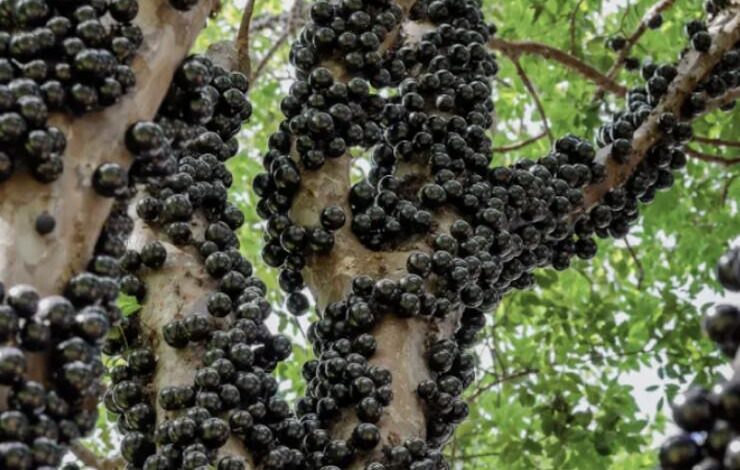
In an age where unusual plants often go viral online, few have managed to capture global attention quite like the jabuticaba tree. Pictures of this remarkable species, showing clusters of grape-like fruit sprouting directly from its trunk, have left social media users amazed. At first glance, the tree looks almost otherworldly, as if it had been decorated by human hands rather than grown by nature.
For most of us, fruit trees are familiar in predictable forms—apples hanging from branches, cherries dangling delicately in clusters, or citrus fruits weighing down leafy limbs. The jabuticaba, however, defies that expectation. Native to South America, this tree bears its fruit along its bark, with shiny purple orbs clinging tightly to the trunk and larger branches in such abundance that the underlying wood often disappears beneath them.
The scientific name for the common jabuticaba is Plinia cauliflora, a member of the Myrtaceae family. The species is native to Brazil, particularly flourishing in the states of Rio de Janeiro, São Paulo, and Goiás. Related varieties grow across Argentina, Paraguay, Bolivia, and Peru, making it a beloved tree in many corners of South America. Locals often refer to it as the Brazilian grape tree, though its flavor and use differ significantly from grapes found in vineyards.
The name “jabuticaba” itself carries a sense of poetry and history. It derives from the Tupi language, spoken by indigenous peoples of Brazil. The word is believed to come from jaboti or jabuti—meaning tortoise—and caba—meaning place. Loosely translated, it means “the place where tortoises are found.” Some linguists argue that the fruit’s soft white pulp, with its almost fatty texture, inspired comparisons to “turtle fat.” Regardless of interpretation, the word reflects the deep bond between the tree and the cultural imagination of the people who first named it.
The tree’s growth cycle only adds to its mystique. Its leaves begin as a delicate salmon hue before maturing into a deep, glossy green. The fruits, about the size of large marbles, start off pale before ripening into a rich purple or nearly black color. Their transformation is rapid, often taking just three to four weeks from flower to ripe fruit. Once ready, they are sweet, slightly tart, and bursting with juice, making them highly prized for fresh eating as well as for processing into jellies, jams, and traditional Brazilian drinks. In fact, jabuticaba wine is a regional specialty, offering a rich, dark flavor similar to port.
Social media has amplified the tree’s global fame. On platforms like Facebook, Instagram, and TikTok, users have shared images and videos of jabuticaba trees so heavily laden with fruit that their trunks appear armored in purple pearls. One user commented on an “Amazing World” post, recalling the joy of eating jabuticaba straight from the tree as a child in Brazil. Another described the surreal experience of encountering a fruiting jabuticaba in Florida, where the tree has been cultivated successfully in small numbers. For many, these photos stirred deep nostalgia, connecting them to childhood memories of climbing branches and plucking fruit by the handful.
The jabuticaba isn’t just beautiful—it’s resilient. These trees adapt well to various soils, though they prefer humid climates and generous rainfall. They can grow slowly, sometimes taking years before they bear their first fruit, but once mature, they can produce multiple harvests annually. Some varieties bloom and fruit up to five or six times per year if conditions are favorable, making them both practical and bountiful for those who cultivate them.
Nutritionally, the fruit offers a wealth of benefits. Jabuticaba is rich in antioxidants, particularly anthocyanins—the same compounds that give blueberries and red wine their healthful properties. Studies suggest these compounds may help reduce inflammation, support cardiovascular health, and protect against certain chronic diseases. The fruit is also a good source of vitamin C, calcium, and iron, making it not only delicious but also nourishing.
But perhaps what makes the jabuticaba most remarkable is its role as a cultural symbol. In Brazil, it has long been a centerpiece of community and family life. Families gather during harvest seasons to collect the fruit together, often eating it fresh in joyful abundance before preserving what remains. Festivals sometimes celebrate the harvest with jabuticaba-based dishes and drinks, highlighting the tree’s importance to both cuisine and identity.
The tree has also appeared in art, literature, and folklore. Its unusual habit of bearing fruit directly on the trunk—called cauliflory—has been interpreted as a metaphor for abundance, accessibility, and generosity. Unlike fruits that hang high in branches, jabuticabas grow where they can be reached easily by anyone, young or old, suggesting nature’s gift meant for all.
In recent years, horticulturists have introduced jabuticaba trees to regions outside South America, including parts of the United States, particularly Florida and California. While not as widespread as other tropical fruits, the tree has developed a niche following among gardeners and fruit enthusiasts eager to grow something rare and spectacular. Videos of backyard gardeners harvesting jabuticaba from their own trees in North America have only fueled global fascination.
Despite its growing popularity abroad, cultivating jabuticaba outside its native climate can be challenging. The tree is slow to grow, often demanding patience from gardeners, and requires specific soil conditions to thrive. Yet those who succeed describe it as deeply rewarding—not just for the fruit but for the sheer wonder of watching it bloom and transform.
For those who have never encountered the jabuticaba in person, it may remain one of nature’s many tantalizing mysteries. Its sudden explosion of dark, glossy fruit clinging to rough bark is almost surreal, like a vision from a dream. But for millions across South America, it is an old friend—an emblem of home, childhood, and the enduring creativity of the natural world.
The jabuticaba tree is more than a botanical curiosity. It is a reminder that nature doesn’t always conform to expectations, that it delights in surprises, and that beauty often emerges in the most unexpected forms. Whether enjoyed as fresh fruit bursting with juice, transformed into a sweet wine, or simply admired for its astonishing appearance, the jabuticaba continues to enchant everyone fortunate enough to see—or taste—it.
Even for those far from its native soil, the images circulating online provide a glimpse of its magic. They inspire wonder, remind us of the diversity of life on Earth, and perhaps encourage us to look at even ordinary trees in our own backyards with renewed appreciation. Because if nature can create something as astonishing as a tree covered in edible jewels, who knows what other marvels await discovery?