The Blind Date Was Empty, Until a Little Girl Walked In and Said, My Mommys Sorry She is Late
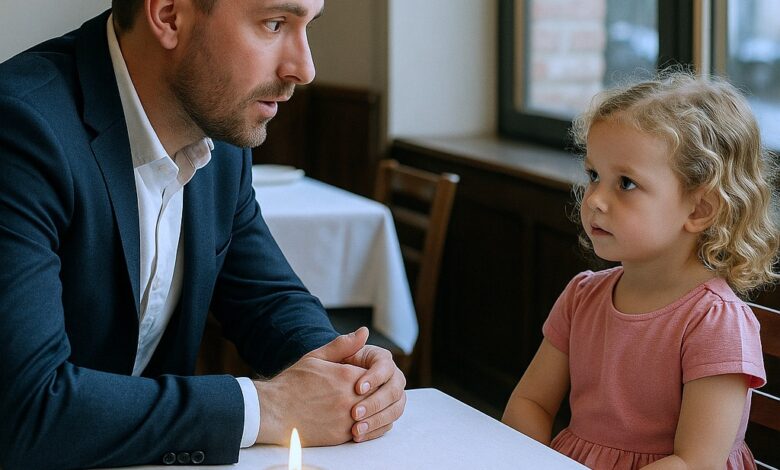
The café glowed in the amber light of early evening, windows fogged from the warmth inside while a drizzle tapped lightly against the glass. Adrian Shaw sat alone at a corner table, his watch face catching the glow of the candles as he checked the time for the third time in fifteen minutes. The seat across from him remained empty. In that silence, he recognized the familiar rhythm of disappointment — the kind that sneaks up when hope has overstayed its welcome.
At thirty-four, Adrian was successful on paper. He ran a growing business, wore tailored suits, and carried the confidence of someone who always had an answer ready. Yet tonight, staring at the vacant chair, he felt something else entirely — a quiet loneliness that no contract or paycheck could disguise. His business partner had set up this blind date, insisting that Adrian needed to stop living through spreadsheets and start living, period. “She’s grounded, kind,” his friend had said. “The kind of woman who might remind you what actually matters.”
But twenty minutes later, the only thing reminding him of reality was the waiter’s polite glances and the sound of his own restless tapping. Just as he reached for the check, a small voice interrupted his solitude.
“Excuse me,” it said, soft but clear.
Adrian turned. A little girl stood beside the table, no taller than the armrest, wearing a pink dress and shiny shoes that squeaked faintly on the floor. Blonde curls framed her face, and a matching ribbon tied them neatly. She looked like she’d stepped out of a picture book — except for the serious expression in her blue eyes.
“Are you Mr. Adrian?” she asked, her tone precise, as if reciting a line she’d rehearsed.
He blinked. “Uh, yes. I am.”
She smiled in relief. “Good. My mommy told me to tell you she’s sorry she’s late. She’s parking the car. She said please don’t leave.”
Adrian’s irritation dissolved instantly. “She sent you in here by yourself?”
“She showed me your picture,” the girl explained matter-of-factly. “She said you’d be sitting by the window with a candle, and you are!”
He laughed softly, charmed despite himself. “Well, you did your job perfectly, Miss…?”
“Lily,” she said proudly, climbing onto the chair across from him. “Mommy says not to talk to strangers, but she said you’re not a stranger, you’re her friend.”
“Your mommy sounds very wise,” Adrian replied.
“She is,” Lily said seriously, folding her hands. Then she tilted her head. “Are you going to marry my mommy?”
He choked on his water. “What?”
“Mrs. Henderson says Mommy needs a husband,” Lily continued without hesitation. “Do you like kids?”
Before he could find words, a voice rushed in behind her. “Lily!”
A woman appeared — breathless, beautiful, and clearly mortified. Her hair, golden like her daughter’s, fell loose around her face as she reached for Lily’s shoulder. “I told you to wait by the door,” she said gently but firmly. Then, turning to Adrian, she flushed. “I’m Isabel. I’m so sorry. Parking was a nightmare, and she—well, she’s independent.”
“I found him, Mommy,” Lily announced proudly. “He was right where you said!”
Adrian smiled. “And she delivered the message perfectly.”
As Isabel sat down, still catching her breath, she offered a shy smile. “I should have told you I have a daughter. I understand if this isn’t what you expected.”
“Why would I leave?” Adrian asked.
“Because most men do,” she admitted quietly. “They like the idea of someone uncomplicated.”
He looked at her, then at the little girl now stirring sugar into her water. “Anyone who sees a child as a complication,” he said, “doesn’t understand what love really looks like.”
Isabel’s eyes softened, and for the first time that evening, the tension at the table faded. Conversation began to flow — first cautious, then easy, and soon colored with laughter. Lily filled every pause with the unfiltered honesty only children possess. She talked about her favorite cartoon, her dislike of broccoli, and her plans to become a “princess-veterinarian” when she grew up.
When dessert arrived, Adrian leaned toward Isabel and said with a grin, “Your daughter asked me if I was going to marry you.”
Isabel groaned. “Oh no. She’s been listening to my neighbor again.”
“It’s fine,” he said. “It made me think, actually. I’ve spent most of my life chasing numbers and goals, but tonight reminded me that the best things aren’t measurable.”
She met his gaze, cautious hope flickering behind her smile. “Are you saying you’d like to see us again?”
“I’m saying I’d like to learn what a life looks like that includes both of you.”
Over the months that followed, he did exactly that. Adrian learned the rhythm of bedtime routines and Saturday pancakes, the chaos of toys underfoot, and the strange peace that came from hearing laughter echo through his once-empty apartment. Isabel learned to trust again. And Lily — bright, fearless Lily — took it upon herself to evaluate his progress. “Mr. Adrian did good today,” she’d announce. “He didn’t burn the pancakes this time.”
A year later, he brought them back to that same café, now brighter in his memory than any boardroom he’d ever stepped into. He knelt beside Lily first. “I’m asking your mommy to marry me,” he told her solemnly. “But that means being your family too. Is that okay?”
She studied him carefully, the way only a child could. “Only if you learn Mommy’s pancake recipe,” she said, “and play dolls without messing their hair.”
“Deal,” he promised.
Then he turned to Isabel. “You and Lily taught me something I’d forgotten — that love isn’t what comes after work ends. It’s what makes the work worth doing. Will you marry me?”
Tears filled her eyes as she whispered yes. Lily clapped so loudly that strangers turned to smile.
Six months later, under a sky filled with soft light and rose petals, Lily walked proudly ahead of her mother, scattering flowers and declaring to anyone who’d listen, “I found Mr. Adrian, so this whole wedding is because of me!”
During the reception, Isabel raised her glass and spoke through tears. “Once, I told Lily to wait by the door while I went to find Adrian. But she didn’t wait — she walked straight to him. In that moment, she showed me everything I needed to know: that love finds you when you least expect it, often through the courage of someone small.”
She looked at Adrian, her voice steady now. “You never asked me to hide the parts of my life that scared other people away. You saw them as a gift. And that’s what love is — seeing someone’s truth and choosing to stay.”
Years later, Adrian would tell the story often. Not as a fairytale, but as a reminder. Love rarely arrives on schedule. It can look like a missed reservation, a child in pink, and a stranger who decides not to walk away.
That night, Adrian had gone to dinner expecting another lonely evening. Instead, he met the family he didn’t know he was waiting for. And sometimes, when he watched Lily laugh with the same fearless joy that first interrupted his solitude, he thought about the tiny messenger who changed everything — the little girl who had simply said, “My mommy’s sorry she’s late.”
Because in truth, love wasn’t late at all. It was right on time — delivered by Lily.