King Charles Delivers Brutal Rebuttal to Trump in Historic Address to Congress That Left Lawmakers Stunned
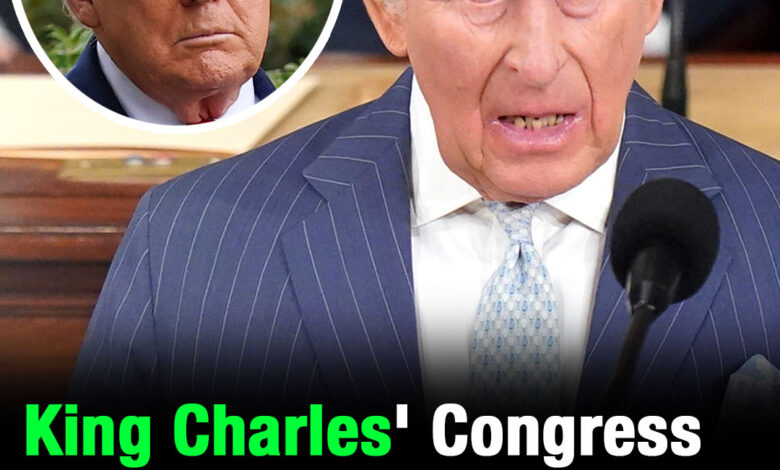
The hallowed halls of the United States Capitol have played host to some of the most pivotal moments in democratic history, but few events in recent memory have carried the subtle, electric charge of King Charles III’s recent address to a joint session of Congress. What was ostensibly billed as a ceremonial visit—a diplomatic bridge-building exercise between an aging monarchy and a restless republic—rapidly transformed into a masterclass in high-stakes political maneuvering. Without ever raising his voice or uttering a single derogatory syllable, the King delivered what many are calling a definitive “bombshell” swipe at the isolationist rhetoric of Donald Trump, effectively resetting the terms of the Transatlantic alliance in a single afternoon.
The atmosphere inside the chamber was thick with anticipation. In an era where American politics is often defined by the loudest voice in the room and the most aggressive post on social media, the arrival of a British monarch represents a different kind of power—one rooted in continuity, tradition, and the long view of history. Charles did not squander this cultural capital. From the moment he took the podium, it was clear that he was not there merely to exchange pleasantries or recount the shared linguistic heritage of the two nations. He was there to defend an international order that has come under increasing fire from the populist right.
The King’s strategy was one of surgical precision. Rather than engaging in the mud-slinging that characterizes modern political discourse, he leaned into the power of collective memory. He began by invoking the visceral imagery of September 11, 2001. By recalling the moment the world stood still and the United Kingdom stood “shoulder to shoulder” with the United States in its darkest hour, Charles reminded the assembled lawmakers—and the global audience watching from home—that the alliance is not a transactional business deal. This was a direct, albeit polite, counter-narrative to the recurring claims that European allies have been “freeloaders” or that they turned their backs on American interests.
By anchoring his speech in the blood and sacrifice of the past, the King made the current leanings toward isolationism look not like strength, but like a betrayal of a sacred oath. He spoke of the North Atlantic Treaty Organization (NATO) not as a line item in a budget, but as a living testament to a promise made between free peoples. The subtext was impossible to ignore: while certain political figures have spent years questioning the utility of NATO and suggesting that the U.S. might abandon its allies if they don’t “pay up,” the King was asserting that the value of the alliance is measured in security, stability, and shared values—currencies that cannot be devalued by a single election cycle.
As the speech transitioned from the historical to the contemporary, the King’s rhetoric took on a sharper, more urgent edge. The pivot to Ukraine was the moment the “swipe” at the Trumpian worldview became most visible. In recent months, the debate over continued support for Kyiv has become one of the most polarizing issues in Washington, with many on the populist right framing aid as an unnecessary drain on American resources or an act of international charity that the U.S. can no longer afford. Charles dismantled this framing with the grace of a seasoned statesman.
He argued that support for Ukraine is not an act of benevolence; it is a fundamental investment in the preservation of the global rule of law. He described the conflict not as a distant territorial dispute, but as a frontline battle for the very soul of the democratic world. By framing the defense of Ukraine as the “price of a just and lasting peace,” he effectively turned the “America First” logic on its head. If the United States and its allies fail to stand firm now, he implied, the eventual cost—both in financial terms and in human lives—will be exponentially higher. It was a call to responsibility that bypassed partisan bickering and spoke directly to the conscience of the room.
The reaction was nothing short of extraordinary. In a Congress so divided that lawmakers often struggle to agree on the time of day, the King’s words triggered a thunderous standing ovation that seemed to bridge the aisle, if only for a moment. Republicans and Democrats alike were seen rising to their feet, moved by a brand of moral clarity that has become increasingly rare in the halls of power. It wasn’t just the content of the speech that moved them, but the delivery—the “calm insistence” on loyalty and courage that stood in such stark contrast to the grievance-fueled spectacle of the current campaign trail.
The digital response was equally explosive. Social media platforms were flooded with clips of the speech, with many users noting the stark juxtaposition between the King’s dignified statesmanlike approach and the chaotic energy of the domestic political scene. Critics of the former president seized on the speech as a “quiet rebuke” of the highest order, praising the King for having the courage to say what many American politicians feel they cannot. For those who have felt exhausted by the constant cycle of conflict and the erosion of international norms, the King’s address landed like a cool hand on a fevered brow.
Beyond the immediate political implications, the speech served as a powerful reminder of the enduring relevance of the British monarchy in the 21st century. While the institution is often criticized as an anachronism, Charles demonstrated that a constitutional monarch can play a vital role as a “soft power” heavyweight. Because he is not a politician seeking re-election, he can speak truths that are unburdened by the need to appease a specific base or win over a swing state. He spoke as a representative of history, and in doing so, he reminded the United States of its own best self.
The speech also highlighted a growing hunger within the American electorate for “real statesmanship.” In an era of “alternative facts” and “fake news,” there is a profound desire for leadership that is grounded in reality and guided by a sense of duty. The King did not need to use hyperbole or insults to make his point. He relied on logic, historical precedent, and a shared sense of purpose. This “statesmanship of the old school” proved to be a devastatingly effective weapon against the populist rhetoric of the day.
As the dust settles on this historic visit, the “Charles Bombshell” continues to reverberate through the political landscape. It has forced a re-evaluation of the Transatlantic relationship and put the proponents of isolationism on the defensive. By reminding the world that the “special relationship” is forged in the fires of common struggle and tempered by a mutual commitment to freedom, King Charles III did more than just deliver a speech; he issued a challenge. He challenged the United States to remember its obligations, to honor its history, and to lead with the same “loyalty and courage” that once saved the world from darkness. In the end, the standing ovation wasn’t just for the King—it was for the vision of a world where honor still matters, and where allies still stand shoulder to shoulder against the tide of history.