Woman Grabs Wine Bottles Mid Shootout While Trump Is Rushed Out And The Internet Is Losing Its Mind
The Washington Hilton is a venue accustomed to the high-stakes theater of American politics. Every year, the White House Correspondents’ Dinner serves as a rare bridge between the corridors of power and the glitz of the media landscape, a night of tuxedoes, fine dining, and carefully rehearsed humor. But on the evening of April 27, 2026, the rehearsed gave way to the visceral. The air in the grand ballroom was thick with the scent of expensive perfume and aged steak when the first reports of gunfire shattered the atmosphere. What followed was a masterclass in modern chaos—a mixture of terrifying security maneuvers and the kind of bizarre human behavior that only the internet age could truly dissect.
As the shots echoed near a secured checkpoint, the ballroom shifted from a site of celebration to a scene of frantic survival. Secret Service agents, trained for the split-second realities of an assassination attempt, moved with a terrifying precision. Donald Trump and Melania Trump were swept off the stage and toward the safety of an armored motorcade, their faces a blur as the crowd around them collapsed into a sea of overturned chairs and abandoned clutch purses. Authorities would later identify the suspect as Cole Tomas Allen, a man reportedly armed with multiple weapons who had attempted to breach the Hilton’s inner sanctum before being subdued by a wall of federal officers.
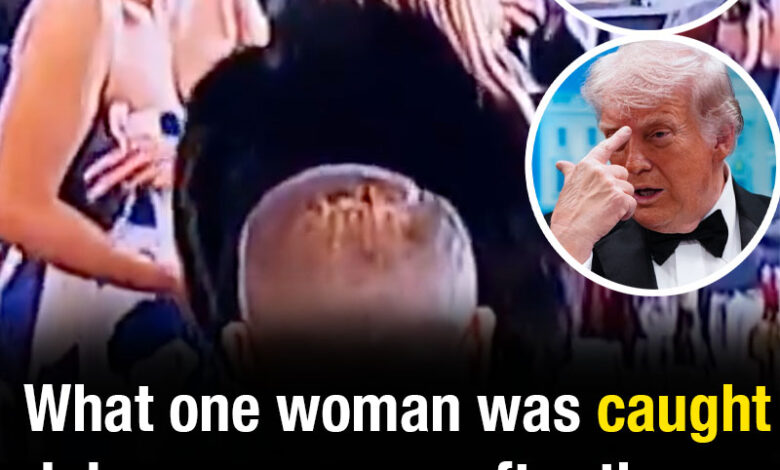
Yet, as the smoke cleared and the VIPs were secured, the digital world didn’t just focus on the shooter or the security breach. Instead, it locked onto a fifteen-second clip that would soon become the most debated piece of media of the year. While hundreds of dignitaries and journalists were scrambling for the exits in a state of sheer panic, one woman was caught on camera performing an act so mundane and yet so out of place that it felt like a glitch in the simulation.
As the sirens wailed outside and guards shouted for everyone to move toward the perimeter, this unidentified woman was seen moving calmly, almost methodically, among the abandoned tables. While others dropped their phones and ran for their lives, she was focused on the wine. With a composure that bordered on the surreal, she began gathering unopened bottles of high-end vintage wine from the centerpieces of the tables. The dinner had barely reached its second course when the shooting started, meaning the ballroom was effectively a buffet of untouched, expensive alcohol. She didn’t look like a person in fear; she looked like someone making the most of a canceled evening.
The footage, captured by a bystander’s shaking phone, shows her cradling several bottles against her chest, her eyes scanning the next table for a specific label before she turns and blends into the departing crowd. Within an hour, the clip had amassed millions of views. It was the ultimate “distraction” from the gravity of a near-political tragedy, a moment of human absurdity that the internet devoured with a mixture of horror and hilarity.
The reaction was a microcosm of a deeply polarized society. On one side of the digital fence, the woman was pilloried as a symbol of societal decay. Commentators on social media platforms argued that her actions showcased a chilling lack of empathy and a complete disconnect from the reality of a life-threatening event. To them, the fact that a human being could think about looting a few bottles of fermented grapes while the former President of the United States was being rushed away from gunfire was a sign of a soulless, consumerist culture. They saw her as a scavenger, someone who valued a free drink over the sanctity of human life and the gravity of a national crisis.
However, a vocal counter-narrative quickly emerged. A significant portion of the internet began to defend the “Wine Lady.” Their argument was rooted in a strange kind of logic: the wine was already paid for, the event was over, and in a moment of extreme stress, people react in unpredictable ways. Some psychological experts weighed in, suggesting that grabbing the bottles might have been a “displacement act”—a way for the brain to latch onto a familiar, low-stakes task to avoid processing the sheer terror of an active shooter situation. Others were more cynical, pointing out that if the Hilton was about to be locked down as a crime scene, that wine was destined to be poured down the drain or seized by staff. In their eyes, she wasn’t a thief; she was a pragmatist who didn’t want to see good alcohol go to waste in the middle of a disaster.
The plot thickened when more footage emerged. It turned out she wasn’t alone. As investigators and armchair detectives slowed down the peripheral videos of the evacuation, other guests were spotted doing the exact same thing. Men in three-piece suits were seen stuffing bottles into their jackets; women were handing off magnums to their partners as they stepped over velvet ropes. The behavior wasn’t an isolated incident of madness; it was a collective, albeit strange, impulse. It suggested that even in the highest echelons of society, the instinct to “take something with you” remains remarkably strong when the party comes to a violent end.
While the internet argued over the ethics of ballroom wine-snatching, the legal machinery of the state was moving with a far more serious focus. U.S. Attorney Jeanine Pirro took to the microphones to outline the charges against Cole Tomas Allen. The list was harrowing: multiple counts of firearm offenses, assault on federal officers, and the attempted breach of a high-security zone. The investigation was widening to see if Allen had worked alone or if this was part of a larger, more coordinated effort to disrupt the democratic process. The ballroom, once a place of light and laughter, was now a grid of evidence markers and discarded wine glasses.
In the final analysis, the incident at the 2026 White House Correspondents’ Dinner will be remembered for two very different things. For history books, it will be the night a security checkpoint barely held against a determined assailant. For the culture of the moment, however, it will always be the night of the “Wine Snatcher.”
This divergence of attention is a hallmark of our current era. We live in a world where the monumental and the trivial occupy the same screen space. We watch a potential assassination attempt through one eye and a woman stealing a bottle of Chardonnay through the other. It reveals a public that is perhaps becoming desensitized to political violence, seeking refuge in the small, weird, and relatable details of a story because the big picture is simply too heavy to carry. As the legal proceedings against Allen move forward, the woman with the wine bottles remains a ghost in the machine—a viral memory of a night where the unexpected became the only thing we could agree to talk about.