Hidden Stitching Exposes Retail Giant Secret and Managers are Left Speechless
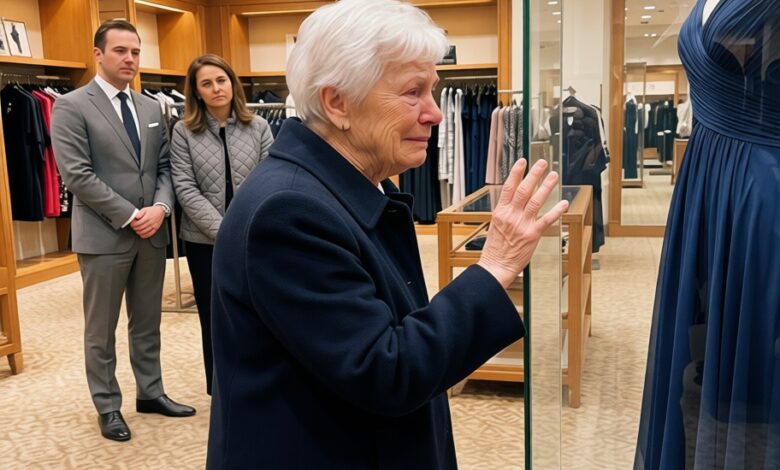
The glass doors of the Mercer & Reed department store hissed shut behind us, cutting off the chill of the April morning. My mother, eighty-two and moving with a deliberate, rhythmic tap of her cane, didn’t stop to look at the gleaming cosmetics counters or the mannequins dressed in fabrics that cost more than her monthly pension. She walked with a quiet, terrifying purpose that I hadn’t seen in years.
“Mom, please,” I whispered, feeling the weight of the eyes on us. “Just tell me why we’re here.”
She didn’t answer. She just kept walking, her old leather purse tucked tightly under one arm. To the polished staff in their designer heels and tailored suits, she was a ghost. She was a “confused grandmother” who had wandered into the wrong tax bracket. I saw the glances—the way the cashiers leaned together to whisper, the way a floor manager picked up a phone while tracking our movement toward the formalwear section.
Mom didn’t notice. Or perhaps she was simply too proud to acknowledge that she had become invisible to a world she helped build.
When we reached the Heritage Collection display, she slowed. Her gnarled, arthritic fingers began to move over the gowns. She wasn’t shopping; she was reading. She turned a sleeve inside out, her thumb tracing a hem with the precision of a master. I recognized that look. It was the same one she wore at our kitchen table forty years ago, sewing late into the night to make beauty for others while she wore the same two house dresses until they were thin as gauze.
Then, she stopped. Under the soft spotlight of the front window sat a midnight-blue gown. It was a masterpiece of silk and hand-finished buttons. A small sign read: From the Mercer & Reed Heritage Collection. Fall 1984. One of One.
Mom pressed her hand to the glass, and her eyes filled with tears so quickly it scared me.
That was when the management arrived. Two men in sharp suits and a security guard with a cold, professional earpiece formed a wall around her. They didn’t see a legendary artisan; they saw a loiterer.
“Can I help you with something?” the manager asked, his voice dripping with that manufactured politeness meant to usher “unwanted” people toward the exit.
“She’s with me,” I snapped. “We’re fine.”
They didn’t move. They hovered like vultures until a young clerk, a girl no older than twenty-three, stepped forward. She didn’t look at my mother with suspicion. She looked with curiosity. She opened the display case, carefully lifted the gown, and turned the collar back.
She froze.
“Ma’am,” the girl whispered, her voice trembling. “Is your name Evelyn Moore?”
“It used to be Evelyn Morrow,” my mother replied softly. “Before I remarried.”
The clerk turned the lining outward. There, hidden in tiny, microscopic hand-sewn letters, were the words: Made by hand by E. Morrow. September 1984.
The silence that followed was absolute. The managers retreated. The security guard looked at his shoes. My mother hadn’t just made that dress; she had breathed life into it in the upstairs workroom of this very store, back when the world still valued the hands that did the work.
But the story didn’t end with a sentimental reunion. The “Elevator Man” arrived—Daniel Cross, the Regional Operations Director. He didn’t see a human triumph; he saw an insurance risk and a PR nightmare.
“Put that dress back,” he barked. “It’s scheduled for tonight’s heritage preview.”
My mother stood as tall as her spine would allow. “Before I put it anywhere, I’d like to know if you always speak about women’s work like it belongs to the building more than the woman who made it.”
The crowd of shoppers that had gathered began to murmur. The air in the store shifted from commercial to confrontational. Mom demanded to go to the third floor—the old sewing room. Cross tried to cite “safety issues” and “restricted access,” but the growing audience of customers wasn’t having it. “Let her up!” a woman shouted from the registers.
Reluctantly, Cross led us to the service stairs. Behind the paneled walls of childrenswear lay a different world—a world of dust, iron heat, and industrial gray. As we climbed, Mom pointed to a bare patch of wall. “There was a clock there. Seven minutes fast so no one would be late after lunch.”
When we reached the third-floor workroom, it was a graveyard of broken mannequins and old crates. But Mom didn’t see the mess. She saw the ghosts of her friends. “Alma sat there,” she said, pointing her cane. “Ruth by the window for the light. Clara in the corner near the washroom.”
She marched to a radiator in the corner, her movements sharp despite her pain. She asked for a screwdriver, wedged it into the baseboard, and pried away a hidden panel. My heart hammered against my ribs. Was it empty? Had time erased her?
I reached into the dark cavity and pulled out a bundle wrapped in faded muslin. Inside was a burgundy ledger titled: UPSTAIRS WOMEN, 1981–1985.
It wasn’t a company book. It was a rebel’s diary. It contained the names of dozens of women the store had tried to forget. Beside each name were the realities of their lives: “Two boys at home,” “Cares for sick father,” “Fastest hemmer on the floor.” And there, tucked into the back, was the original sketch of the midnight-blue gown.
Cross looked at the sketch, then at the ledger, then at the woman he had tried to kick out of his store. He knew he was caught. The “Heritage Collection” was built on a lie of “House Design” that erased the very women who designed it.
He tried to pivot. He offered an “honorarium.” He offered a “formal recognition” at the gala. He used the soft, corporate language of “later” and “coordination” to try and buy her silence. He even tried to guilt her, claiming that a scandal would hurt the current low-level employees.
I looked at my mother’s hands—the hands that could no longer open a jar without pain, the hands that had built a legacy for a company that didn’t know her name. I thought about the bills on her kitchen table and the roof that leaked. I wondered if she would take the money.
But my mother looked at Leah, the young clerk who had stood by her. “If someone had asked you downstairs, before you found that stitching, whether I belonged near that dress, what would you have said?”
“I would have said I didn’t know,” Leah admitted.
“Exactly,” Mom said, turning back to Cross. “That is what your building depends on. People not knowing. You aren’t asking for time, Mr. Cross. You’re asking for ownership. And my name is already in the gown.”
She didn’t take the check. She took the ledger. We walked out of that store through the front doors, not the service exit. As we hit the sidewalk, she gripped the book to her chest like a shield. The world might have tried to make her invisible, but that afternoon, the stitches finally spoke.