Widow Claims Victory at Grave Only to Lose It All in the Final Reveal
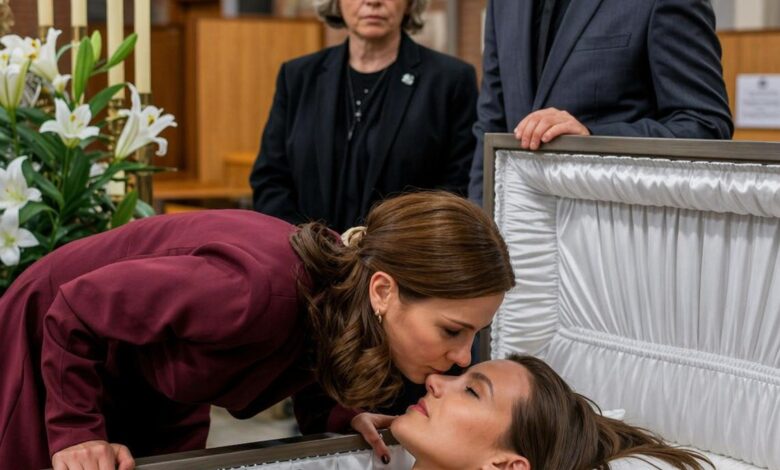
The humidity of the afternoon clung to the velvet linings of the chapel pews, making the air feel as heavy as the grief that filled the room. I sat in the front row, my knuckles white as I gripped a lace handkerchief that had once belonged to my daughter, Clara. She was only thirty-two when the cancer took her, a vibrant soul extinguished far too soon. My heart was a hollow chamber, echoing with the silence she left behind. But that silence was brutally shattered by the rhythmic, metallic click of stiletto heels against the marble floor.
The doors at the rear of the sanctuary swung open with a violence that bordered on theatrical. Every head turned, the collective gasp of the mourners rippling through the air like a physical wave. Julian, my son-in-law, did not walk down the aisle with the bowed head of a grieving widower. He marched with his chin tilted toward the rafters, his suit a sharp, arrogant charcoal gray that looked more suited for a boardroom takeover than a funeral. On his arm was a woman who could not have been more than twenty-five, wearing a dress the color of fresh arterial blood. It was short, tight, and an insult to every prayer uttered in that room.
They didn’t take a seat in the back to hide their shame. Julian led her to the third pew, forcing distant cousins to scoot over to make room for his audacity. He didn’t look at the casket. He didn’t look at me. He whispered something into the woman’s ear, and she let out a soft, melodic giggle that sliced through the organ music like a razor blade. The disrespect was a poison gas, filling the lungs of everyone present until the priest himself faltered mid-liturgy, his eyes wide with disbelief at the spectacle unfolding before him.
I felt my husband’s hand tighten on mine, his breathing ragged with suppressed rage. We had known about the affair toward the end. Clara had whispered it to me in the sterile white light of the hospice ward, her voice a fragile thread. She had known Julian was waiting for her to fade so he could step into the sun with his new prize. But to bring her here, to the sacred space of her final goodbye, was a level of cruelty I hadn’t prepared for.
As the service moved toward the interment, the tension only thickened. At the graveside, under the searing glare of the midday sun, the mistress leaned in close to Julian. I was standing mere feet away, separated only by the floral arrangements that were already beginning to wilt. As the priest finished the final commendation, she turned her head slightly toward me. Her eyes were bright with a predatory triumph. She didn’t speak to the crowd; she leaned toward me, her breath smelling of expensive mints and champagne.
I won, she whispered. The words were a hissed confession, a tiny dart of venom intended only for my ears. She squeezed Julian’s arm, her smile widening as she looked at the mahogany casket being lowered into the earth. To her, this wasn’t a tragedy; it was an eviction. She had moved into Clara’s house, she was wearing Clara’s jewelry, and now she believed she was about to inherit the vast estate my daughter had spent a decade building as a tech executive.
Julian gave me a curt, dismissive nod as the crowd began to disperse toward the reception. He looked like a man who had already spent the money in his head. He had been the primary beneficiary of Clara’s will for five years, and he clearly assumed that death had simply cleared the path for his luxury lifestyle with his new companion.
The following morning, we gathered in the mahogany-paneled office of Clara’s long-time attorney, Mr. Sterling. The room was cold, the air-conditioning humming with a clinical persistence. Julian arrived late, the mistress still attached to his side, her red dress replaced by a white silk suit that screamed of new money and unearned confidence. They sat across from me and my husband, Julian leaning back with his ankles crossed, looking bored.
I have a lunch reservation at one, Julian said, tapping his gold watch. Can we get through the formalities? I’m sure everything is straightforward. Clara was always organized.
Mr. Sterling didn’t look up from his files. He adjusted his spectacles and cleared his throat, a sound that seemed to signal the shifting of the earth’s plates. Indeed, he said softly. Your late wife was exceptionally organized. However, she made a series of significant amendments to her last will and testament exactly fourteen days before her passing.
The mistress stiffened. Julian’s smirk didn’t vanish, but it flickered. What amendments? We had a pre-nuptial agreement that guaranteed the house and the liquid assets to the surviving spouse.
Mr. Sterling finally looked up, his gaze icy. That agreement remained valid only as long as the marriage was conducted in good faith. Clara provided this office with a digital dossier—logs, photographs, and financial records—documenting your infidelity and the misappropriation of marital funds to support your companion over the last eighteen months.
The silence in the room became absolute. I could hear the mistress’s shallow, panicked breathing.
The will now states, Sterling continued, his voice gaining a sharp, rhythmic edge, that the family estate, the penthouse in the city, and the entirety of the investment portfolios are to be placed into a perpetual charitable trust. The primary executors of this trust are her parents.
Julian leaped to his feet, his face flushing a deep, mottled purple. That’s impossible! I’m her husband! She can’t just cut me out! What about the house?
The house is part of the trust, Julian, Sterling said, closing the folder with a definitive thud. You have forty-eight hours to vacate the premises. As for the liquid assets, Clara left you a very specific sum.
The mistress leaned forward, her eyes darting between Julian and the lawyer, her triumph from the funeral evaporating into a cold, hard desperation. How much? she demanded.
Mr. Sterling reached into a drawer and pulled out a single, crisp envelope. He slid it across the table. It was addressed to Julian. Inside was not a check, but a printed receipt for a storage unit on the outskirts of town.
Clara left you the contents of your closet and the sum of one dollar, Sterling informed him. She also included a note.
Julian snatched the paper, his hands trembling. He read it silently, but I had already seen a draft. It simply said: You told me you loved me for who I was, not what I had. Now you get to prove it.
The mistress stood up so quickly her chair nearly toppled. She looked at Julian, not with love or support, but with a sudden, sharpened clarity. She saw a man stripped of his tailored suits, his luxury cars, and his social standing. She saw a man who was now a liability. Without a word, she grabbed her designer handbag—the one I knew Clara had bought for herself a year ago—and walked out of the office. The sound of her heels on the hallway floor was no longer triumphant; it was the sound of someone running away from a sinking ship.
Julian sat back down, his shoulders slumped, the weight of his own betrayal finally pinning him to the chair. He looked at me, perhaps hoping for a flicker of maternal pity, but he found only the reflected iron of my daughter’s resolve. The woman who had whispered I won at the edge of a grave had forgotten one thing: my daughter was a fighter until her very last breath. And in the end, the only thing Julian and his mistress truly inherited was the emptiness they had created.