The Forgotten Math Teacher Was Mopping Floors Until Her Former Student Opened a Secret Shoebox From 37 Years Ago
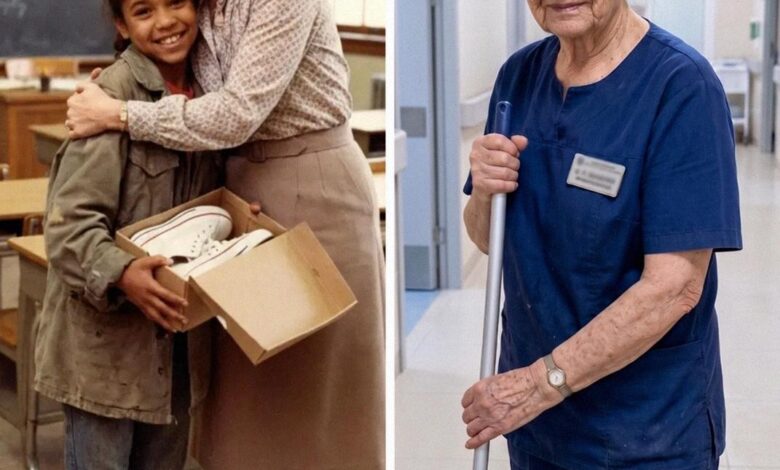
The fluorescent lights of the Shady Oaks Retirement Home hummed with a clinical, soul-crushing persistence. I was there for my weekly visit with my grandmother, walking a path I knew by heart, when a flash of silver hair and a particular, labored stance caught my eye. An elderly woman was bent over a mop bucket, her hand pressed firmly against the small of her back in a gesture of quiet, rhythmic pain. When she looked up to apologize for blocking the hallway, my world tilted on its axis. Those gentle brown eyes were unmistakable. They belonged to Mrs. Price, the woman who had saved my dignity when I was an eleven-year-old girl with nothing but holes in my shoes and a heart full of grief.
Seeing her in a janitor’s uniform felt like a physical blow. Life was not supposed to end here for someone like her. As I drove home that evening, the image of her weathered hands gripping a mop handle haunted me. I realized that while I had spent the last four decades building a successful career in educational advocacy and community partnerships, the woman who had planted the first seed of my ambition was slipping through the cracks of a system that had forgotten her.
That night, sleep was an impossible luxury. I went to the back of my closet and pulled down a dusty, taped-up shoebox. I hadn’t opened it in years, but I knew exactly what was inside. Lifting the lid felt like opening a time capsule. Resting in yellowed tissue paper were a pair of white sneakers with blue stripes. They were pristine, preserved like holy relics. Tucked beneath the rubber soles was a piece of notebook paper, folded so tightly the creases had begun to fray.
My mind drifted back to 1989. My father had passed away suddenly, leaving my mother buried under a mountain of debt that felt like a living, breathing monster in our small apartment. We were the “one bill away from disaster” family. My sneakers had become a cruel joke; the soles had detached at the toes, creating a “flap-flap” sound with every step I took. In the cruel ecosystem of a middle school hallway, I was easy prey.
Dana, a girl whose cruelty was as polished as her brand-new wardrobe, led the charge. “Ew, I can see Alice’s dirty sock through the front of her shoe,” she had whispered loudly enough for the whole math class to hear. I remember the hot, stinging shame that flooded my cheeks. I had mastered the art of sitting in the back corner, tucking my feet under my chair, and praying to be invisible. I never told my mother. She was already working double shifts at the diner, her face etched with a permanent exhaustion that terrified me.
One rainy Tuesday, the “flap” of my shoes was louder than usual. I was sitting in Mrs. Price’s class, holding my textbook high to hide the tears that were finally spilling over. I thought I was being subtle. I thought the world was too busy to notice a girl with broken shoes. But Mrs. Price was different. She didn’t call me out. She didn’t offer pity in front of the others. Instead, she waited until the recess bell rang and quietly asked me to stay behind.
She reached under her desk and pulled out a shoebox. “I noticed yours were getting a little worn,” she had said with a voice like warm velvet. “And I thought you might like these.” When I opened the box and saw those blue-striped sneakers, the dam broke. I sobbed into her wool sweater, and she just held me. She told me then, “I never want you to cry because of something like this again. Do you understand?”
That gift was the turning point of my life. It wasn’t just about footwear; it was about the realization that I was seen. That I was worthy of care. Because of those shoes, I started raising my hand. I started believing that my voice mattered. I eventually earned scholarships, went to grad school, and dedicated my life to ensuring that other “invisible” children were given a floor to stand on.
The next morning, I didn’t go to my office. I went back to the nursing home. I found Mrs. Price in a cramped supply closet, restocking paper towels.
“Mrs. Price?” I said, my voice trembling.
She turned, squinting through her bifocals. “Yes? Can I help you, dear?”
“I don’t expect you to remember me,” I said, holding the box out like an offering. “But you were my math teacher thirty-seven years ago. I have something that belongs to you.”
She looked confused, her hands shaking slightly as she removed her latex gloves. She took the box and eased the lid off. When she saw the blue-striped sneakers, her breath hitched. She sank down onto a closed toilet lid, her eyes wide with shock. “Oh, my heavens,” she whispered. “Why would you do this to me? Why did you keep these?”
“Because they changed everything,” I told her.
She reached into the box and found the letter. She unfolded it with reverent care. It was the unfinished thank-you note from 1989. It read: Dear Mrs. Price, thank you for the shoes. You showed me that I want to be the kind of person who helps people before they have to ask…
As she read the shaky, childhood handwriting, tears carved tracks through the dust on her cheeks. “I’m working here because my pension doesn’t cover my heart medication,” she confessed, her voice a fragile thread. “Everything got so expensive after my husband passed. I felt… I felt like I had disappeared.”
I knelt in front of her, taking her hands in mine. “You were never invisible to me, Mrs. Price. And you’re not going to be invisible anymore.”
I explained that I sat on the board of a major educational foundation. We were launching a new mentorship program designed to pair retired educators with at-risk youth. We needed someone with her heart, her patience, and her history. I told her the salary would more than cover her medical expenses and provide her with a comfortable life.
“This isn’t a handout,” I insisted. “It’s a debt being paid with interest. I became the person I wrote about in that letter because of you. Now, I need you to help me find the next Alice.”
The following week, Mrs. Price walked into our community center. She wasn’t wearing a janitor’s uniform; she was wearing a bright floral blouse and a look of purpose I hadn’t seen on her face at the nursing home. I introduced her to the staff and the students as the woman who made my entire career possible.
At the end of her first day, after the kids had gone home and the room was quiet, she sat at a desk, running her fingers over a stack of math worksheets. “I’d forgotten,” she said softly. “I’d forgotten how much I loved the noise. The life of it all.”
I leaned against the doorway, watching her. For thirty-seven years, I had carried a pair of shoes and an unfinished letter. Finally, the letter was finished, and the woman who had taught me how to walk tall was finally standing on solid ground again.