My Husband Demanded We Give Away Our Newborn Twins After Being Alone With Them For One Day But The Truth About Who Was Really Pulling The Strings Is Beyond Sickening
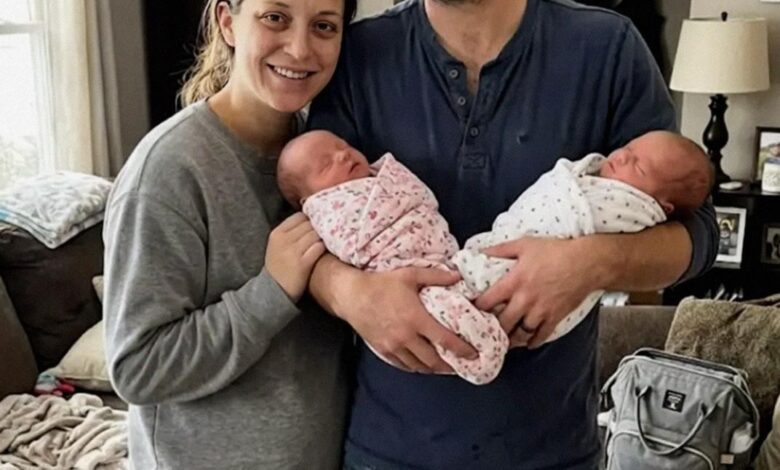
The sound that greeted me when I opened my front door was not the gentle cooing of infants or the peaceful hum of a happy home. It was a jagged, visceral wall of noise—the kind of crying that has crossed the line from hunger into sheer, breathless exhaustion. One of my twin girls, Jade, was wailing in a ragged rhythm that signaled she had been at it for hours, while her sister Amber let out angry, desperate squeaks between sobs. The scene in the living room was a portrait of total domestic collapse: formula powder dusted the granite counters like snow, a half-empty bottle lay abandoned on the sofa, and my husband, Brian, sat motionless with his elbows on his knees, staring into a middle distance that didn’t exist.
I dropped my purse and sprinted past him, my maternal instincts screaming. Jade’s face was a blotchy, inflamed red as I hoisted her from the crib, and Amber’s tiny fists were balled so tight her knuckles were white. I settled them against my shoulders, whispering the frantic, soothing nonsense that mothers use to anchor their children in a storm. When the screaming finally subsided into heavy, shuddering gasps, I looked at Brian. I expected an apology, or perhaps a panicked explanation about a missed nap or a stubborn diaper. Instead, he looked at me with eyes that were terrifyingly flat and said in a voice I didn’t recognize that we had to give them away.
For a heartbeat, I thought the stress of the day had simply broken his mind. We had spent three years fighting for these children—three years of fertility specialists, hormone shots, and silent prayers over negative tests. When those two pink lines finally appeared, and later when the ultrasound technician laughed and told us we were having twins, Brian had squeezed my hand so hard I thought it might bruise. He had been my rock through a difficult pregnancy and the first month of newborn chaos. But standing there in a shirt stained with spit-up and spilled coffee, he looked like a man who had decided to resign from his own life.
The day had started with a different kind of crisis. My mother had called, breathless and shaken, after slipping on her back step. I had scrambled to get ready to head to the hospital, and despite my hesitation about leaving Brian alone with both infants for the first time, he had insisted he could handle it. He had puffed out his chest with a father’s pride and told me to go. I spent the afternoon in the emergency room, checking my phone every few minutes for a signal of distress that never came. Brian’s only text had been a dismissive “Fine, Willow. Relax.” But as I stood in my living room listening to him suggest we abandon our daughters, I realized that the silence had been the sound of a total internal collapse.
The true horror of the situation revealed itself when I noticed a white travel mug on the side table—one that didn’t belong to us. It belonged to my mother-in-law, Denise. Denise had never been particularly supportive of our struggle to conceive, often dropping thinly veiled comments about how “some people just aren’t meant to be parents.” When the twins arrived, she had looked at them with a detached curiosity that made my skin crawl. As Brian began to speak, the pieces of the puzzle fell into a sickening pattern. He hadn’t just been overwhelmed by the crying; he had been systematically dismantled by his own mother.
Denise had “stopped by” shortly after I left. She had found Brian in a moment of natural, new-parent panic when Jade had spit up and Amber started screaming. Instead of helping him, instead of showing him how to burp a baby or settle a nursery, she had spent the afternoon pouring poison into his ear. She told him that they were in over their heads. She told him that twins were not a blessing, but a “natural disaster” that would destroy his marriage and his future. Most unforgivably, she told him that she had already started looking into “family options”—a euphemism for temporary placement and adoption. She had sat in our home and treated our daughters like a defective product that needed to be returned.
Brian admitted that when Jade had choked slightly on some milk, he had lost his nerve and yelled in frustration, scaring himself. Denise had used that moment of weakness to convince him that he was dangerous and incompetent. She made abandonment sound like an act of mercy. As I listened to my husband—the man who was supposed to be my partner in everything—admit that he had entertained his mother’s suggestions, I felt a part of my heart harden into ice. He hadn’t just failed a test of endurance; he had allowed a third party to place a price tag on our children’s belonging.
I looked at my sleeping daughters, their chests rising and falling in the synchronized rhythm of innocence, and I made a decision that felt as sharp as a blade. I told Brian that we were not giving anyone away, but that he was going to have to decide right now whether he wanted to be a father or his mother’s son. I wasn’t just angry; I was finished with the ambiguity. I demanded he pack a bag for the girls, along with their green blankets and enough formula for the night. I was taking them to my mother’s house, away from the toxic air of a man who could even consider disposal as a solution to a difficult day.
As we arrived at my mother’s porch, Brian’s phone rang. It was Denise. I told him to put it on speaker, and her voice came through—bright, brittle, and utterly devoid of shame. She told Brian not to let me “shame him” for admitting the girls were “too much.” I didn’t wait for Brian to answer. I stepped closer to the phone and told her that she would never see my children again. I told her that she didn’t get to call herself family after trying to make abandonment sound reasonable. I promised her that a lawyer would be the only person she would be hearing from in the future.
The silence that followed on the other end of the line was the first real peace I had felt all day. Brian stood there, looking helpless and broken, but I couldn’t afford to comfort him yet. My priority was the two tiny lives I held in my arms. I carried Jade and Amber into my mother’s house, and as the door clicked shut behind me, I knew that the battle for my family had only just begun. I had realized that being a mother wasn’t just about love and late-night feedings; it was about being the fierce, unyielding wall that stands between your children and anyone—even their own father—who would dare to treat them as anything less than a miracle. Brian had a long road of redemption ahead of him, but Denise was a ghost of the past. From that moment on, my daughters would only ever be surrounded by people who knew that “too much” was exactly the amount of love they deserved.