THE SACRED VATICAN SECRET ONLY SEVEN CHOSEN WOMEN ARE ALLOWED TO KEEP
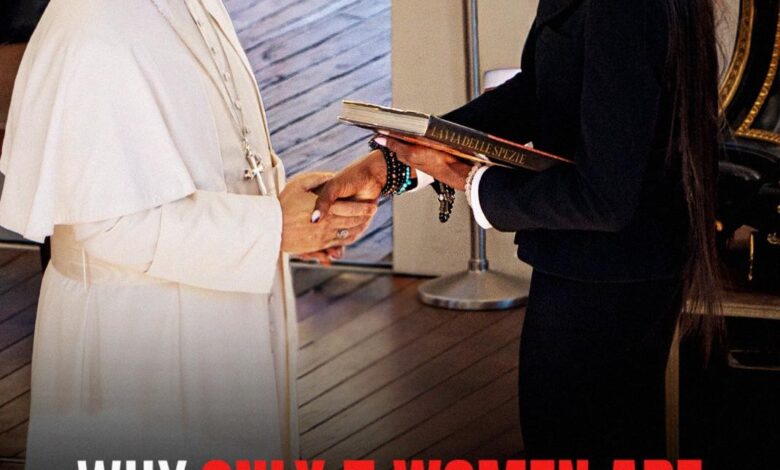
Within the labyrinthine corridors of the Vatican, where ancient stone meets divine decree, there exists a protocol so exclusive that it separates the global elite from the truly anointed. In a world of diplomatic nuances and rigid formalities, the visual language of the Holy See is typically dominated by a somber palette. For centuries, the standard for any woman granted an audience with the Sovereign Pontiff has been a rigorous display of humility: floor-length black gowns and the delicate, lace architecture of the traditional mantilla. Yet, in a striking departure from this sea of mourning shades, a tiny handful of women possess the right to stand before the Pope draped in the purest white. This is not a fashion choice or a modern concession; it is an ancient, inherited honor known as le privilège du blanc, and today, only seven women on the entire planet hold the key to this ethereal wardrobe.
To understand the weight of this distinction, one must look back through the annals of European history and the intricate dance between church and state. The privilege of the white is a vestige of the era when the world was divided by crowns and faith, specifically reserved for Catholic queens and princesses of monarchies that historically held the title of Rex Catholicissimus, or Most Catholic Majesty. This was not a title given lightly; it was a papal recognition of a throne’s unwavering devotion to the Holy See. While the modern world has largely moved toward secular diplomacy, the Vatican maintains this visual hierarchy as a living testament to these historic bonds. It is a structural honor, one that typically passes down through royal lineage or is granted to the consorts of these specific reigning houses, unless a sitting Pope decides to rescind the right.
As of April 2026, the elite circle consists of a specific roster of European royalty. The list includes the legendary Queen Sofia of Spain and her daughter in law, the elegant Queen Letizia. From the Belgian court, both the venerable Queen Paola and the reigning Queen Mathilde are permitted the white vestments. They are joined by Grand Duchess Maria Teresa of Luxembourg, Princess Marina of Naples, and the serene Princess Charlene of Monaco. These women represent the last bastions of a tradition where clothing serves as a spiritual and political document. When they appear in white during a canonization, a beatification, or a private audience, they are not merely dressed for a photo opportunity; they are signaling their status as protected daughters of the Church.
Princess Charlene of Monaco has recently brought this rare protocol back into the global spotlight. Her journey to this privilege was one of both heart and law, having converted to Catholicism before her 2011 marriage to Prince Albert II. During the historic visit of Pope Leo XIV to the Princely Palace of Monaco in March 2026, the visual impact of the tradition was undeniable. Standing near a portrait of the late Princess Grace—who, despite her legendary status, frequently adhered to the black lace tradition during her own audiences—Charlene stood as a vision in white, her head covered by a matching veil. The Palace of Monaco took the unusual step of highlighting this on social media, explicitly citing The Privilege of the White as a symbol of the unique and unbreakable bond between the Principality and the Holy See. Interestingly, young Princess Gabriella was also seen in white during the festivities, but experts note that for a child of eleven, the choice is a stylistic nod rather than a formal exercise of the privilege, which is traditionally reserved for the consort or reigning female sovereign.
However, having the right to wear white does not mean these women are shackled by it. The privilege is an option, not an obligation, and its usage often reflects the personal relationship between the royal and the sitting Pontiff. For instance, despite her clear entitlement, Princess Charlene chose a somber black ensemble for the inauguration mass of Pope Francis in 2013, perhaps sensing that the occasion called for a more universal display of humility. Similarly, Queen Letizia of Spain has become a figure of modern adaptation. She has been known to forgo the traditional mantilla entirely, opting for a streamlined, contemporary white suit that respects the color protocol while shedding the heavy lace of the past. Her mother in law, Queen Sofia, made similar waves by abandoning the veil in recent years, signaling a shift in how the royal houses of Europe interpret ancient rules in a 21st century context.
The exclusivity of this rule is perhaps best highlighted by who is left out. The privilege is not a reward for being a powerful Catholic woman; it is a specific monarchical right. This means that even the most influential female heads of state, such as former Argentine President Cristina Fernández de Kirchner, must adhere to the standard black dress code. Even the Catholic spouses of world leaders, like the iconic Jacqueline Kennedy or more recently Michelle Obama, followed the black lace protocol to the letter. Most notably, the privilege does not extend to Catholic queens who are married to non Catholic monarchs. Queen Máxima of the Netherlands, a devout Catholic, wears black when she visits the Vatican because the Dutch throne is not one of the designated Most Catholic houses. Even within the royal spheres of Liechtenstein and Lesotho, the honor is not automatically recognized, proving that the Vatican’s “white list” is one of the most difficult circles to join in human history.
When the lines of this protocol are blurred, the reaction from traditionalists can be swift and biting. One of the most famous instances of protocol friction occurred in 2003, when Cherie Blair, the wife of former British Prime Minister Tony Blair, appeared before Pope John Paul II dressed in white. As a practicing Catholic, many expected her to know the gravity of the color choice. The move sparked a firestorm of criticism from conservative circles, with some officials reminding the public that a Prime Minister’s wife, no matter how devout, is not a Catholic Queen. The incident served as a stark reminder that in the eyes of the Vatican, tradition is not a suggestion—it is the fabric of their identity.
Even those outside the Catholic faith have found ways to navigate these waters with symbolic grace. The late Queen Elizabeth II, who as the head of the Church of England was certainly not entitled to the privilege of the white, showed a masterful command of diplomatic dressing during her final visits to the Vatican. In 2014, she met Pope Francis wearing a soft lavender outfit, a departure from the stark black she had worn in decades past. This choice was widely interpreted as a gesture of warmth and a move toward a more informal, contemporary friendship between the two faiths.
Ultimately, the privilege of the white stands as one of the last remaining vestiges of a world where symbols were absolute. In an age of fast fashion and instant digital updates, the sight of a woman in white standing against the crimson and gold of the Apostolic Palace remains a powerful jolt to the system. It is a reminder that some things—history, lineage, and the specific blessing of an ancient institution—cannot be bought or earned through modern merit. They are carried, like the heavy silk of a royal gown, by only a chosen few who represent the intersection of the earthly and the divine. As Princess Charlene and the queens of Europe continue to navigate their roles, the white veil remains a silent, potent statement of their unique place in the architecture of the world.