THE POPE BREAKS HIS SILENCE AND DELIVERS A STUNNING REBUKE TO TRUMP AFTER BEING BRANDED WEAK IN A SCATHING PUBLIC TIRADE
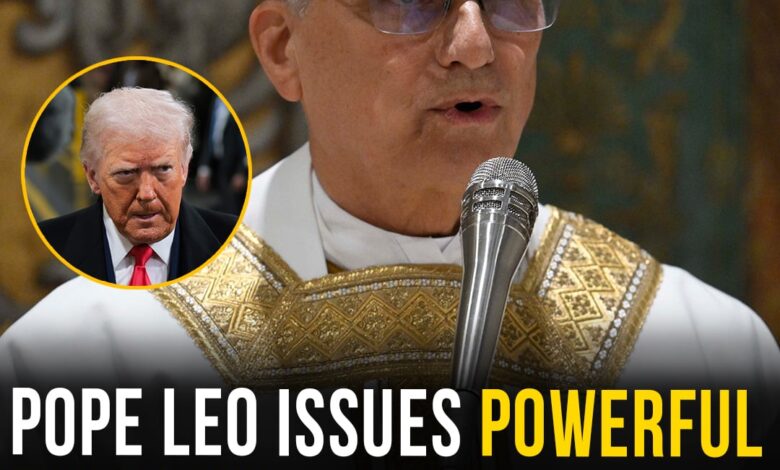
The delicate dance between the highest office in the United States and the ancient authority of the Vatican has reached a boiling point in 2026. Following a series of blistering attacks by President Donald Trump, in which he characterized the leader of the Catholic Church as “weak on crime” and a liability to global security, Pope Leo XIV has finally issued a formal response. In an era defined by aggressive rhetoric and the instant gratification of social media combat, the nature of the Pope’s reply has stunned political observers and theologians alike. Rather than descending into the arena of public insults or engaging in a line-by-line refutation of the President’s accusations, Leo XIV has chosen a path of profound moral clarity, effectively shifting the terms of the debate from political survival to humanitarian survival.
The tension began when President Trump unleashed a characteristic tirade against the Pontiff, targeting his stance on international cooperation and his persistent calls for a ceasefire in the escalating Middle Eastern conflicts. Trump’s narrative was clear: he framed the Pope’s emphasis on diplomacy as a form of surrender, arguing that such a “soft” approach emboldens adversaries and puts the American people at risk. He described Leo XIV’s foreign policy influence as “dangerous” and questioned the relevance of a spiritual leader who refuses to acknowledge the necessity of military force in the modern world. For days, the political landscape was thick with anticipation, as many expected the Vatican to issue a sharp, defensive rebuttal that would mirror the combative energy coming from the White House.
However, the response that emerged from the Apostolic Palace was striking for its refusal to mirror the fury aimed at it. Pope Leo XIV did not just decline to trade insults; he fundamentally rejected the premise of the argument. In a statement that felt more like a spiritual manifesto than a political press release, the Pope insisted that he would not “get into a debate” with the President. He made it clear that he views the Gospel not as a tool for political point-scoring or a prop for nationalistic fervor, but as an uncompromising mandate for peace. By refusing to engage in the spectacle of the “Trump rant,” the Pope signaled that his authority does not derive from popularity polls or executive approval, but from a tradition that predates modern nation-states by centuries.
The heart of the Pope’s message was a relentless focus on the human cost of conflict—a reality he argued is often obscured by the sanitized language of geopolitics and “foreign policy.” He spoke with raw intensity about the faces behind the statistics: the children growing up in the rubble of shattered cities, the elderly who have lost everything they spent a lifetime building, and the nameless civilians whose lives are treated as collateral damage in the quest for domination. While Trump’s rhetoric focused on strength through power, Leo XIV redefined strength as the courage to defend life in its most vulnerable forms. He returned to these themes again and again, painting a vivid picture of the human suffering that remains long after the podiums are cleared and the cameras are turned off.
Leo XIV vowed to keep speaking “loudly against war,” even if doing so results in further mockery or political isolation. He defended the concepts of dialogue and international cooperation as the only viable paths forward for a civilization that possesses the technology to destroy itself many times over. In doing so, he drew a clear and intentional line between spiritual witness and political loyalty. He suggested that the duty of a moral leader is not to align with the temporary powers of the world, but to stand as a permanent witness to the dignity of the individual. This “quietly confrontational” stance has resonated far beyond the walls of the Church, striking a chord with a global audience that is increasingly weary of the cycle of aggression and retaliation.
The clash between these two figures represents a fundamental conflict between two worldviews. On one side is a vision of the world as a zero-sum game of dominance and strength, where “weakness” is the ultimate sin and power is the only currency. On the other side is Leo XIV’s vision of a world bound by mutual responsibility and a shared commitment to the common good. By choosing conscience over combat, the Pope has positioned himself as a foil to the prevailing political winds of 2026. He argued that true strength is found in the ability to forgive, to listen, and to protect those who cannot protect themselves.
This exchange has also sparked a broader conversation about the role of faith in modern governance. While Trump’s supporters often view his strong-arm tactics as necessary for national preservation, the Pope’s response serves as a reminder that moral authority often operates on a different timeline than a four-year election cycle. Leo XIV’s refusal to “abuse the Gospel” for political gain was a subtle but pointed critique of how religious language is often co-opted for partisan ends. He reminded his global audience that the message of peace is not a “weakness” to be overcome, but a standard to be upheld, regardless of the political cost.
As the news cycle moves forward, the impact of this “powerful response” continues to ripple through diplomatic circles. International leaders are now forced to navigate the space between the President’s demands for loyalty and the Pope’s call for universal empathy. The Pope has effectively created a moral sanctuary for those who believe that the solution to global instability is not more violence, but more humanity. His choice to remain steady in the face of a “tirade” has reinforced his image as a leader who is unswayed by the whims of the moment, grounded instead in the enduring values of his office.
In the final analysis, the standoff between the Pope and the President is a testament to the enduring power of the word. While Trump used his platform to project power and demand submission, Leo XIV used his platform to project grace and demand reflection. The Pope’s message was simple: in a world addicted to the spectacle of the strongman, the most radical act one can perform is to choose the path of the peacemaker. Whether this moral stand will influence the trajectory of American foreign policy remains to be seen, but for now, Leo XIV has succeeded in reclaiming the narrative. He has reminded the world that while leaders can be branded as “weak” by their rivals, the true measure of a man is found in what he is willing to stand for when the world is screaming for him to fight. This chapter in the history of the 2026 administration will likely be remembered not for the insults that were thrown, but for the silence and the dignity that answered them. In the battle between spectacle and conscience, the Pope has chosen a side, and in doing so, he has invited the world to do the same.