He Humiliated Me Over a $5 Salad While I Was Pregnant, He Had No Idea That Moment Would Cost Him Everything
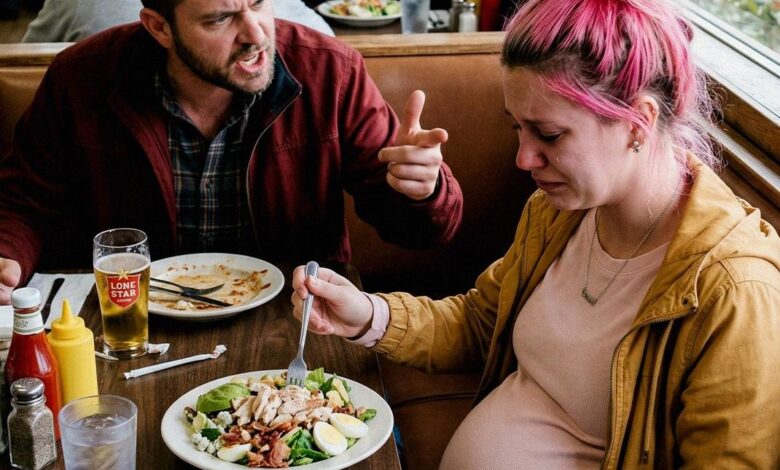
I didn’t ask for much. Just a $5 salad.
That’s all it took for everything to crack open.
I was 26, pregnant with twins, and already exhausted in a way I didn’t know existed. When I saw those two lines on the test, I thought things would soften. I thought he’d step up. I thought becoming a father might make him gentler.
Instead, it made him louder.
Briggs loved calling himself a provider. He said it like it was his identity, like it gave him authority over everything in our lives. When he asked me to move in, he framed it like security, like stability. Like I was being taken care of.
But it didn’t take long to realize it wasn’t care. It was control.
“What’s mine is ours,” he’d say. “But don’t forget who earns it.”
At first, I brushed it off. I told myself I was just tired, hormonal, overthinking things. But the comments kept coming, and they started sounding less like jokes and more like rules.
“You’ve been asleep all day, Rae. Seriously?”
“You’re hungry again?”
“You wanted kids. This is part of it.”
He always said it just loud enough for someone else to hear. Like he needed an audience. Like humiliation worked better when it had witnesses.
By ten weeks, my body felt like it was shutting down. The nausea, the fatigue, the constant heaviness—it was relentless. But that didn’t stop him from dragging me along to meetings, deliveries, whatever he had lined up that day.
“You coming?” he called once while I struggled to get out of the car.
“I can barely stand,” I said, gripping the door.
“I can’t have people thinking I don’t have my life together,” he snapped. “You’re part of the picture.”
So I went.
Inside, he didn’t even look at me before handing me a box.
“If you’re going to be here, you might as well help.”
I didn’t argue. I didn’t have the energy left for it.
That day stretched on forever—four stops, hours of standing, lifting, pretending I was fine. By the time we got back to the car, I felt hollow.
“I need to eat,” I said quietly. “Please. I haven’t had anything all day.”
He sighed like I’d asked for something unreasonable.
“You’re always eating.”
“I’m carrying two babies,” I said. “I need food.”
“You had a banana.”
I stared out the window, blinking hard.
“Can we just stop somewhere? I feel dizzy.”
He rolled his eyes but eventually pulled into a roadside diner. It wasn’t much—foggy windows, sticky booths—but I didn’t care. I just needed to sit down and not feel like I was about to pass out.
I slid into the booth and closed my eyes for a second. In that moment, I pictured my girls—Mia and Maya. I didn’t know why those names stuck, but they did. They felt soft. Safe.
A waitress came over, warm but tired, her name tag reading Dottie.
Before I could even speak, Briggs leaned back in his seat.
“Something cheap,” he said.
I ignored him and opened the menu. I needed protein, something steady. I found a Cobb salad. Five dollars.
That seemed safe enough.
“I’ll have the Cobb salad, please,” I said.
Briggs laughed. Loud. Sharp.
“A salad? Must be nice spending money you didn’t earn.”
My cheeks burned.
“It’s five dollars,” I said. “I need to eat.”
“Five dollars adds up. Especially when you’re not the one working.”
The diner went quiet around us. A couple nearby looked over, the woman’s expression tightening.
Dottie didn’t flinch.
“You want some crackers while you wait, sweetheart?” she asked gently.
“I’m okay,” I said, but my hands were shaking.
She didn’t listen. She came back with iced tea and a bowl of crackers anyway.
“You’re shaking,” she said softly. “You need something in you.”
Briggs scoffed.
“Is everyone here trying to be a hero?”
Dottie looked at him, calm and steady.
“No. I’m just being a woman who sees someone struggling.”
When the food came, there was grilled chicken on my salad. I hadn’t ordered it.
“That part’s on me,” she said quietly. “Don’t argue. I’ve been you.”
That almost broke me.
I ate slowly, letting the food settle something deeper than hunger. Briggs barely touched his meal. When I finished, he threw cash on the table and stormed out.
The second we got in the car, he snapped.
“Charity is embarrassing.”
“I didn’t ask for anything.”
“No, you just sat there and let people pity you. Do you know how that makes me look?”
I turned to him, steady for once.
“I let someone be kind. That’s more than you’ve managed.”
He didn’t respond. And for the first time, neither did I.
That night, he came home different. Quieter. No swagger, no noise. Just a man sitting at the edge of something he didn’t understand.
“My boss called me in,” he muttered eventually. “The client doesn’t want me at meetings anymore.”
I said nothing.
“They took my company card.”
Still nothing.
“Can you believe that? Over nothing?”
I tilted my head slightly.
“Nothing?”
“That waitress must’ve said something. People are too sensitive.”
I stepped closer.
“Or maybe people are finally paying attention.”
He didn’t argue. He just walked upstairs, like he didn’t want to hear it.
I stayed on the couch, one hand resting on my stomach.
“Mia. Maya,” I whispered. “You’ll never have to earn kindness.”
In the days that followed, he avoided me. No apologies. No conversations. Just tension and silence.
But something in me had shifted.
I couldn’t unsee what happened in that diner. I couldn’t forget what it felt like to be seen by a stranger when the person closest to me refused to.
So I started moving.
Slowly. Quietly. But forward.
I reached out to old friends. Looked up prenatal clinics. Took walks, even when it hurt. Every step felt like reclaiming something I’d let go of.
One morning, after he left, I grabbed my keys and drove back to that diner.
Dottie smiled the second she saw me.
“You came back,” she said.
She brought me hot chocolate, fries, pie—everything I didn’t know I needed.
“I keep thinking maybe he’ll change,” I admitted.
She shook her head gently.
“You can’t build a life on maybe.”
“Twins,” I said, correcting her. “I’m having twins.”
She reached across the table and squeezed my hand.
“Then show them what love looks like,” she said. “By how you let yourself be treated.”
That stayed with me.
When I left, she handed me a small bag. Fries, still warm. Her number tucked inside.
“For when you need a place,” she said.
I sat in my car afterward and made decisions I should’ve made sooner.
Booked a prenatal appointment.
Arranged a ride.
Then I texted Briggs.
“You will not shame me for eating again. Ever. I’m moving back to my sister’s. I need peace. Not permission.”
My hand rested on my stomach.
“Mia. Maya,” I whispered. “We’re done shrinking.”
And for the first time in a long time, I meant it.