My Former Teacher Embarrassed Me for Years – When She Started on My Daughter at the School Charity Fair, I Took the Microphone to Make Her Regret Every Word!
There are some memories you think you’ve buried for good. You move away, build a life, and convince yourself that certain people no longer have any place in your story. But sometimes, life has a way of bringing them back—right when you least expect it, and in a way that forces you to face everything you thought you had left behind.
For me, that person was Mrs. Mercer.
School had never been easy, but her classroom made it unbearable. I was thirteen—awkward, trying my best, and already insecure enough without someone in authority making me feel small. But Mrs. Mercer didn’t just teach. She targeted. She mocked my clothes, called me “cheap” in front of the entire class, and once said, loud enough for everyone to hear, “Girls like you grow up to be broke, bitter, and embarrassing.”
I went home that day and didn’t eat. I didn’t tell my parents either. I was afraid. Afraid of making things worse, afraid of retaliation, afraid that speaking up would only prove her right.
So I stayed quiet.
I endured it until graduation, and the moment I was done, I left that town with one promise to myself—I would never think about her again.
And for years, I didn’t.
Until my daughter came home one evening and pushed her dinner around in silence.
Ava is not a quiet child. She talks about everything—school, friends, random thoughts that pop into her head. So when she went quiet, I knew something was wrong.
“What happened?” I asked.
She shrugged at first. Then, slowly, she admitted there was a teacher at school who had been picking on her. Calling her “not very bright.” Making comments in front of other students that turned her into a joke.
“What’s her name?” I asked.
“I don’t know,” she said quickly. “She’s new. Mom, please don’t come to school. It’ll just make it worse.”
I told her I wouldn’t—not yet.
But something about it didn’t sit right. It felt familiar in a way I couldn’t ignore.
I planned to go to the school myself, to see what was going on. But life had other plans. I got sick—bad enough to be put on bed rest for two weeks. My mother stepped in, took over the house, handled everything while I lay there feeling completely useless.
Every morning, Ava went to school, and every afternoon, I asked the same question.
“Is she okay?”
“She’s okay,” my mom would say.
But “okay” wasn’t enough for me.
I made myself a promise: the moment I was back on my feet, I would deal with this.
Then the school announced a charity fair, and everything changed.
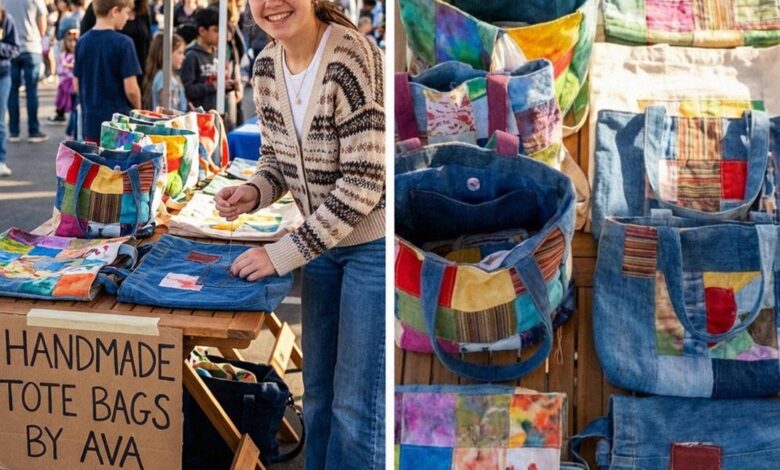
Ava signed up immediately. That same night, I found her at the kitchen table, surrounded by fabric scraps, sewing late into the evening.
“Tote bags,” she explained, her voice lighter than it had been in days. “Reusable ones. I want to raise money for families who need winter clothes.”
For two weeks, she worked every night. Careful stitching, neat lines, determination in every movement. I told her she didn’t have to push so hard.
She just smiled. “People will actually use them.”
Watching her, I felt proud. But I also felt something else—a growing suspicion I couldn’t shake.
Then I saw the flyer.
At the bottom, under “Faculty Coordinator,” was a name I hadn’t seen in over twenty years.
Mrs. Mercer.
Everything clicked.
I didn’t need confirmation. I already knew.
The day of the fair, the school gym was full of noise and energy—kids laughing, parents browsing, the smell of baked goods in the air. Ava’s table was near the entrance, her bags neatly arranged, a small handwritten sign explaining her cause.
Within minutes, people were lining up. They picked up the bags, admired the stitching, complimented her work. Ava was smiling again, the kind of smile that comes from pride.
For a moment, I thought maybe it would stay that way.
Then I saw her.
Mrs. Mercer walked in like she owned the space. Same posture, same expression, same way of looking at everything as if she had already judged it.
Her eyes landed on me.
“Cathy?” she said, recognition flickering across her face.
“I was planning to speak to you,” I replied calmly. “About my daughter.”
She followed my gaze to Ava’s table.
Without hesitation, she picked up one of the bags, holding it between her fingers like it offended her.
Then she said it.
“Like mother, like daughter. Cheap work. Cheap standards.”
The words landed exactly the way they had all those years ago.
Ava froze.
I saw her hands press against the table, her shoulders tighten, her eyes drop. And in that moment, something inside me snapped—not out of anger, but out of clarity.
I wasn’t thirteen anymore.
I walked straight to the announcer’s table and asked for the microphone.
“May I have your attention?” I said, my voice steady.
The room quieted.
“I’d like to talk about standards,” I continued. “Because Mrs. Mercer seems very concerned about them.”
Heads turned.
“When I was thirteen, this teacher stood in front of a classroom and told me I would grow up to be ‘broke, bitter, and embarrassing.’”
A ripple moved through the crowd.
“And today, she said something similar to my daughter.”
I walked back to Ava’s table, picked up one of the bags, and held it up.
“This was made by a fourteen-year-old girl who spent two weeks sewing every night, using donated fabric, so families she’s never met could have something they need this winter.”
The room went silent.
“She didn’t do it for praise. She didn’t do it for a grade. She did it because she wanted to help.”
Then I asked, “How many of you have heard this teacher speak to students like this?”
At first, nothing.
Then one hand went up.
Then another.
Then more.
One by one, people spoke.
“She told my son he wouldn’t succeed.”
“She said I wasn’t worth the effort.”
It wasn’t chaos. It was truth, finally spoken out loud.
Mrs. Mercer tried to interrupt, but no one was listening to her anymore.
“I’m not here to argue,” I said. “I just want the truth to be heard.”
Then I looked directly at her.
“You don’t get to decide who children become.”
I took a breath, feeling something release inside me that I had carried for years.
“You told me what I would be,” I said. “You were wrong.”
I held up the bag again.
“This is what I became. A mother who raises a kind, hardworking daughter. Someone who builds people up instead of tearing them down.”
The silence broke into applause.
When I handed back the microphone, Ava was standing taller than I had seen her in weeks.
Across the room, the principal was already approaching Mrs. Mercer.
“Come with me,” he said.
And just like that, she walked away—not with authority, but without it.
By the end of the fair, every single one of Ava’s bags was gone.
That evening, as we packed up, Ava looked at me.
“Mom, I was so scared,” she admitted.
“I know,” I said.
She hesitated. “Why weren’t you?”
I thought about the girl I used to be.
“Because I’ve been scared of her before,” I said. “I’m just not anymore.”
She leaned against me, and I held her close.
Some people try to define you when you’re too young to fight back.
But they don’t get to decide who you become.
And they definitely don’t get to decide who your children will be.