My Pregnant Daughter Died – When Her Will Was Read at the Funeral, the Entire Room Went Silent!
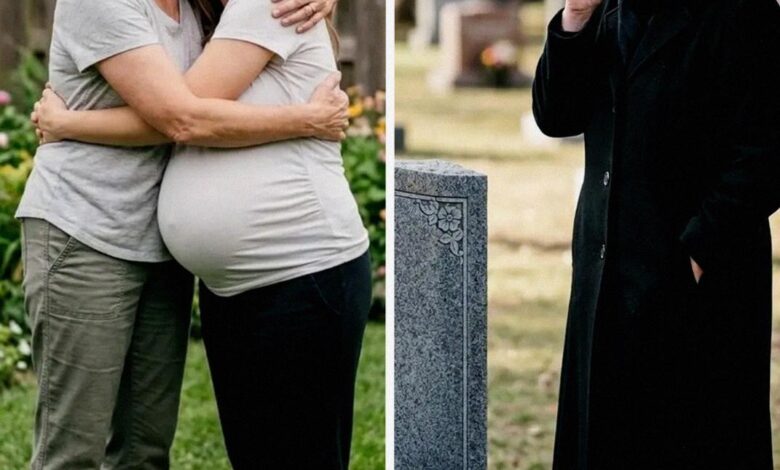
The fragrance of lilies had always been a source of comfort for Grace. Every spring, she would place a fresh bouquet on her kitchen windowsill, a small ritual that signaled renewal. But as I sat in the front pew of the chapel, surrounded by those same white blooms, the scent felt suffocating. They weren’t a sign of spring anymore; they were the ornamentation of an unfathomable tragedy. My daughter was gone, and the unborn grandson she had already named Carl was gone with her. The police had labeled the car crash a tragic accident, a phrase that felt entirely too hollow to contain the magnitude of our loss.
My husband, Frank, sat beside me in a state of rigid, silent grief. We were holding onto each other, trying to survive the organ music and the heavy atmosphere of the funeral, when the church doors creaked open behind us. The collective gasp that rippled through the mourners told me something was wrong before I even turned around. There, walking down the center aisle, was my son-in-law, Bill. He wasn’t alone. Clinging to his arm was a tall woman in a black dress that was far too tight and a hemline far too short for a house of God.
It was Sharon. I recognized the name immediately. Grace had spent her entire first trimester in a state of tearful anxiety, confiding in us about Bill’s late nights at the office and his constant, secretive texting with a colleague named Sharon. At the time, I had tried to soothe her, telling her it was likely just work stress or pregnancy hormones. Watching Bill guide his mistress into the front row—the space reserved for the “grieving” husband—I felt a surge of rage so potent I tasted copper in my mouth.
I started to rise, my hands trembling as I prepared to physically remove that woman from my daughter’s memorial. Frank’s hand clamped down on my arm, his grip firm and desperate. “Not here, Em,” he whispered, his own jaw tight with fury. “Don’t let them win by making a scene during the service.” I sat back down, my fingers digging into my purse strap, glaring at the back of Bill’s head as Sharon leaned her head against his shoulder. They weren’t just attending a funeral; they were auditioning for their new life together over Grace’s casket.
The service proceeded in a blur of eulogies and hymns. The pastor spoke of Grace’s kindness, her volunteer work, and her excitement for the baby. Through it all, Bill acted the part of the distraught widower only when he thought people were looking, while Sharon remained a silent, looming insult to my daughter’s memory. Just as the final hymn faded, a man in a sharp gray suit stood up and approached the pulpit. It was Mr. David, Grace’s attorney.
The room grew unnaturally still. Bill’s head snapped up, his eyes narrowing. “Now?” he hissed. “We’re doing legal business now?” Mr. David didn’t flinch. He explained that Grace had left very specific, ironclad instructions: her will was to be opened and read at her funeral, in front of everyone she loved—and in front of the man she had married.
“To my family,” Mr. David began reading, “I love you more than words can hold. If you are hearing this, it means the accident I feared has finally happened.” A chill swept through the room. Frank went cold beside me. The lawyer turned a page and addressed the front row directly. “To my husband, Bill. I know about Sharon. I’ve known for months.”
The chapel erupted in a low roar of whispers. Sharon ducked her head, and Bill turned a sickly shade of gray. Grace’s voice, via a pre-recorded video on a tablet the lawyer set upon the podium, suddenly filled the space. Seeing her face—vibrant, beautiful, and heartbreakingly alive on the screen—made me forget how to breathe.
“Hi,” Grace said from the screen, her expression shifting from a sad smile for us to a gaze of cold steel for Bill. “If you’re watching this, it means I didn’t make it. Mom, Dad, I love you. There’s something for you later. But Bill… when you cheat on your pregnant wife, it stops being a mistake. You became the mistake.” Bill tried to stand, to protest, but a chorus of “Sit down!” forced him back into his seat.
Grace revealed that three days before her death, she had filed for divorce. She had screenshots, receipts, and a paper trail of his infidelity that she had handed over to her legal counsel. Then came the final blow: the update to her will. Using the ironclad prenuptial agreement Bill had signed years ago, Grace had ensured that every asset she owned—the house, the savings, the legacy—would return to our family. Bill would inherit nothing. He was her husband only on paper, and as she put it, “a pretty worthless one at that.”
The video ended, leaving the room in a stunned silence that was eventually broken by Sharon’s shrill voice. “You lied to me!” she snapped at Bill, her hand recoiling from his. “You said we’d get everything!” The mourning crowd shifted instantly into a mob of indignation. Grace’s best friend led the charge, demanding they leave, and within minutes, the two were escorted out of the church by a sea of disgusted stares.
After the chapel cleared, Mr. David approached Frank and me with a private envelope. We retreated into a small side room, my hands shaking as I broke the seal. Inside was a letter that turned our grief into a different kind of resolve. Grace wrote that Bill had been acting strangely for months, pressuring her to significantly increase her life insurance policy, claiming it was for the baby’s future. “But the way he brought it up felt wrong,” she wrote. “I hope I’m wrong. But if I’m not, someone needs to look into it. Mom, I know you’ll do the right thing.”
The documents attached were the insurance forms Bill had tried to force through. The realization hit us like a physical blow: Grace hadn’t just died in an accident; she had died in an accident she was actively expecting. She had used her final days to set a trap for a man she no longer trusted, ensuring that even if she couldn’t save her own life, she could secure justice from beyond the grave.
Frank and I didn’t wait. We went to the police that same afternoon with the letter and the insurance documents. What began as a tragic accident investigation quickly pivoted into a criminal inquiry. The police discovered evidence of tampering with Grace’s vehicle and a paper trail of Bill’s mounting debts that only a life insurance payout could have solved.
Months later, I sat in a courtroom and watched Bill walk in. He wasn’t the arrogant man who had flaunted his mistress at a funeral; he was a small, broken figure facing a judge. When the gavel finally fell, declaring him guilty, I felt a strange sense of peace. I hadn’t just buried my daughter; I had fulfilled her final request. I stood in the hallway of the courthouse, and for the first time since that spring day, I thought of the lilies on Grace’s windowsill. They didn’t represent death anymore. They represented the truth, finally coming into the light.