I Found a Camera in Our Airbnb, Then the Hosts Reply Chilled Me
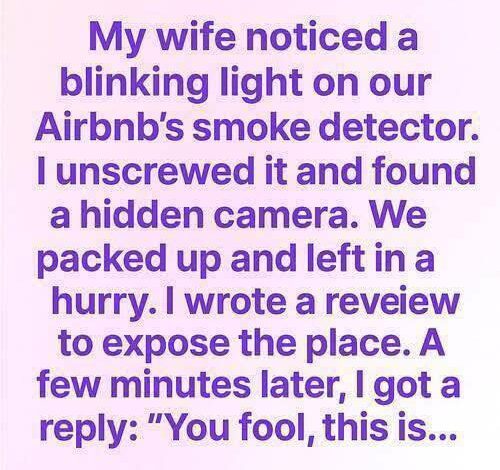
We live in an age where comfort and convenience have become second nature. With a few taps on a screen, we can book homes, flights, or rides, trusting strangers based on reviews and photos. But sometimes, trust is the most dangerous mistake you can make.
When my wife and I booked a quiet Airbnb in the countryside for a weekend getaway, it felt perfect. The photos showed a cozy cabin surrounded by trees, the kind of place meant for silence and long mornings with coffee on the porch. The reviews were glowing — “peaceful,” “private,” “immaculate.” We’d stayed in dozens of rentals before. There was no reason to think this one would be any different.
The first night went smoothly. We unpacked, cooked dinner, watched a movie on my laptop, and fell asleep listening to the sound of rain against the window. But the next morning, something strange happened.
My wife, brushing her teeth, stopped mid-sentence and pointed toward the ceiling. “Do smoke detectors usually have blinking red lights?”
I looked up. There it was — a faint, rhythmic flash coming from the smoke detector above our bed. I frowned, half-annoyed, half-curious. “Probably just the battery indicator,” I said. But something about it felt wrong. The light wasn’t the dull flicker of a dying battery. It was sharp, steady — deliberate.
I grabbed a chair, climbed up, and unscrewed the cover. What I saw made my stomach twist. Inside wasn’t a sensor or a wire I recognized — it was a tiny black lens, no bigger than a pinhead, staring back at me.
For a second, the room spun. “It’s a camera,” I said, barely above a whisper.
My wife went pale. “You’re kidding.”
I climbed down, holding the device in my shaking hands. “We’re leaving. Now.”
We didn’t talk much as we threw our things into our bags. My wife’s hands trembled as she zipped the suitcase. Every corner of the room suddenly felt threatening — the mirror, the lamp, even the air vents. I unplugged the Wi-Fi router, shut off my phone, and we bolted for the car.
Only when we were twenty miles away, sitting in a diner parking lot with coffee that neither of us touched, did we breathe again. I opened my laptop and started writing a furious message to the Airbnb host. I attached photos of the smoke detector, the lens, and the timestamped location. I hit “send.”
Five minutes later, the reply came.
“You fool. That wasn’t a camera. That was the transmitter for our private security system. Now you’ve broken it — and they’ll come looking for it.”
I froze. They’ll come looking for it. Who was “they”?
I showed my wife. She covered her mouth, eyes wide. “What does that mean? Who’s coming?”
I scrolled through the listing again. The host’s profile photo — a middle-aged man smiling on a porch — now looked staged, too perfect. His account had dozens of reviews, but suddenly, they all read the same: short, generic, copy-pasted. Lovely stay. Clean and quiet. Would visit again.
Something clicked in my head. I opened the folder of photos I’d taken of the cabin when we first arrived — for the review, just casual snapshots. As I zoomed in on one image of the living room window, my breath caught.
Behind the curtain, faint but visible, was a red dot. Not the smoke detector light — this was different. It was a laser.
And it was pointed at the wall where the camera had been.
My hands went cold. My wife whispered, “You think they were watching us?”
“I think they still might be,” I said.
We didn’t go back. We didn’t even call the host again. We just drove. Three more hours down the highway until city lights appeared, and we checked into a chain hotel. I bought a prepaid phone, smashed the one I’d used to book the Airbnb, and threw it into a trash bin behind a gas station.
The next morning, I filed a report with the local police. The officer on duty was polite but skeptical. “Hidden cameras aren’t uncommon,” he said, typing notes without looking at me. “But the message about a transmitter — that’s strange. We’ll send someone out.”
Weeks later, I received a short email from the department. They’d found the property empty. No sign of the host. The listing was deleted, the account deactivated. The name used to rent it wasn’t real. The address was registered to a shell company.
No further details. No resolution. Just a dead end.
For days, I replayed everything in my mind — the blinking light, the host’s cryptic message, the laser behind the curtain. My wife barely slept. Every sound outside our window made her flinch.
It wasn’t just about that one camera anymore. It was the realization that the trust we placed in technology — in digital ratings, in apps that claim to “verify identities” — had failed us completely.
We like to think the five stars mean safety, that a clean photo equals honesty. But those little icons and algorithms can’t protect you from what’s hidden behind the walls.
That trip taught us that safety isn’t just about locks and lights — it’s about awareness. We now carry a small camera detector when we travel, scan every room before unpacking, and never assume anything electronic is harmless.
The deeper we looked, the more we realized we weren’t alone. Hundreds of travelers had shared similar stories online — hidden cameras in clocks, vents, light bulbs, and TV remotes. Some were reported, most weren’t. A few people laughed them off. But for us, it was no joke.
Weeks later, a package arrived at our door. No return address. Inside was a plain envelope with a single piece of paper.
“You shouldn’t have touched it.”
No signature. No explanation. Just those five words.
I took it to the police immediately. They opened an investigation, but again — nothing. No fingerprints, no traceable origin.
That night, as I sat in the dark, I caught my reflection in the window — a tired man staring back, trying to make sense of something he couldn’t. That’s when it hit me: whoever was behind this didn’t care about being found. They wanted us scared. They’d already succeeded.
It’s been months since that weekend, and we still don’t know who “they” were, or what the camera was really recording. Maybe it was an elaborate scam. Maybe it was worse.
But one thing is certain: the illusion of safety we once felt is gone for good.
Now, every time I see a blinking light, even on my own smoke detector, my chest tightens. Every stranger’s smile online looks just a little too perfect. And every five-star review feels like a dare to trust again.
Because sometimes the scariest part of the story isn’t what you find — it’s realizing that someone, somewhere, is watching while you do.