Cajamarca Bus Crash in April 2024
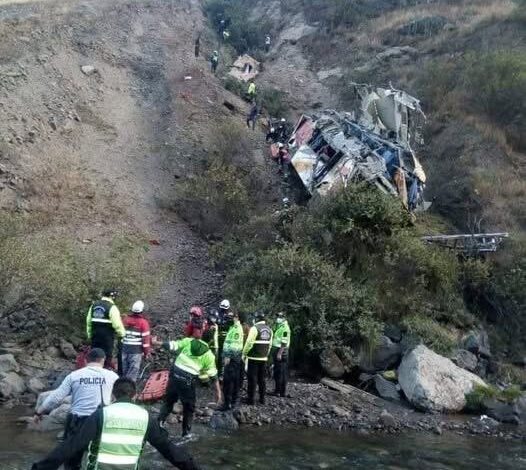
A routine journey through the mountains ended in unimaginable tragedy when a passenger bus veered off a narrow rural road and plunged more than 200 meters into a ravine in northern Peru. The wreckage came to rest near the fast-flowing Sendamal River, leaving emergency workers facing an extremely difficult rescue operation.
The first reports were devastating: at least 23 people had lost their lives, while numerous passengers were injured. As police officers, firefighters and local rescue teams descended the steep hillside, the scale of the disaster became increasingly apparent. The damaged vehicle lay among rocks and rushing water, far below the road where the journey had begun.
Photographs of the aftermath show rescuers navigating the rocky terrain, examining the wreckage and working near the riverbank. But behind those dramatic images lies a much bigger story: families waiting desperately for information, survivors requiring urgent medical attention, and difficult questions about the safety of mountain transportation.
The tragedy occurred in Cajamarca, Peru, in April 2024. Although the first reports confirmed 23 deaths, the toll subsequently increased as authorities continued identifying victims and updating information from the rescue operation.
What happened during those final moments on the mountain road? Why was reaching the wreckage so difficult, and what did investigators discover afterward? The answers reveal why this accident became such a painful reminder of the dangers facing passengers who travel through remote mountainous regions.
A Journey That Ended in Disaster
The accident happened on the night of Sunday, April 28, 2024, in the Celendín province of the Cajamarca region in northern Peru.
The passenger bus was traveling along a rural mountain route associated with the communities of Celendín and Sorochuco. This region is characterized by rugged terrain, steep slopes and roads that can become particularly difficult to navigate after dark.
According to early accounts reported by local authorities, the vehicle left the roadway and plunged into a deep ravine before reaching the area around the Sendamal River.
The distance between the road and the river was enormous. Reports described a fall of approximately 200 meters, although some local accounts gave different estimates of the depth.
The bus eventually came to rest near the river, with its structure badly damaged. The impact was severe, and the surrounding landscape made it difficult for emergency personnel to reach the vehicle quickly.
News of the accident spread rapidly through nearby communities. Residents became aware that something terrible had happened and began seeking information about the passengers.
For families who knew someone traveling on that route, the first hours were filled with uncertainty. A phone call that did not arrive, an unanswered message or an unfamiliar name appearing in an early report could suddenly become a source of overwhelming anxiety.
Local officials and emergency services began coordinating their response as information from the crash site continued to emerge.
The initial death toll was reported at 23, with additional passengers injured. However, that figure was not final.
As rescue and recovery work progressed, officials released updated information indicating that the number of fatalities had increased.
This distinction is important because several online posts continue repeating the earliest figure without explaining what happened afterward.
The Terrifying Scene at the Bottom of the Ravine
The photographs accompanying reports of the accident provide a disturbing picture of the conditions facing rescuers.
A passenger bus can be seen lying severely damaged near a rocky riverbank. Parts of its structure appear twisted, while sections of the vehicle are surrounded by stones, vegetation and flowing water.
The hillside above the wreckage is steep and uneven. There are no convenient roads leading directly to the bottom, meaning emergency workers had to approach the scene using difficult routes.
In some photographs, rescue personnel wearing brightly colored reflective jackets can be seen making their way through the area. Police officers and firefighters worked alongside other emergency workers, carefully examining the wreckage and surrounding ground.
The situation was especially challenging because the vehicle was close to the Sendamal River.
Moving around a riverbank is difficult even under ordinary circumstances. After a major vehicle accident, the risks become greater. Rocks may be unstable, metal fragments may have sharp edges, and water currents can make certain sections dangerous to cross.
Rescuers therefore had to consider their own safety while trying to reach the victims.
Every movement required attention. A person carrying equipment across slippery stones could easily lose their footing. A stretcher team needed enough space to move safely, while personnel inspecting the vehicle had to avoid disturbing dangerous sections of the wreckage.
The photographs also demonstrate something that is often overlooked in reports about major transportation accidents: the rescue operation does not end when emergency workers arrive.
In many cases, reaching the victims is only the beginning.
Teams must assess the condition of the vehicle, determine which areas can be approached safely, locate survivors, provide medical assistance and coordinate the movement of injured people toward ambulances or other available transportation.
When an accident occurs in a remote mountain location, even these basic tasks can become complicated.
The dramatic images from Cajamarca capture this difficult reality.
Why Reaching the Wreckage Was So Difficult
The geographical conditions surrounding the accident played a significant role in the emergency response.
Cajamarca is located in the northern Peruvian Andes, a region where communities are often connected by winding roads that cross hills, valleys and mountainous terrain.
Some rural routes are narrow and uneven. They may contain potholes, loose stones and sections where the road surface is not paved.
For residents who regularly use these roads, such conditions can be familiar. However, familiarity does not eliminate the danger.
Driving along a mountain road requires constant attention because the available space for correcting a mistake may be extremely limited.
A driver approaching a sharp curve must consider the width of the road, the condition of the surface, the vehicle’s speed and the distance available to stop.
At night, visibility becomes another major concern.
A bend that appears manageable during daylight can become much more difficult to judge when headlights illuminate only a limited section of the road.
If a vehicle loses control near an unprotected edge, the consequences can be catastrophic.
In the Cajamarca accident, local authorities described the road as difficult and unpaved. Reports also indicated that the bus fell into the ravine and reached the river below.
The location created an additional problem for rescue workers.
Unlike an accident on a major highway, where ambulances can usually park close to the vehicle, a crash at the bottom of a steep ravine requires personnel to descend through difficult terrain.
Equipment must also be transported.
Medical supplies, stretchers, communication devices and protective equipment all need to reach the crash site. After injured passengers receive initial treatment, they must be moved back toward accessible roads or suitable medical transportation.
These challenges can consume valuable time.
The surrounding environment also affects communication. Mountain slopes can interfere with mobile signals, while the distance between the crash site and nearby communities may make coordination more difficult.
The rescue teams therefore faced a situation in which geography, damaged infrastructure and the condition of the vehicle all complicated their work.
The Rescue Teams Faced a Race Against Time
When a passenger bus falls into a ravine, emergency workers must make difficult decisions almost immediately.
Their first priority is to determine whether anyone is still alive and needs urgent medical assistance.
This requires careful examination of the vehicle and its surroundings.
Passengers may have been thrown from their seats during the impact. Others may remain trapped inside damaged sections of the bus. Some may be located near the river, where water and debris can complicate recovery.
Rescuers must avoid moving injured people unnecessarily, particularly when serious spinal, head or internal injuries are possible.
At the same time, they cannot afford to delay essential medical assistance.
The operation in Cajamarca involved police and firefighting personnel, with specialized rescue teams also sent to support the response.
Photographs show workers wearing reflective clothing as they move around the accident area. Such equipment is particularly important when people are operating near roads, vehicles and uneven terrain.
Visibility helps other team members identify their colleagues, especially when several groups are working in different parts of the site.
The rescue process also requires coordination.
One group may examine the vehicle, another may search the surrounding area, while medical personnel prepare to receive injured passengers.
Police officers may be responsible for controlling access to the site and documenting important evidence.
These responsibilities must be managed together.
A poorly coordinated rescue can expose personnel to unnecessary danger and make it harder to identify which areas have already been examined.
The difficult conditions around the Sendamal River meant that emergency workers had to pay attention not only to the damaged bus but also to the landscape itself.
Loose rocks, steep ground and flowing water can create additional hazards.
A rescue worker carrying a stretcher needs a stable route. A medical team needs enough space to assess an injured person. Equipment must be positioned where it can be accessed without blocking other personnel.
The photographs show the physical effort involved in this work.
They also remind viewers that behind every reported casualty figure are emergency workers who must continue performing demanding tasks under extraordinary pressure.
The Death Toll Increased as More Information Emerged
One of the most important details about this accident is the changing number of reported fatalities.
The first widely circulated reports stated that 23 people had died. This was the figure used in many early headlines and social media posts.
However, the situation developed as authorities gathered additional information.
Reuters reported on April 29, 2024, that the death toll had risen to 25, with 13 people injured.
Local Peruvian reports subsequently carried further updates. The Peruvian news agency Andina reported that the number of fatalities had reached 27.
These changing figures explain why different articles about the same accident may contain different numbers.
The earliest reports reflected information available during the initial emergency response. Later reports incorporated additional findings from police, medical facilities and local officials.
The difference between 23, 25 and 27 is not evidence that three separate accidents occurred.
It reflects the evolving information surrounding one devastating incident.
The final figures also illustrate the difficulty of reporting on a major disaster while rescue operations are still underway.
At the beginning of an emergency, officials may not know the exact number of passengers. Some victims may be difficult to reach, while injured people may be transported to different hospitals.
Information can therefore change several times within a relatively short period.
For families, these updates are more than statistics.
They determine whether someone is still missing, whether a relative has been located and whether an injured passenger has reached medical care.
For journalists, accuracy requires explaining when a figure was reported and whether a later update changed it.
That is particularly important when dramatic headlines continue circulating long after the original event.
In this case, the headline stating that at least 23 people died was consistent with the initial reports, but it did not reflect the subsequent increase in the reported death toll.
Families Waited for News of Their Loved Ones
While rescue workers were dealing with the wreckage, families were facing another kind of emergency.
They needed information.
When a bus accident occurs far from major cities, relatives may have very limited ways to determine whether someone was involved.
Passengers may not have been carrying identification that is immediately accessible. Mobile phones may have been damaged or lost. Some injured people may be unable to communicate with their families.
Even when hospitals begin receiving survivors, relatives may not immediately know which facility has admitted a particular person.
This uncertainty can become unbearable.
Imagine receiving a message that a bus traveling through the region has crashed, followed by a report that dozens of passengers may have been killed or injured.
If someone you love was expected to be on that journey, every passing minute becomes important.
People may contact transport companies, local authorities, hospitals and other relatives in an attempt to establish what happened.
Some may travel toward the crash area, hoping to receive information directly.
Others may gather near police stations or hospitals where emergency personnel are coordinating information.
Reports from the Cajamarca tragedy described relatives gathering near local authorities as they searched for news.
The local community was deeply affected.
The accident involved people who were traveling for ordinary reasons, including work, family responsibilities and everyday activities.
For many relatives, the journey would have seemed like a routine part of life.
No one expects a normal bus trip to become the last journey a loved one ever takes.
This is one reason why transportation disasters have such a profound impact on communities.
The immediate victims are not the only people affected. Families, friends, neighbors and colleagues must also deal with the consequences.
In the days following a tragedy, communities often face practical difficulties alongside grief.
They may need to arrange funerals, support injured relatives, travel to hospitals and communicate with authorities.
The emotional impact can continue long after the wreckage has been removed.
What Happened to the Injured Passengers?
The accident also left numerous people requiring medical attention.
Initial reports differed slightly regarding the number of injured passengers. Reuters reported 13 injuries in its April 29 update, while other early accounts mentioned different figures.
Some injured passengers were transported to nearby medical facilities, while those requiring more specialized treatment were taken to the Regional Hospital of Cajamarca.
The distance between the accident site and medical facilities presented another challenge.
In a major crash, the first stage of treatment often takes place before a patient reaches a hospital.
Emergency personnel must assess breathing, circulation, bleeding and possible traumatic injuries.
They may need to stabilize patients before transporting them across difficult terrain.
The types of injuries associated with a severe bus crash can vary considerably.
Some passengers may suffer fractures or cuts. Others may experience head injuries, chest trauma or damage to internal organs.
The impact can also produce injuries that are not immediately obvious.
For this reason, people who survive a major collision generally require medical assessment even when they initially appear able to walk or communicate.
The treatment process does not necessarily end when a patient leaves the emergency department.
Some survivors may need surgery, rehabilitation, psychological support or additional medical monitoring.
Families may also face difficult decisions about where to obtain treatment and how to support relatives during recovery.
For the people who survived the Cajamarca crash, the physical consequences were only one part of the experience.
A serious accident can also leave survivors with fear, sleep disturbances and emotional distress.
Some may struggle to return to public transportation. Others may experience anxiety when traveling along mountain roads or hearing the sound of a vehicle approaching a sharp curve.
These reactions can be part of the psychological aftermath of a traumatic event.
Recovery is therefore not always measured by the number of days spent in hospital.
It can involve a much longer process of rebuilding physical strength and emotional confidence.
Investigators Turned Their Attention to the Road and the Bus
Once the immediate rescue operation was underway, investigators needed to establish why the vehicle left the road.
A fatal accident involving a passenger bus requires more than an examination of the wreckage.
Investigators generally need to consider the driver’s actions, the vehicle’s mechanical condition, the road surface, visibility, weather and the circumstances surrounding the journey.
In the Cajamarca incident, authorities began examining the circumstances of the crash.
The route was described as a difficult, unpaved mountain road with potholes. Such conditions can increase the demands placed on drivers, particularly when they are operating a large passenger vehicle.
However, poor road conditions alone do not establish the precise cause of an accident.
A vehicle can leave a road for many reasons, and investigators must distinguish between confirmed findings and possible explanations.
Mechanical problems, excessive speed, driver fatigue and inadequate road infrastructure are among the factors that can be examined in a serious bus crash.
Each possibility requires evidence.
For example, if investigators suspect a mechanical failure, they may need to inspect the braking system, tires, steering components and other vehicle parts.
If road conditions are being examined, investigators may document the width of the road, the presence or absence of protective barriers, the condition of the surface and the visibility around the relevant section.
Witness accounts may also be important.
People who were traveling in the bus, residents living nearby and other motorists may provide information about what happened immediately before the vehicle left the roadway.
The bus itself can provide additional evidence.
Damage patterns may help investigators understand how the vehicle moved after leaving the road, while the final position of the wreckage can provide clues about the sequence of events.
Nevertheless, conclusions should not be drawn simply by looking at photographs.
A severely damaged bus does not automatically reveal whether the accident resulted from driver error, mechanical failure or road conditions.
The investigation must consider the available evidence as a whole.
This distinction matters because public discussion following a major accident can quickly become emotional.
People naturally want an explanation. They want to know whether the disaster could have been prevented and whether anyone should be held responsible.
Those are legitimate questions.
But the answers must come from a proper investigation rather than speculation.
Questions About Passenger Transport Safety
The Cajamarca tragedy renewed attention to the challenges of passenger transportation in mountainous regions of Peru.
Public buses play an essential role in connecting communities.
In rural areas, residents may depend on buses to reach schools, workplaces, hospitals, markets and government services.
For many people, there is no convenient alternative.
Private vehicles may be expensive, while other forms of transportation may be unavailable or operate only on limited schedules.
As a result, passenger buses are an important part of everyday life.
However, the safety of these journeys depends on several factors working together.
The condition of the vehicle matters. So does the experience of the driver, the quality of the road and the effectiveness of transport regulations.
A bus that is mechanically sound can still be involved in a serious accident if it travels too quickly for the road conditions.
Similarly, a careful driver may face additional risks when a route contains dangerous curves, poor visibility or inadequate roadside protection.
Safety therefore cannot depend on one individual alone.
It requires a system in which vehicles are properly maintained, drivers are appropriately trained, operators follow passenger limits and roads are designed and maintained with realistic risks in mind.
The accident also raises an important question about the safety of vehicles traveling on remote routes.
Passengers often have little information about the maintenance history of the bus they are boarding.
They may not know whether the vehicle has recently undergone a technical inspection or whether the operator has addressed previously identified problems.
Transport authorities and companies have a responsibility to ensure that passenger vehicles meet applicable safety requirements.
These responsibilities become particularly important on routes where an accident could result in a vehicle falling down a steep slope.
A roadside barrier cannot prevent every possible disaster, but properly designed protective infrastructure can reduce the risk of vehicles leaving the road in certain circumstances.
Better warning signs, road maintenance and appropriate speed controls can also help.
The tragedy demonstrates why investment in rural transportation infrastructure should be considered a matter of public safety rather than simply a matter of convenience.
Why Mountain Roads Can Become So Dangerous
Mountain roads have characteristics that make driving especially demanding.
Unlike long, straight highways, they frequently follow the natural shape of the landscape.
A road may curve around a hillside, cross a narrow ridge or descend toward a river before climbing again.
These changes can create blind corners and sudden differences in elevation.
Drivers may encounter sections where the available space is limited and where there is little room to correct an error.
In some locations, the edge of the road may be separated from a steep drop by only a small shoulder.
If the vehicle loses traction, the driver may have very little time to respond.
Several conditions can increase these risks.
Road surfaces: Loose gravel, potholes and uneven surfaces can affect tire grip and vehicle stability.
Visibility: Fog, darkness, rain and dust can make it difficult to identify hazards ahead.
Curves and slopes: Sharp bends and steep descents require careful speed control, particularly for large vehicles carrying passengers.
Vehicle condition: Tires, brakes and steering components must be suitable for the demands of the route.
Driver fatigue: Long journeys and inadequate rest can reduce concentration and reaction time.
These factors can interact.
A road that is manageable in daylight may become significantly more challenging at night, particularly when its surface is uneven.
A driver approaching a curve on a steep descent must account for the vehicle’s weight, speed and braking distance.
The consequences of a mistake may be much more serious than they would be on a flat urban road.
This is why transportation safety specialists emphasize that drivers should adjust their speed to the actual conditions rather than relying solely on posted limits.
Passengers can also take sensible precautions.
Wearing seat belts where available, avoiding unnecessary movement inside the vehicle and choosing reputable transport operators are useful measures.
No precaution can eliminate every risk, but safety practices can reduce the likelihood of preventable injuries.
The Importance of Seat Belts on Passenger Buses
One issue that deserves particular attention after a severe bus accident is the use of seat belts.
Many passengers do not think about seat belts when boarding a bus.
They may assume that because they are traveling in a large vehicle, they are automatically protected.
However, the size of a bus does not eliminate the risk of injury during a collision or rollover.
Passengers who are not restrained may be thrown from their seats or collide with other passengers and interior structures.
In some accidents, the force of the impact can cause severe injuries even when the vehicle itself remains largely intact.
Seat belts are designed to help keep occupants in their seats and reduce the likelihood of certain types of injury.
Their effectiveness depends on proper installation, availability and correct use.
For transport operators, ensuring that safety equipment is present and maintained is an important responsibility.
For passengers, using available restraints is a simple precaution that can make a difference.
The Cajamarca accident should not be used to make unsupported claims about whether seat belts were available or used on the particular bus.
That information needs to be established through reliable reporting or official investigation records.
Nevertheless, the broader safety lesson remains relevant.
Passenger protection must be considered before a journey begins, not only after an emergency occurs.
The Role of Emergency Services in Remote Communities
The images of rescuers working near the damaged bus also highlight the importance of emergency services outside major cities.
Large urban areas may have hospitals, ambulances and specialized rescue units located relatively close together.
Remote mountain communities often face different conditions.
An emergency team may need to travel a considerable distance before reaching an accident site.
Once there, workers may discover that the terrain prevents ordinary vehicles from approaching the injured passengers.
This means rescue operations must be adapted to the landscape.
Teams may need ropes, specialist equipment, stretchers and additional personnel capable of operating on steep or unstable ground.
Communication is another important factor.
When several organizations are involved, information must be shared clearly so that personnel understand which areas have been searched and which tasks remain outstanding.
A coordinated response can help reduce duplication and prevent unnecessary delays.
Local residents can also play an important role in the earliest stages of an emergency.
People living near a crash site may be able to alert authorities, identify the location and provide information about accessible routes.
However, untrained volunteers should not put themselves in danger by entering unstable wreckage or attempting complicated rescues without appropriate equipment.
The safest contribution is often to provide accurate information and allow trained personnel to carry out dangerous operations.
The Cajamarca incident demonstrates how important local knowledge can be when an accident occurs in an isolated area.
Rescue teams need to understand the landscape, the location of nearby roads and the safest possible ways to move people and equipment.
That knowledge can be particularly valuable when weather, water and difficult terrain make an operation more complicated.
The Community’s Response After the Tragedy
The consequences of a major transportation disaster extend beyond the crash site.
In Celendín and surrounding communities, the accident became a painful event that affected families and residents alike.
Local authorities announced a period of mourning as the community dealt with the loss.
Such measures are symbolic, but they also communicate that the tragedy is being recognized as a collective loss.
In smaller communities, people may know one another through family relationships, workplaces, schools and everyday activities.
The loss of passengers can therefore affect many households at once.
A single bus journey may include people traveling for completely different reasons.
Some may be returning home after work. Others may be visiting relatives, attending appointments or carrying out routine responsibilities.
When a crash occurs, these ordinary activities suddenly become part of a much larger tragedy.
The emotional impact can also affect those who were not directly involved.
Residents who witnessed the rescue operation may remember the scene for years. Emergency workers may carry memories of the difficult conditions they faced.
Children may hear about the accident through family conversations or local news.
Community support becomes especially important during this period.
Families may need help with transportation, medical expenses, funeral arrangements and other practical responsibilities.
Local organizations and authorities can help coordinate assistance while ensuring that relatives receive reliable information.
For survivors, the community can also provide an important source of emotional support.
Recovering from a traumatic accident may require more than medical treatment. People may need time, understanding and professional assistance as they adjust to what happened.
The process of recovery can be long, and different individuals respond in different ways.
There is no single timetable for overcoming the emotional effects of a disaster.
Could Better Infrastructure Help Prevent Similar Accidents?
The question of prevention becomes particularly important after the immediate emergency has ended.
A serious bus crash should not be treated only as an isolated event.
It should also encourage authorities to examine whether similar dangers exist elsewhere.
If a road contains narrow sections, dangerous curves and steep unprotected edges, transportation agencies may need to consider improvements.
These could include stronger roadside barriers, clearer warning signs, better drainage, improved surfaces and measures to reduce excessive speed.
However, infrastructure improvements must be based on engineering assessments.
A barrier that is suitable for one type of road may not provide sufficient protection on another. Mountain roads have different requirements from urban streets or major highways.
The type of vehicle using the route must also be considered.
Large passenger buses have different weight and movement characteristics from small cars.
Road designers must account for these differences when evaluating protective measures.
Regular maintenance is equally important.
A road that was considered safe several years ago may deteriorate because of heavy traffic, rainfall, landslides or poor maintenance.
Potholes can become larger, drainage systems can become blocked and sections of roadside protection can become damaged.
Routine inspections help identify problems before they contribute to a serious incident.
Local authorities also need accurate information about accident patterns.
If several vehicles have previously lost control at the same curve, that location may require additional attention.
Recording and analyzing crashes can help identify dangerous sections of roads and guide investment toward areas where improvements are most needed.
For remote communities, these measures can make an important difference.
Safer transportation infrastructure benefits not only bus passengers but also pedestrians, motorcyclists, delivery drivers and emergency vehicles.
The tragedy in Cajamarca is a reminder that safe roads are essential infrastructure.
They connect people to opportunities, healthcare and family life. Their condition directly affects the safety of those who depend on them.
What Passengers Can Learn From This Tragedy
Although passengers cannot control every aspect of a journey, they can take certain precautions when choosing and using public transportation.
First, it is sensible to select transport operators that follow applicable safety requirements.
Passengers can also pay attention to the general condition of the vehicle before boarding.
A bus with visibly damaged tires, malfunctioning doors or other obvious problems should raise concerns.
Second, passengers should use seat belts whenever they are provided.
A seat belt may feel uncomfortable during a long journey, but it is an important safety measure.
Third, passengers should avoid distracting the driver.
A professional driver needs to concentrate on the road, especially when traveling through difficult mountain sections.
Fourth, people should be cautious about traveling with operators that appear to overload vehicles.
Excessive passenger numbers can create additional safety problems and may complicate emergency evacuation.
Finally, passengers should remember that road conditions can change.
Rain, fog, darkness and loose gravel can make a familiar route more dangerous than expected.
A journey that takes slightly longer because the driver is traveling carefully is preferable to unnecessary risk.
These precautions cannot guarantee safety.
However, they form part of a broader culture in which transportation companies, authorities, drivers and passengers all recognize the importance of preventing accidents.
Why Accurate Reporting Matters After a Major Accident
In the hours following a disaster, information often changes rapidly.
An early headline may report 23 deaths, while a later announcement confirms a higher number. Photographs may circulate without their original captions, and older images may be shared as if they were taken during a new emergency.
The Cajamarca crash illustrates why readers should pay attention to dates, locations and updates.
The original accident occurred on April 28, 2024. Initial reports on April 29 stated that 23 people had died. Subsequent reporting increased the toll to 25, and Peruvian news agency Andina later reported 27 fatalities.
These updates are important because a headline containing an early figure can remain online long after more complete information becomes available.
The same issue can arise with photographs.
An image of a damaged bus may be authentic but still be used with an incorrect date or an unrelated headline. A photograph showing rescuers near a river does not automatically establish that it was taken during the incident being discussed.
In this case, the photographs of the bus wreckage and rescue activity are consistent with the documented Cajamarca disaster. However, the unrelated close-up image of an amber-colored object appearing above the accident headline in the supplied screenshot should not be treated as evidence from the crash.
Readers should also be careful when encountering social media posts that combine several unrelated images.
A dramatic photograph can attract attention, but its meaning depends on the original context.
Reliable reporting should identify the location, date and source of an image whenever possible.
It should also distinguish between preliminary information and confirmed updates.
This is particularly important when the subject involves fatalities, injured passengers and grieving families.
The Lasting Human Cost of a Road Disaster
A bus accident is often reported through numbers.
The number of people killed, the number injured, the distance the vehicle fell and the number of emergency workers sent to the scene all help explain the scale of the incident.
But these figures cannot fully describe the human consequences.
Every passenger had a life beyond that journey.
Some had families waiting for them. Others had work responsibilities, personal plans or appointments that seemed ordinary before the accident happened.
For those who lost relatives, the consequences did not end when rescue workers left the scene.
Families had to confront grief, arrange funerals and adjust to a future that had changed unexpectedly.
Survivors faced their own challenges.
A person who survives a serious accident may need months of medical treatment and rehabilitation. Even after physical injuries improve, memories of the crash can remain difficult.
Emergency workers can also be affected.
People who repeatedly attend major accidents may experience emotional exhaustion, particularly when incidents involve large numbers of casualties.
Providing psychological support for emergency personnel is therefore another important part of disaster response.
Communities also need time to recover.
When several residents are lost in the same incident, schools, workplaces and local organizations may all feel the effects.
The tragedy in Cajamarca was not simply an event involving a vehicle and a mountain road.
It was a disaster that affected an entire network of families and communities.
That is why remembering the victims should go hand in hand with examining how similar incidents might be prevented.
A Warning That Should Not Be Forgotten
The images of emergency workers moving through the rocky landscape provide a powerful reminder of the difficulties associated with responding to accidents in remote areas.
The bus that plunged into the ravine was traveling along a challenging mountain route. Its wreckage came to rest near a river, making access difficult for rescuers.
The initial reports confirmed at least 23 deaths. Later updates from local authorities and news organizations reported a higher toll, reaching 27 in subsequent Peruvian coverage.
Investigators examined the circumstances surrounding the accident, while families and the local community faced the devastating consequences.
The incident also raised broader concerns about road conditions, passenger transportation and emergency preparedness in mountainous regions.
There is no single measure that can eliminate every transportation risk.
However, better vehicle inspections, responsible driving, appropriate passenger limits, improved road maintenance and effective emergency services can all contribute to safer journeys.
For passengers, the lesson is simple: never assume that a familiar route is automatically a safe one.
For transport operators and authorities, the responsibility is greater. They must work to ensure that people can travel without being exposed to preventable dangers.
The most important legacy of a tragedy like this should not be another dramatic headline.
It should be a serious effort to understand what happened, support those affected and prevent another family from receiving the same devastating news.
A Timeline of the Cajamarca Bus Tragedy
Understanding the sequence of events helps explain why early reports and later accounts contained different figures.
Sunday, April 28, 2024 – The accident
The passenger bus was traveling through the mountainous area of Celendín, in the Cajamarca region of northern Peru. During the night, it left the road and plunged into a deep ravine, eventually reaching the Sendamal River.
The accident occurred in a rural area where the road surface and surrounding geography made access difficult.
Monday, April 29 – Initial reports emerge
Local authorities began reporting the scale of the disaster. Early information indicated that at least 23 people had died and that numerous passengers had been injured.
Police, firefighters and rescue personnel worked around the wreckage, while injured passengers were transported to medical facilities.
April 29–30 – The reported toll increases
As more information became available, the reported number of fatalities increased.
Reuters reported 25 deaths and 13 injuries. Subsequent reporting by Andina indicated that the number of fatalities had reached 27.
The following days – Investigation and recovery
Authorities continued examining the circumstances of the crash, while hospitals treated injured passengers and the local community mourned those who had died.
This timeline also explains why a headline using the number 23 should be understood as referring to the initial reports rather than the highest subsequent figure.
What Makes a Bus Accident in a Ravine Different From an Ordinary Collision?
A collision on a relatively flat highway can be extremely dangerous, but an accident involving a steep ravine creates additional challenges.
The vehicle may travel a considerable distance after leaving the road, striking rocks, vegetation or other obstacles before reaching the bottom.
During that movement, the vehicle can overturn several times.
Passengers may be thrown against the interior of the bus, while structural damage can make it difficult to open doors or reach people trapped inside.
The surrounding landscape can also affect the rescue operation.
In a conventional road accident, emergency vehicles may be able to park nearby and provide immediate assistance.
In a ravine accident, the wreckage may be hundreds of meters below the nearest accessible road.
Rescuers must find a safe route down the slope before they can begin working.
This may require specialist equipment and personnel trained to operate on difficult terrain.
The river near the Cajamarca wreckage introduced another concern.
Water can move debris, reduce visibility and make the ground slippery. If a vehicle comes to rest near a river, responders must assess whether the current creates additional risks.
The operation may also require several teams working at different elevations.
Some personnel remain near the road, coordinating access and transporting equipment. Others work lower down, inspecting the vehicle and surrounding area.
Medical teams must be prepared to receive injured passengers once they can be moved to a safe location.
These complications explain why emergency operations in mountainous regions can take considerably longer than people might expect.
They also highlight the importance of preparing rescue services for the specific geographical conditions of the communities they serve.
Why the Investigation Matters Beyond This One Accident
Once the immediate emergency has passed, determining the cause of a major accident becomes essential.
An investigation can help establish whether the incident involved a vehicle defect, road conditions, driver decisions or a combination of contributing factors.
The findings may also reveal problems that affect other transport operators.
For example, if an inspection identifies inadequate vehicle maintenance, authorities may need to examine whether similar vehicles are operating on the same routes.
If a dangerous section of road is identified, road authorities may consider improvements to warning signs, barriers or the road surface.
If transport regulations were not followed, enforcement measures may need to be strengthened.
The goal of an investigation should not simply be to identify someone to blame.
It should also establish the facts and help reduce the possibility of another disaster.
That process requires careful documentation, reliable witness statements and technical examination.
It is equally important that investigators distinguish between what has been established and what remains uncertain.
For the public, this can sometimes be frustrating.
People naturally want immediate answers after a tragedy, particularly when so many lives have been lost.
However, a rushed explanation can be misleading.
A responsible investigation takes the time necessary to examine the evidence.
The people who died in the Cajamarca accident deserve accurate reporting, and the families affected deserve an honest account of what happened.
That is more important than a dramatic explanation based on assumptions.
The Broader Challenge of Protecting Passengers in Rural Peru
Peru’s mountainous geography makes road transportation particularly important for communities located far from major urban centers.
Many residents rely on buses to travel between towns, access healthcare and maintain connections with relatives.
However, providing reliable transportation in remote regions requires considerable investment.
Road construction and maintenance can be difficult where the landscape includes steep slopes, narrow valleys and areas vulnerable to heavy rainfall.
In some locations, roads must follow the natural contours of the mountains, creating sharp turns and steep gradients.
These conditions make vehicle inspections and driver training especially important.
A passenger bus traveling through such an environment needs to be suitable for the route. Its braking system, tires, steering and other essential components must be maintained properly.
Drivers must also understand how to control a heavy vehicle when traveling downhill or approaching a sharp bend.
Transport companies have an important responsibility to ensure that schedules do not encourage drivers to travel too quickly or continue driving when they are excessively tired.
Authorities, meanwhile, need to ensure that safety regulations are properly enforced.
The Cajamarca disaster demonstrates why these responsibilities should be taken seriously.
For passengers, a bus journey is often simply a way to get from one place to another. They should not have to become experts in vehicle maintenance or road engineering before boarding.
They depend on transport operators and public authorities to provide a reasonable level of safety.
When a journey ends in a disaster of this scale, the entire transportation system deserves careful examination.
Improving road safety is not a task that can be completed overnight. It requires consistent investment, effective regulation and cooperation between public authorities and private operators.
But the potential benefits are enormous.
Safer roads mean fewer families receiving devastating news, fewer passengers requiring emergency treatment and fewer communities forced to mourn preventable losses.
The tragedy in Celendín should therefore remain part of a broader conversation about protecting people who depend on public transportation.