Sonora Bus Collision Near Noche Buena Gold Mine Killed 16 and Injured 14
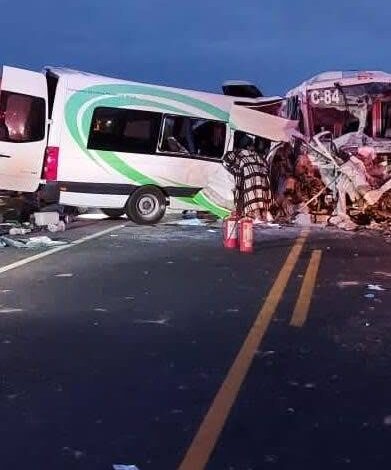
The early morning darkness had barely begun to lift when a devastating collision brought an ordinary workday to a horrifying end. Two buses carrying mine workers collided head-on near a gold mine in the Mexican state of Sonora, leaving 16 people dead and 14 others injured. What should have been a routine journey to or from work suddenly became one of the most tragic road accidents reported in the region that year.
The crash occurred near the entrance to the Noche Buena gold mine, south of the Arizona–Mexico border. Emergency responders were confronted with a devastating scene: two damaged buses blocking a narrow two-lane highway, families waiting for news, and survivors requiring urgent medical attention.
But behind the shocking death toll was another heartbreaking reality. Every person aboard those buses had been travelling as part of an ordinary working day. They were workers with families, responsibilities, personal plans and people expecting them to return home.
As investigators began examining the wreckage, important questions emerged about how the collision happened, why the smaller bus suffered such devastating consequences, and what was known about the workers involved.
The tragedy was reported on April 6, 2021, and the details released by Sonora authorities revealed that the accident involved a passenger bus operated by Movimex and a passenger van operated by Transportes Ejecutivos Premier (TEPSA). The 16 people who died were travelling in the van, while 14 people aboard the bus were injured. This distinction is important because some early reports described the vehicles differently as information was still emerging.
The Collision That Turned a Quiet Highway Into a Disaster
The accident happened at approximately 3:36 a.m. on Tuesday, April 6, 2021, near kilometer 156 of International Highway 2, along the Caborca–Sonoyta route in Sonora, Mexico.
The location was close to the entrance of the Noche Buena gold mine, a mining operation situated south of the Arizona–Mexico border. The highway connects communities across a region where long-distance travel, commercial transportation and industrial activity are important parts of everyday life.
At that hour, most people in nearby communities would have been asleep. The workers travelling in the company transportation vehicles were part of a routine that many employees in remote industrial locations understand well: travelling considerable distances between their accommodation, workplaces and surrounding communities.
Then came the collision.
According to the Sonora State Attorney General’s Office, the emergency was reported at 3:36 a.m. The two vehicles had collided near the mine entrance, leaving a devastating scene that required an immediate response from emergency personnel.
The first reports established that 16 people had died and 14 others had sustained injuries.
The location was particularly significant. The collision occurred on a major highway rather than inside the mine itself. Although the accident was closely connected to transportation serving the mining operation, it was a road disaster that required the intervention of highway authorities, forensic specialists and medical emergency teams.
The distinction also helps explain why the incident attracted attention beyond the immediate mining community.
A tragedy involving 30 people travelling on a regional road raised questions about passenger transportation, vehicle safety and the risks faced by workers who depend on organized transport to reach remote workplaces.
The accident was not simply a story about two damaged vehicles. It was a tragedy involving families, livelihoods and an entire community suddenly confronted with an overwhelming loss.
Two Vehicles, 30 People and a Devastating Outcome
The vehicles involved were identified in reports as a Movimex passenger bus, bearing fleet number C84, and a passenger van operated by Transportes Ejecutivos Premier, commonly referred to as TEPSA.
The Movimex vehicle was transporting personnel associated with the Noche Buena mining operation. The other vehicle was carrying 16 passengers.
The collision proved fatal for everyone travelling in the van.
The 14 people aboard the Movimex bus survived the initial impact but suffered injuries serious enough to require medical attention. They were transported to hospitals in the nearby city of Caborca.
This difference between the two vehicles became one of the most important details in the official account.
The death toll was especially devastating because the smaller vehicle’s occupants were unable to survive the collision. Reports described the van as suffering extensive damage, while photographs from the scene showed severe destruction to the vehicles involved.
For investigators, the condition of the vehicles would become an important part of reconstructing what had happened.
A collision between two passenger vehicles can involve several factors, including vehicle speed, road position, visibility, driver reaction, mechanical condition and the amount of time available to avoid impact.
However, photographs alone cannot establish which of those factors caused this particular accident.
That responsibility belongs to investigators examining the available evidence.
The initial reports established the location, the vehicles and the number of people affected. They did not provide a definitive explanation of the sequence of events leading to the collision.
That distinction is essential when discussing a tragedy of this scale.
The public naturally wants to know why it happened. Families want answers, survivors deserve clarity, and communities need confidence that the circumstances have been examined properly.
But an accurate account must distinguish confirmed information from speculation.
The most certain fact was already heartbreaking enough: 16 people had lost their lives, and 14 others were injured in a single collision near a mining operation.
Emergency Responders Arrived Before Sunrise
Once the accident was reported, emergency personnel were sent to the highway.
The National Guard’s highway division was among the first authorities involved in responding to the scene. Their responsibilities included securing the road, managing traffic and coordinating the initial response.
Red Cross personnel and other emergency services also took part in the operation.
The timing made the response particularly challenging. The collision occurred in the early hours of the morning, when visibility was limited and the surrounding area was still dark.
Rescue workers had to approach a scene involving severely damaged passenger vehicles and numerous casualties.
In major road accidents, the first minutes are especially important.
Emergency teams must determine how many people are involved, identify those who require immediate medical assistance, establish whether anyone remains trapped and organize transportation to suitable medical facilities.
At the same time, highway personnel must protect the scene from additional traffic accidents.
The presence of damaged vehicles on a two-lane highway can create a secondary danger. Drivers approaching the scene may not immediately understand what has happened, especially when the accident occurs at night or before sunrise.
Traffic management therefore becomes an essential part of the emergency response.
In this incident, the injured passengers were taken to medical facilities in Caborca.
The city served as an important nearby destination for treatment because it had hospitals capable of receiving people transported from the accident site.
The rescue operation was only the beginning of a much longer process.
After survivors had been transported, forensic personnel needed to examine the vehicles and identify the people who had died.
Authorities also had to coordinate communication with relatives and establish the official circumstances surrounding the collision.
For the families waiting for news, those hours were undoubtedly among the most difficult of their lives.
A phone call from an authority, a hospital update or confirmation of a person’s identity could change everything.
Behind every number in the official report was someone whose absence would affect an entire family.
The Injured Were Taken to Hospitals in Caborca
The 14 injured passengers were transported to hospitals in Caborca after the collision.
According to the Sonora Attorney General’s Office, the injured people had been travelling in the Movimex bus.
Their reported injuries included significant bruising and fractures.
Although these injuries differed from person to person, they were serious enough to require professional medical evaluation.
Some early reporting also described the bus driver as being in critical condition. This detail illustrates the severity of the impact, although the available reports do not provide a complete medical history or long-term outcome for every injured person.
A person who survives a major collision may face a recovery process that extends far beyond the initial hospitalization.
Fractures can require surgery, rehabilitation and months of physical therapy. Severe bruising and internal injuries may also require continued monitoring.
For survivors, the psychological effects can be just as significant.
People involved in serious accidents sometimes experience anxiety, sleep disturbances, fear of travelling and recurring memories of the collision.
These reactions can affect their ability to return to work or resume everyday activities.
The emotional burden can be especially complicated when survivors learn that other people involved in the same accident did not survive.
A person may leave hospital physically recovering while simultaneously dealing with grief, shock and questions about the event.
Families of the injured also face considerable uncertainty.
They may need to arrange transportation, accommodation, medical expenses and time away from work while supporting a loved one through recovery.
In this case, the 14 injured people were fortunate to survive the immediate collision, but survival did not necessarily mean that their difficulties ended when the emergency vehicles left the highway.
The available reporting confirms that they were taken to hospitals for treatment. It does not establish the complete subsequent recovery of each individual.
That is why it is important not to assume that every survivor recovered quickly or returned to normal life without complications.
The human consequences of a serious accident continue long after the first news reports disappear.
The 16 Victims and the Families Left Behind
The loss of 16 lives was the most devastating part of the incident.
The Sonora authorities confirmed that all 16 people travelling in the TEPSA van died at the scene.
Forensic specialists were assigned to inspect the vehicle and assist in identifying the victims.
Identification is an essential part of any fatal accident investigation.
Authorities must establish the identities of those who died, notify relatives and ensure that official records accurately reflect the circumstances.
The process can be particularly difficult when a vehicle has suffered extensive structural damage.
Forensic teams may need to examine personal belongings, identification documents and other evidence while following established procedures.
In the days following the accident, Mexican media reported that victims came from several different states.
Some reports identified people from Veracruz, while others described connections to the states of Hidalgo, Querétaro and the State of Mexico.
The geographic spread of the victims illustrated how employment and transportation can bring people from distant communities into the same workplace and region.
For families living far from the accident site, receiving information could involve coordinating with authorities across considerable distances.
Some relatives may have been hundreds of miles away when the collision happened.
They had to depend on official communication to understand what had occurred and whether their loved ones were among the dead or injured.
The emotional impact of such news is difficult to express.
A person who leaves home for work may be expected to return after a shift, call a family member or send a message confirming that the journey has gone safely.
When that familiar routine is interrupted by a fatal accident, ordinary expectations become painful memories.
Children may lose parents. Parents may lose adult children. Partners may suddenly face a future that looks completely different from the one they had imagined.
Colleagues may return to a workplace where familiar faces are permanently absent.
The official figure of 16 fatalities provides a numerical record of the tragedy, but it cannot fully represent the individual lives affected.
Each victim had a personal history that extended beyond the road where the collision occurred.
Some had families depending on their income. Others may have been supporting relatives in their hometowns or making plans for the future.
Their deaths left a human loss that cannot be measured by the number of vehicles involved or the distance between two highway markers.
Why the Noche Buena Gold Mine Was at the Center of the Story
The accident attracted particular attention because it happened near the Noche Buena gold mine, an industrial operation in the Caborca area of Sonora.
The mine was owned and operated by Minera Penmont, a Mexican mining company associated with Fresnillo plc, a major mining group with operations in Mexico.
According to the information published by the company, mining operations at Noche Buena had been underway since 2012.
Gold mining is an important economic activity in several parts of northern Mexico. It provides employment opportunities and supports businesses involved in transportation, equipment, maintenance, food services and other industrial activities.
However, mining operations are often located away from major population centers.
This creates a practical challenge for employers and contractors: workers need reliable transportation between their homes, accommodation facilities and the mine.
For employees, transportation can become a regular part of the working day.
Depending on the shift schedule, some workers may travel early in the morning, late at night or during hours when ordinary commercial transportation is limited.
The accident near Noche Buena demonstrated how a transportation incident can affect people connected to an industrial operation even when the collision takes place outside the mine itself.
A workplace may have procedures for equipment safety, protective clothing, emergency response and operational hazards, but employees can still face risks during the journey to and from work.
This is particularly relevant to industries operating in remote areas.
Mining workers often have little control over the transportation arrangements provided for their shifts. They may depend on buses or contracted vehicles selected by employers or service providers.
The quality of those arrangements can therefore become an important part of occupational safety.
Vehicle maintenance, driver qualifications, passenger capacity, rest periods and route planning all contribute to the safety of workers travelling on public roads.
The Noche Buena accident brought these issues into public discussion because the consequences were so severe.
It also highlighted the relationship between companies, transportation contractors and the wider community.
When a vehicle operated by a contractor is involved in a major accident, several questions may arise about responsibility, supervision and the standards required for passenger transportation.
Those questions must be addressed through evidence and applicable law rather than assumptions.
The Company and Its Response to the Tragedy
The Noche Buena mine was associated with Minera Penmont, while the passenger vehicles identified in reports were operated by separate transportation companies.
The Arizona Republic reported that Fresnillo did not immediately respond to a request for comment at the time of its publication.
Other Mexican news coverage reported that Penmont expressed condolences and said it was cooperating with the relevant authorities following the incident.
The company’s involvement was important because the accident affected transportation connected to its mining operation.
When a serious accident involves employees or contractors working for an industrial operation, companies are expected to communicate with affected families, cooperate with investigations and review any safety concerns that emerge.
Such situations often require coordination between several parties.
The transportation operator may need to provide vehicle records, driver information and operational documents.
The mining company may need to assist in identifying workers, contacting relatives and arranging support.
Medical facilities must provide appropriate treatment, while public authorities investigate the collision and determine whether any laws or regulations were violated.
These responsibilities are not interchangeable.
A company statement expressing sympathy does not establish the cause of an accident, just as the presence of a vehicle belonging to a particular operator does not automatically establish legal responsibility.
Investigators must examine the circumstances and evidence before reaching conclusions.
In the aftermath of the Noche Buena collision, the most immediate concern was the welfare of survivors and the identification of those who had died.
The wider questions surrounding transportation safety and responsibility required a separate process.
For the families affected, however, the distinction between corporate statements and official findings did little to lessen the pain of losing someone they loved.
They needed answers, support and assurance that the circumstances would be examined seriously.
What Investigators Needed to Establish
After the initial rescue operation, forensic personnel were tasked with examining the two vehicles.
This examination was important because the physical evidence could help establish how the collision occurred.
Investigators examining a serious head-on collision generally consider several categories of evidence.
The condition of the vehicles
The damage to the front sections, doors, passenger compartments, steering systems and braking components can provide information about the forces involved.
Investigators may also examine whether any mechanical defect contributed to the accident.
A damaged vehicle does not automatically indicate a mechanical failure. The damage may simply be the result of the collision itself.
The position of the vehicles
The final position of the vehicles can help investigators understand where the collision occurred and how the vehicles moved afterward.
Road markings, debris distribution and physical damage may help establish the direction of travel.
The condition of the road
Investigators may examine the road surface, visibility, lighting, signs, road markings and any nearby obstacles.
The time of the accident is also relevant.
At approximately 3:36 a.m., natural daylight would have been limited. However, the precise visibility conditions at the time cannot be established from the time alone.
Driver and operational records
Investigators may also need to review driver qualifications, work schedules, rest periods, vehicle inspection records and other relevant documents.
These records can help establish whether the vehicles were operating in accordance with applicable requirements.
Witness accounts
Witnesses may provide information about the vehicles’ movements before the impact.
Their accounts can be compared with physical evidence and other available records.
The investigation must consider all relevant information before determining the sequence of events.
It would be irresponsible to state that speeding, fatigue, poor visibility or mechanical failure caused the Noche Buena accident without verified findings supporting that conclusion.
The initial news reports established the fatal collision and the number of casualties. They did not provide a complete, final reconstruction of the accident.
That is an important limitation when looking back at the event.
The public deserves accurate information, particularly when a story involves so many deaths.
A Dangerous Journey Along an Important Regional Highway
The accident occurred on International Highway 2, along the Caborca–Sonoyta section of the road.
The highway is part of an important transportation route in northern Sonora.
It connects communities and supports the movement of commercial vehicles, private motorists and passengers travelling between different parts of the region.
The road also serves industrial operations and businesses that depend on transportation to move workers and supplies.
Unlike a busy urban street, a highway in a relatively remote area may have long stretches between population centers and emergency facilities.
This can make serious accidents especially challenging.
When a collision occurs far from a large hospital, injured passengers may need to be transported to another town.
The distance between the accident site and medical facilities can influence the organization of emergency services.
It also means that authorities need to coordinate carefully to ensure that ambulances can reach the scene and transport injured people without unnecessary delays.
Another challenge is the variety of vehicles using the same highway.
Passenger buses, commercial trucks, private cars and smaller transportation vans may all share the same road.
Their size, weight, speed and handling characteristics are different.
When two vehicles collide head-on, the consequences can be particularly severe because the forces of impact can combine.
The structural protection available to passengers also varies depending on the type of vehicle.
A passenger bus and a smaller van do not necessarily provide the same level of protection during a major collision.
However, the exact reasons that one vehicle suffered a more devastating outcome in this incident would require a technical examination of the vehicles and collision dynamics.
The Noche Buena tragedy therefore raised an important question for transportation safety: how can passenger journeys on remote highways be made safer?
There is no single measure that eliminates every risk.
Nevertheless, road safety programs generally emphasize driver training, appropriate vehicle maintenance, passenger protection, safe driving speeds and effective enforcement.
These measures are particularly important for commercial transportation operators whose vehicles carry multiple passengers every day.
Why Early-Morning Transportation Requires Particular Attention
The timing of the collision deserves attention.
The accident happened shortly before dawn, at approximately 3:36 a.m.
For many industries, working hours do not follow the traditional morning-to-evening schedule.
Mining operations may run around the clock, requiring employees to work different shifts.
Transportation arrangements must accommodate those schedules.
As a result, some workers travel when most people are asleep.
Driving during the early morning hours can present several challenges.
Human alertness follows a natural daily rhythm. During the biological night, people may experience reduced alertness and increased sleepiness.
Long working hours and insufficient rest can make the situation more difficult.
Professional drivers therefore need appropriate rest periods and schedules that reduce the risk of fatigue.
Transportation companies also have a responsibility to maintain vehicles and establish operational procedures that support safe journeys.
Passengers, meanwhile, should have access to functioning seat belts where required and should be transported in vehicles designed and approved for their intended use.
These principles are relevant to many industries, not only mining.
Workers in construction, manufacturing, agriculture and other sectors may also depend on early-morning transportation.
The Noche Buena accident cannot be attributed to fatigue simply because it occurred before sunrise.
There is no sufficient evidence in the initial reports to make that claim.
Nevertheless, the timing illustrates why driver alertness and safe scheduling deserve attention in any broader discussion about transportation.
A responsible safety review must consider the full circumstances rather than selecting one possible explanation.
The Wider Impact on the Mining Community
A major accident can affect an entire industrial community, even when only a relatively small number of vehicles are directly involved.
The Noche Buena mine and the surrounding region depended on a network of employees, contractors and transportation services.
When 16 people died and 14 others were injured, the consequences extended beyond the immediate crash site.
Colleagues had to confront the loss of people who may have shared their shifts, transportation arrangements and everyday workplace experiences.
Supervisors and managers faced the responsibility of communicating with employees and families.
Transportation contractors had to deal with an accident involving their vehicles and passengers.
Local hospitals had to provide treatment to those injured.
Emergency responders had to carry out a difficult operation under demanding circumstances.
The community also had to process the emotional consequences.
In close working environments, people often develop relationships that go beyond formal employment.
They may travel together every day, share meals, discuss family responsibilities and support one another through difficult shifts.
A familiar passenger who regularly sits in the same seat can become part of a person’s daily routine.
When such people suddenly disappear, the workplace itself can feel different.
For those who survived the collision, returning to a familiar transportation route or workplace may also become emotionally difficult.
The road where the accident happened may remain associated with fear and grief.
These effects are not always visible in official casualty reports.
A report can state that 16 people died and 14 were injured, but it cannot measure the emotional consequences experienced by families, friends and colleagues.
That is why the human dimension of industrial transportation accidents deserves attention long after the initial headlines fade.
Why the Accident Attracted Attention Beyond Sonora
The Noche Buena accident was reported by several Mexican and American news organizations.
Its location near the international border made it relevant to readers on both sides of the region.
The Arizona Republic covered the incident under a headline reporting 16 deaths and 14 injuries near a mine south of the Arizona–Mexico border.
Mexican media also reported extensively on the collision, including details released by the Sonora Attorney General’s Office.
The coverage highlighted the scale of the tragedy and the fact that the people involved were travelling in vehicles associated with transportation serving the mining operation.
The border location may have attracted additional attention because the highway forms part of a larger transportation network connecting communities in northern Mexico.
However, the accident itself occurred in Sonora, Mexico. It was not an accident inside Arizona or at a United States border crossing.
This geographical distinction is important because dramatic headlines sometimes create the impression that an event happened directly at the border.
The Noche Buena mine was located south of the border, and the collision took place on the Caborca–Sonoyta highway.
The incident was therefore a Mexican road tragedy with regional significance.
It also demonstrated how a local accident can attract international attention when the number of casualties is high and the location is close to a major international boundary.
For readers unfamiliar with the area, the name of the mine and the highway may initially mean very little.
But the basic circumstances were straightforward: two passenger transportation vehicles collided near a mining operation, 16 people died, and 14 others were injured.
That was the central story reported in April 2021.
Road Safety Lessons That Cannot Be Ignored
Although the collision happened in 2021, the questions it raised remain relevant to passenger transportation today.
Road accidents involving commercial vehicles are particularly serious because a single incident can affect many people at once.
A private car may carry only a few passengers. A passenger bus or transportation van can carry a much larger group, meaning that a single collision has the potential to produce numerous casualties.
For companies that arrange transportation for employees, safety should be treated as an essential part of their operations.
One important consideration is the condition of vehicles.
Passenger vehicles should undergo regular inspections, and any mechanical problems that could affect safe operation should be addressed before the vehicle returns to service.
Braking systems, tires, steering components, lights and structural safety features all require attention.
A vehicle that appears acceptable from the outside may still have mechanical problems that are not immediately visible.
Driver training is another important factor.
Commercial drivers must be prepared to operate their vehicles under different road and weather conditions. They also need to understand how to respond when unexpected situations arise.
Safe driving involves more than controlling a vehicle.
Drivers must maintain an appropriate following distance, observe speed limits, remain attentive and avoid unnecessary risks when passing other vehicles.
Fatigue management is equally important.
A driver who has worked for an extended period may experience reduced concentration and slower reaction times.
Companies operating transportation services should establish schedules that allow drivers sufficient rest and should have procedures for addressing signs of fatigue.
Passenger protection also deserves attention.
Seat belts, appropriate seating arrangements and compliance with vehicle capacity requirements can influence the consequences of an accident.
The availability of emergency equipment and clear procedures for reporting accidents can also improve the response when something goes wrong.
None of these measures can guarantee that a collision will never happen.
However, they can help reduce risks and improve the chances of protecting passengers.
The Noche Buena tragedy is a reminder that transportation safety should never be treated as a secondary responsibility simply because a journey is part of an ordinary working day.
For the people travelling to a remote workplace, the journey is an essential part of their employment experience.
They should be able to expect that reasonable precautions have been taken to protect them.
The Importance of Supporting Families After a Fatal Accident
When a major accident occurs, attention naturally focuses on the immediate emergency.
People want to know how many died, how many survived and what emergency responders are doing.
But after the initial response, families face a different set of challenges.
For relatives of the victims, the process of receiving official confirmation can be emotionally overwhelming.
They may need to travel to another city, communicate with authorities, complete documentation and make arrangements for funeral services.
Families of injured passengers may face medical expenses, rehabilitation requirements and uncertainty about the future.
In some cases, the injured person may be the primary income earner in the household.
A serious accident can therefore create financial difficulties in addition to physical and emotional suffering.
Support following such an event may involve several different organizations.
Authorities are responsible for official procedures and investigations.
Employers and relevant contractors may need to communicate with affected families and provide assistance according to their responsibilities.
Hospitals provide medical treatment, while social services and community organizations may help families manage practical difficulties.
The emotional needs of survivors also deserve attention.
A person who has witnessed a fatal accident may experience psychological distress even if they have no serious physical injuries.
Professional counseling can help survivors and relatives process grief, anxiety and traumatic memories.
It is important not to assume that everyone responds to tragedy in the same way.
Some people may want to talk about what happened, while others may need privacy and time.
Children in affected families may require particular support because they may struggle to understand sudden loss.
For communities connected to the mining operation, remembering the victims and supporting surviving families can become part of the longer process of recovery.
The accident may have lasted only moments, but its consequences could remain with those affected for years.
Remembering the 16 People Who Never Returned Home
There is a tendency for major accidents to become defined by numbers.
Sixteen dead.
Fourteen injured.
Two vehicles.
One highway.
Those figures are essential to understanding the scale of the Noche Buena disaster, but they represent only the beginning of the story.
The 16 people who died were individuals with different backgrounds, families and personal experiences.
They may have had parents waiting for their calls, children expecting to see them, partners planning their next day together or relatives who depended on their support.
Their journeys that morning were part of ordinary life.
Nobody expects a routine transportation trip to become the final journey of someone they love.
For the people who survived, the event may have permanently changed how they view road travel.
For families, the memories of the accident may remain connected to a particular date, a telephone call or the moment they received devastating news.
The surrounding community also experienced the loss.
When an accident affects people connected to the same workplace, its impact can be felt among colleagues who continue working long after the emergency has ended.
A familiar face may no longer appear at the workplace.
A regular seat on a transportation vehicle may remain empty.
Conversations about ordinary plans may suddenly become memories.
These are the human consequences that cannot be fully represented by an official casualty figure.
The Noche Buena accident deserves to be remembered not because of sensational photographs or dramatic headlines, but because of the people whose lives were lost and the families who had to continue without them.
What We Know About the Accident Today
Looking back at the reports published in April 2021, several important details can be established.
Date: April 6, 2021.
Time: Approximately 3:36 a.m.
Location: Kilometer 156 of International Highway 2, on the Caborca–Sonoyta route in Sonora, Mexico.
Nearby landmark: Entrance to the Noche Buena gold mine.
Vehicles involved: A Movimex passenger bus and a TEPSA passenger van.
Fatalities: 16 people travelling in the van.
Injuries: 14 people travelling in the Movimex bus.
Emergency response: The National Guard highway division, Red Cross personnel and other emergency services responded.
Medical treatment: The injured passengers were transported to hospitals in Caborca.
Investigation: Sonora authorities assigned forensic personnel to examine the vehicles and investigate the collision.
These details are supported by contemporaneous reporting and information attributed to the Sonora Attorney General’s Office.
There are also important details that should not be presented as established facts.
The initial reports do not provide a definitive explanation of which driver caused the collision.
They do not establish that excessive speed, fatigue or a mechanical failure was responsible.
Nor do they provide a complete account of the subsequent medical recovery of every injured passenger.
The available reporting establishes the immediate tragedy, but it should not be expanded into claims that cannot be independently supported.
This distinction is especially important when reporting fatal accidents.
Families deserve accurate information, and readers should not be encouraged to accept speculation as an official finding.
The central facts are already serious enough to explain why the incident attracted so much attention.
A Tragedy That Remains a Reminder of the Human Cost of Road Accidents
The collision near the Noche Buena gold mine was one of the devastating road accidents reported in Sonora in 2021.
It involved people travelling as part of an ordinary transportation routine, yet its consequences were anything but ordinary.
Sixteen people died, and 14 others were injured.
Emergency workers faced a difficult operation before sunrise. Hospitals in Caborca received injured passengers. Authorities began the process of examining the vehicles and identifying those who had lost their lives.
The accident also brought attention to the responsibilities associated with transporting workers and passengers along regional highways.
For those who lost loved ones, the tragedy was not simply a news event that ended when the headlines disappeared.
It was a permanent change to their families and their futures.
For survivors, it was an experience that may have affected their health, confidence and everyday lives.
And for the wider community, it was a reminder that every passenger journey carries responsibilities that should never be taken lightly.
The road near Noche Buena continued to serve people travelling through Sonora, but the events of April 6, 2021, left a painful memory associated with that stretch of highway.
Behind the reported numbers were 30 people whose lives were suddenly changed by one collision.
Sixteen never returned home.
Fourteen had to begin the difficult process of recovery.
Their story deserves to be told with accuracy, compassion and respect.