MY GRANDMA WAS THE CHEAPEST WOMAN IN THE WORLD!
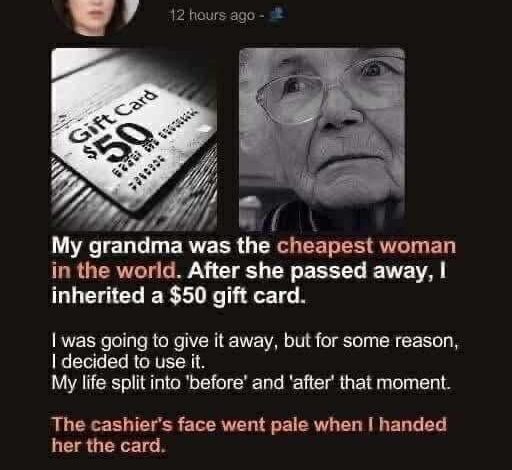
My grandmother was the cheapest woman I’d ever met—or at least, that’s what we all thought. She reused wrapping paper, collected spare buttons in jars, and once cut paper towels into quarters “to make them last.” When she passed away, her frugality was almost a family joke.
So when I found a $50 gift card among her belongings, I laughed. “Classic Grandma,” I said to myself. I almost threw it away but decided to use it on a grocery run instead. That one small decision split my life into before and after.
The moment I handed the card to the cashier, everything changed.
She slid it through the reader, froze, and looked up at me like I’d just handed her a winning lottery ticket. Her face drained of color. “Where did you get this?”
“It was my grandma’s,” I said slowly. “Why? Is something wrong?”
The cashier’s eyes darted toward her manager, then back at me. “Don’t move,” she said quietly, before raising her voice. “Stop everything!”
The store went silent. Conversations cut off mid-sentence. Carts stopped rolling. I could feel every eye on me. My stomach dropped.
The manager—a composed woman in her fifties—hurried over. The cashier whispered something to her. The manager’s gaze locked on the card. “Sir,” she said, calm but firm, “could you come with me for a moment? We need to talk privately.”
I followed her to a small office at the back of the store, my heart hammering. She gestured to a chair and asked for my grandmother’s name.
“Margaret Harper,” I said, my voice unsteady. “She passed away a few weeks ago. Is this about the card?”
For a moment, the manager just stared at me, then exhaled softly. “So it’s true,” she murmured. “She really existed.”
I frowned. “What do you mean, she ‘existed’? Of course she did—she was my grandmother.”
The woman leaned forward, eyes kind but sharp. “Around here, your grandmother was known by another name. We called her The Angel in Disguise.”
I blinked, trying to process that. “That can’t be right. My grandma was… cheap. She hoarded coupons and scolded me for leaving lights on.”
The manager smiled faintly. “That’s what she wanted people to think. But Margaret Harper had a heart bigger than this store. She spent years buying gift cards—like the one you’re holding—and quietly leaving them for people who needed help. Single parents, laid-off workers, struggling families. No one ever knew who she was, and she wanted it that way.”
My throat tightened. “You’re telling me my grandmother secretly gave money away?”
“She did,” the manager said gently. “Every few weeks, she’d come in, buy a few cards, and ask us to keep them on hand for anyone who needed groceries but couldn’t afford them. She never took credit, never wanted attention. Then one day, she just stopped coming. We wondered what had happened to her.”
I sat in stunned silence, memories flooding my mind. My grandmother, who patched old clothes and refused to replace a broken toaster, had been quietly saving people from hunger. She’d scolded me for wasting money not because she was greedy—but because she knew how far every dollar could stretch.
“But why did the cashier react like that?” I asked. “Why stop the whole store?”
The manager pulled out a folder from her drawer and slid it across the desk. Inside was a list of serial numbers, handwritten notes, and receipts. At the top, one number matched the card in my hand.
“This was the last one she bought,” the manager explained. “We thought it was lost. It’s been ten years since she purchased it, and it’s never been used. Normally, cards like this expire or get tossed—but not this one. It was fully loaded. It’s like it was waiting for you.”
Tears welled up in my eyes. I traced my finger over the paper, imagining my grandmother at that counter, quietly paying for a stranger’s groceries, smiling to herself. “She never told us,” I whispered.
“She wouldn’t,” the manager said. “She didn’t do it for recognition. She did it because she believed kindness should be quiet.”
I left the store in a daze, clutching the card like a relic. For days, I couldn’t stop thinking about her. Every thrift-store sweater, every reused gift bow—it all made sense now. She’d lived small so she could give big.
A week later, I walked into a small diner my grandmother used to love. I ordered a coffee and sat by the window, trying to feel close to her. That’s when I saw a young woman at the counter, her face tight with worry, counting coins while balancing a baby on her hip.
Something in me shifted. I stood, walked over, and held out the gift card. “Here,” I said. “I think this is meant for you.”
Her eyes widened. “What? I can’t take that.”
“Please,” I said softly. “It belonged to my grandmother. She used to help people without them knowing. I think she’d want you to have it.”
The woman hesitated, then took it with trembling hands. “Thank you,” she whispered. “You have no idea how much this helps.”
“I think I do,” I said, smiling through tears.
That moment changed me. I realized my grandmother’s greatest lesson wasn’t thrift—it was generosity disguised as simplicity. She gave what she could, quietly, consistently, without ever expecting anything in return.
In her honor, I started something new: The Margaret Project. A small fund dedicated to helping local families in need—sometimes with gift cards, sometimes with groceries, sometimes with rent support. Every time I give, I think of her hands, worn and careful, counting every penny not for herself but for others.
And every time I see someone struggling, I remember her motto—one she never said aloud, but lived every day: you don’t need wealth to make the world better; you just need heart.
My grandmother wasn’t the cheapest woman in the world. She was the richest—in compassion, in grace, in quiet strength.
She showed me that real generosity doesn’t announce itself. It whispers. It waits. It lives on in the choices we make after the people who taught us kindness are gone.
Now, when I pay for someone’s groceries, or slip a bill into a stranger’s hand, I feel her beside me. Not as a memory, but as a reminder—that sometimes, the smallest acts of giving create the biggest ripples of love.
So yes, my grandmother was cheap—cheap with herself, so she could be endlessly generous with the world. And that’s a kind of wealth I can only hope to live up to.