Legal Experts React To Trumps Third Term Idea
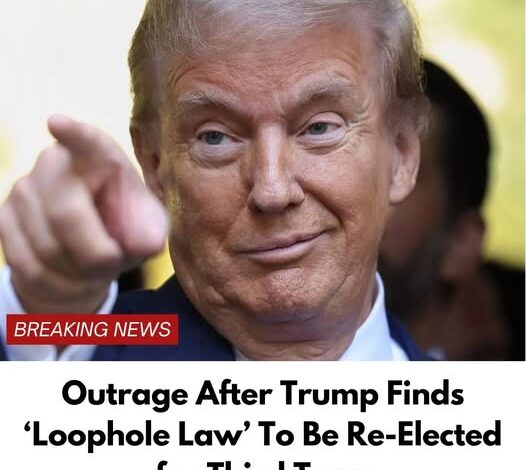
Donald Trump has never been shy about testing the limits of political convention — or the Constitution itself. His latest comments, suggesting there might be ways for him to serve a third term as president, have reignited a storm of debate across Washington and beyond. While his words may have been half in jest, constitutional scholars and legal analysts are taking them seriously — and their verdict is nearly unanimous: it can’t be done.
At a campaign event last week, Trump hinted that a third term wasn’t entirely off the table, remarking that “some people are saying” it could be possible under certain circumstances. He didn’t outline a concrete plan, but he left just enough ambiguity to fuel speculation online. Within hours, headlines and pundits were dissecting what exactly he might have meant — and whether any “workaround” could exist in the nation’s founding laws.
The U.S. Constitution is explicit on this matter. The 22nd Amendment, ratified in 1951 after Franklin D. Roosevelt’s unprecedented four terms, states: “No person shall be elected to the office of the President more than twice.” It’s one of the clearest and most unambiguous restrictions in the entire document. Still, Trump’s remarks — and his allies’ subsequent commentary — raised a question that, while improbable, has now entered the national conversation: could there possibly be a loophole?
Some of Trump’s former advisers have floated creative — and legally dubious — ideas. One suggestion was that Trump could run in 2028 as a vice-presidential candidate alongside a trusted ally. If that running mate were to win and then resign, Trump could, in theory, assume the presidency again. It’s a move that would hinge on exploiting the line of succession rather than direct election.
But legal scholars immediately shut down that notion. The 12th Amendment clearly bars anyone who is ineligible to serve as president from holding the office of vice president. In other words, if you can’t legally be president, you can’t be vice president either. That amendment was written precisely to prevent this kind of constitutional end-run.
“The idea that a two-term president could sneak back into power through the vice presidency is constitutionally absurd,” said Laurence Tribe, a constitutional law professor at Harvard. “It’s not a gray area — it’s a hard stop. The Founders foresaw power-hungry leaders and designed the system to prevent them from rewriting the rules midgame.”
Other analysts have been more blunt. “There’s no loophole,” said Richard Pildes, a law professor at New York University. “Once you’ve been elected twice, that’s it. The only way around it would be to amend the Constitution — and that’s not happening in our lifetime.”
Even among Trump’s base, reactions have been mixed. While some supporters have brushed off the comment as typical Trump showmanship — another instance of him “trolling the media” — others have taken it as a serious proposition. On social media platforms, Trump-aligned influencers have amplified the idea, claiming that the Constitution only restricts being “elected” twice, not serving more than twice. That distinction, however, is a semantic illusion. The law doesn’t allow for a third term under any condition, regardless of how one enters office.
Democrats, for their part, responded swiftly and sharply. “This isn’t about jokes or legal theory,” said Senator Cory Booker. “When a former president starts floating the idea of a third term, that’s an authoritarian dog whistle. It’s a test balloon — and we’ve seen where that leads in other countries.” Representative Jamie Raskin, who served on the January 6th Committee, echoed the concern: “The Constitution is not a buffet. You don’t get to pick and choose which amendments apply to you.”
The controversy underscores a recurring pattern in Trump’s political playbook — pushing boundaries to see how far they bend before they break. From questioning the results of the 2020 election to challenging judicial independence, Trump has often blurred the line between political rhetoric and constitutional defiance. To his critics, the third-term talk is another step in normalizing the once unthinkable.
Trump himself later clarified that he wouldn’t pursue such a scenario with his current running mate, Senator JD Vance, calling him “a great friend” and saying he’d never put him in that position. But the remark came only after days of public backlash and extensive media coverage. Whether he meant it seriously or not, the episode reminded many Americans that Trump remains willing — even eager — to test the legal and moral guardrails of American democracy.
Behind the noise lies a deeper political truth. Trump’s suggestion of a third term, however implausible, taps into the populist energy that has long powered his movement — the idea that rules and institutions are obstacles to the will of “the people.” By hinting at constitutional rebellion, even in jest, Trump reinforces his image as the outsider unafraid to challenge the establishment.
Still, legal experts stress that the system, for now, remains intact. The 22nd Amendment is ironclad. To repeal or alter it, Congress would need to pass a new amendment with two-thirds support in both chambers, followed by ratification from three-quarters of the states. In today’s polarized climate, that’s virtually impossible.
Some constitutional historians have drawn parallels to past strongmen abroad — leaders who used similar rhetoric to justify extending their power. Vladimir Putin, for instance, amended Russia’s constitution to allow himself to stay in office until 2036. China’s Xi Jinping abolished presidential term limits entirely in 2018. While the U.S. political system is far more resilient, the mere suggestion of a third term by a former president serves as a reminder that even democracies are only as strong as their collective commitment to the rule of law.
“Democracy doesn’t collapse overnight,” said political analyst Ruth Ben-Ghiat. “It erodes when leaders start joking about authoritarian ideas, and followers start taking those jokes seriously.”
For now, Trump’s musings about another run beyond 2028 remain legally impossible — but politically potent. The controversy has reignited debates about the limits of presidential power, the durability of the Constitution, and the fragility of norms that once seemed unquestionable.
Whether Trump intended to spark that conversation or simply stir outrage, he’s succeeded. And as the nation barrels toward another heated election season, one thing is clear: the boundary between performance and ambition in American politics has never been thinner.