My Parents Canceled My Graduation Party Because My Brother Felt Left Out So I Walked Away With One Duffel Bag
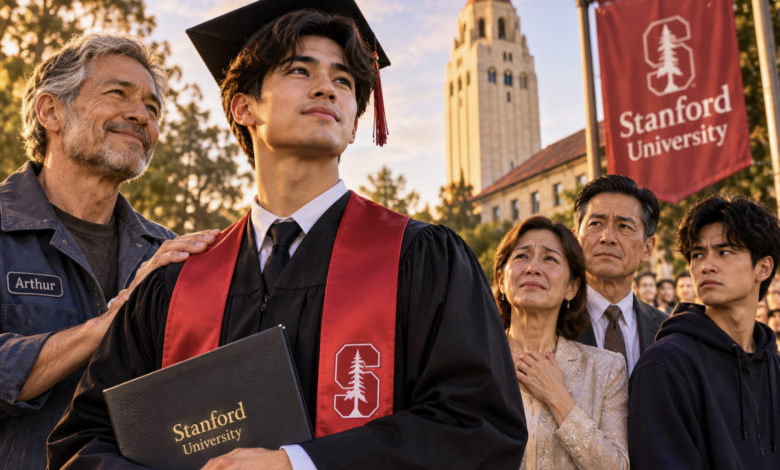
My parents canceled my graduation party because my brother felt “left out”—so I walked out with one duffel bag, a secret Stanford letter, and years later they watched the son they erased become the name everyone in town was talking about
My mother canceled my graduation party while I was still wearing my grocery store uniform.
I remember the smell first.
Cardboard boxes. Floor wax. Sweat dried into the collar of a cheap polo shirt after a fourteen-hour shift.
I had just come home tired enough to feel my bones ache, but I was still smiling because the invitations were finally on the table.
Cream-colored cardstock.
Gold lettering.
My name printed across the front like it mattered.
Julian Reynolds.
Valedictorian.
Stanford-bound.
The kind of thing most parents would put on the refrigerator, talk about at church, brag about to every neighbor within earshot.
My mother had ordered those invitations from a fancy stationery boutique downtown. Nearly two hundred dollars for paper and gold ink, she told everyone. She made it sound like proof that she cared.
Then she folded her manicured hands over the stack and looked at me like she was about to discuss the weather.
“Julian, your brother has been feeling really left out lately.”
I stood there in the kitchen doorway, still holding my work bag.
“What?”
She sighed.
That soft, disappointed sigh she used whenever she wanted to make me feel cruel for needing anything.
“Leo thinks everyone is making too big a deal about your graduation. We’re going to postpone the party indefinitely.”
Indefinitely.
That was the word she used.
Not cancel.
Not ruin.
Not erase.
Postpone indefinitely.
My younger brother Leo was nineteen years old. He had dropped out of community college twice, spent most of his days gaming upstairs, and ate groceries I bought with money from my shift.
But somehow, my graduation was the problem.
My father came home right then, dropped his briefcase by the door, loosened his tie, and looked from my mother to me.
He didn’t ask what happened.
He just joined the side he always joined.
“Don’t be selfish,” he said. “Sometimes you make sacrifices for family.”
Sacrifices.
I almost laughed.
I had sacrificed my childhood in that house.
I bought my own car when I was sixteen, a rusted 2009 Honda Civic that shook whenever it rained.
I paid for my own insurance.
My own gas.
My own school supplies.
When I needed a twenty-dollar AP textbook, my mother told me money was tight.
Two weeks later, my parents leased Leo a brand-new luxury sedan because they wanted him to “focus on his social life.”
When I got accepted to Stanford on a scholarship, my mother glanced at the letter like it was junk mail.
When Leo bought an electric guitar he played three times, they cleared space in the living room and called him gifted.
That was our family.
Leo was the sun.
I was the shadow they blamed for blocking the light.
So when my father stood there and told me I was being dramatic over “one little party,” something inside me finally went quiet.
Not angry.
Not broken.
Quiet.
A clean break.
I looked at my mother and said, “Cancel it.”
Her face softened with relief.
Not guilt.
Relief.
“Thank you for understanding,” she said.
I went upstairs, locked my bedroom door, and opened my banking app.
$9,154.
Every dollar from bagging groceries, mowing lawns, shoveling driveways, skipping lunch, buying nothing I didn’t need.
Freedom, in green numbers.
I pulled my duffel bag from under the bed and packed fast.
Clothes.
Documents.
Birth certificate.
Social Security card.
Bank statements.
Stanford acceptance letter.
The proof that I existed outside that house.
When I walked downstairs with the bag on my shoulder, my mother stepped out of the kitchen holding a wooden spoon.
“Where do you think you’re going?”
“For good.”
My father stood so fast the leather couch creaked.
“If you walk out that door,” he said, his face turning red, “don’t bother coming back. You get nothing from us.”
He expected fear.
He expected the old Julian.
The boy who apologized for taking up space.
The son who swallowed every insult just to keep the house quiet.
I looked at both of them.
Then I said, “Okay.”
I walked out.
No screaming.
No slammed door.
Just the sound of my duffel hitting the passenger seat of my old Civic.
The first person who called me was Uncle Arthur.
My father’s older brother.
The black sheep.
The mechanic.
The man my parents looked down on because he smelled like motor oil instead of expensive cologne.
He didn’t ask for a speech.
He just said, “Send me your location.”
Twenty minutes later, he was sitting across from me in a 24-hour diner, pushing a plate of greasy fries toward me while I told him everything.
Nineteen years of it.
He listened in silence.
Then he said, “You’re staying with me until you leave for California.”
That was the first time an adult in my family chose me without asking what it would cost.
A few weeks later, I flew to Stanford with one suitcase and the kind of peace that scares you because you’re not used to it.
California felt unreal.
Warm air.
Eucalyptus trees.
People who asked what I wanted to study and actually listened when I answered.
I was no longer Leo’s problem.
I was just Julian.
I worked hard because work was the only language I trusted.
I studied late.
Ate cheap noodles.
Lived off scholarship money and whatever I had saved.
Then I met Marcus, my roommate from Chicago, who became more like a brother than Leo ever had.
For months, my parents said nothing.
Then Thanksgiving came.
A package arrived at my dorm.
Inside was an expensive Stanford sweatshirt, store-bought cookies, and a note in my mother’s perfect handwriting.
“We miss you. Wear this so everyone knows where you belong.”
No apology.
No “we were wrong.”
No “we hurt you.”
Just a sweatshirt they could imagine me wearing in photos.
That was when I understood.
They didn’t miss me.
They missed owning my story.
By spring, my life changed again.
I earned a paid research position under Dr. Sterling, one of the most respected psychology professors at Stanford. She read my essay on childhood emotional neglect and family scapegoating, called me into her office, and offered me the job on the spot.
The university alumni page shared my photo.
Then my hometown news picked it up.
“Local Graduate Makes Waves At Stanford Research Lab.”
That headline did what years of silence never could.
It made my family want me back.
My mother called, voice sweet as frosting.
She said everyone was proud.
She said the neighborhood wanted to throw me a belated celebration.
A party.
Now.
Now that I was useful.
Now that I was shiny enough to display.
I told her no.
Two days later, Leo posted about me online.
A long, ugly story.
He said I abandoned a loving family because Stanford made me arrogant.
He said I demanded a luxury car.
He said I stole money.
He said my mother cried for weeks and my father ended up in the hospital because of me.
And the worst part?
People believed him.
Old classmates.
Neighbors.
Even Sarah, a girl who used to sit with me at lunch, commented that she always knew something was “off” about me.
My mother shared the post.
Aunt Evelyn shared it.
The whole town watched my brother turn my escape into his victim story.
I sat in my dorm at two in the morning, staring at the screen while the lies multiplied.
Marcus stood beside me, jaw tight.
“What are you going to do?” he asked.
Every part of me wanted to fight.
To post receipts.
To scream the truth.
To tell the world exactly what they had done.
Instead, I closed the laptop.
Because I knew something they didn’t.
The truth had witnesses.
And by sunrise, the first one was about to speak…
PART 2: At 7:13 the next morning, my phone started vibrating so violently against my desk that it nearly fell onto the floor. I had barely slept. The night before, I had watched my own brother turn years of my life into a collection of lies. He had painted himself as the abandoned son, my parents as heartbroken victims, and me as an ungrateful young man who had supposedly walked away from a loving family because I thought I was better than everyone else. And the worst part was that he had made the story believable. People didn’t know what happened behind our front door. They didn’t know how many nights I had gone to bed hungry because I was saving money for college applications. They didn’t know that the car my parents supposedly bought for me was actually a twelve-year-old Honda I paid for myself. They didn’t know that the grocery store uniform I wore every weekend was the same uniform I wore when I came home to find my graduation party canceled… SAY “”YES”” IF YOU WANT TO READ THE FULL STORY
### PART 3
They didn’t know anything.
But they were already judging me.
I picked up my phone.
There were thirty-seven missed notifications.
Then I saw a message from Uncle Arthur.
**Arthur:** Don’t respond to anything your brother posted. I know what happened. And I think it’s time people heard the truth. Call me.
I immediately called him.
He answered on the first ring.
“Morning, kid.”
His voice sounded different.
Not angry exactly.
More like someone who had finally decided he was done keeping a secret.
“Uncle Arthur, have you seen what Leo posted?”
“I have.”
“Everyone thinks I stole money from my parents. He even said Dad was hospitalized because of me.”
Arthur was silent for a moment.
Then he asked, “Do you remember the summer before your senior year?”
I frowned.
“Which summer?”
“The summer you worked double shifts at the grocery store because you wanted to save enough money for Stanford.”
“Yeah. What about it?”
“Your father came to my garage that summer. He asked me for money.”
I sat up straighter.
“Why?”
“Because he had spent the money he was supposed to use for your college application fees.”
I stared at the wall.
“What?”
Arthur continued.
“Your father told me he needed money to cover an emergency. I gave him two thousand dollars. He said it was for your education.”
My stomach tightened.
“Did he ever tell you what happened to that money?”
“No. But a few months later, I found out he had used most of it to help Leo buy that gaming setup.”
I closed my eyes.
The gaming computer.
The expensive monitor.
The mechanical keyboard.
The special chair.
I remembered all of it.
I remembered asking my father for thirty dollars to pay for an application fee and being told I needed to learn responsibility.
I remembered Leo receiving a gaming setup worth thousands of dollars for his nineteenth birthday.
And I remembered my mother telling me that his happiness mattered because he had been struggling emotionally.
“Arthur,” I whispered, “why didn’t you tell me?”
“Because I didn’t want to destroy your relationship with your parents. I thought your father would eventually make things right.”
He sighed.
“That was my mistake.”
For a moment, neither of us spoke.
Then he said something that changed everything.
“Julian, I still have the bank transfer receipt. And I have the text messages your father sent me about the money.”
My heart began beating faster.
“Why?”
“Because your father never paid me back. And when I asked him about it, he told me I should stop interfering in his family.”
I looked at my laptop.
Leo’s post was still open.
Hundreds of comments.
Hundreds of people discussing a family they knew nothing about.
“Uncle Arthur, I don’t want to start a public fight.”
“Then don’t.”
“What do you mean?”
“Let people speak for themselves. You don’t have to become like them to prove they were wrong.”
That sentence stayed with me.
I thanked him and ended the call.
But I wasn’t ready to put my phone down.
Because another message had arrived.
It was from Sarah.
The same Sarah who had commented under Leo’s post that she always knew something was wrong with me.
Her message was short.
**Sarah:** Julian, I’m sorry. I think I owe you an apology. Can we talk?
I didn’t respond immediately.
I had learned something important over the previous few months.
Not everyone who apologized deserved immediate access to my life.
Still, I wanted to know what she had to say.
So I replied.
**Me:** What do you want to talk about?
Her response came almost instantly.
**Sarah:** Your graduation party. I was there that night. I saw something your brother didn’t mention.
My fingers stopped moving.
I stared at those words for nearly a minute.
Then I typed:
**Me:** What did you see?
She sent a voice message.
I pressed play.
“Julian, I don’t know how to explain this, but I remember the night your mother canceled the party. I was helping her organize some decorations because my mom had offered to help. Leo came downstairs while we were working. He was angry because your invitations had already been sent out. He said he didn’t want everyone talking about you for an entire evening. Your mother told him she understood. Then she said she would take care of it.”
I replayed the message.
Then again.
And again.
I felt something cold move through my chest.
Sarah continued.
“I also remember your father saying that the party money could be used for something more important. I didn’t know what he meant at the time. I’m sorry I didn’t say anything.”
I sat completely still.
There was something I hadn’t considered.
The party.
The invitations.
The decorations.
The money.
My mother had already spent nearly two hundred dollars on stationery.
She had ordered food, reserved tables, and discussed decorations with relatives.
I had assumed she canceled everything because Leo complained.
But what if there was more?
I typed back.
**Me:** Did you hear where the money was going?
Sarah took several minutes to answer.
Then she sent another message.
**Sarah:** I think your parents were planning to use it to pay for Leo’s birthday trip.
I leaned back in my chair.
A birthday trip.
For a nineteen-year-old who had already received a luxury car, an expensive gaming computer, and nearly everything he had asked for.
Meanwhile, I had been saving every dollar I could find to afford life at Stanford.
I didn’t know whether to laugh or cry.
But before I could ask Sarah anything else, Marcus walked into the room holding two coffees.
He looked at my face.
“What’s wrong?”
I handed him my phone.
He read the messages.
Then he slowly lowered it.
“Julian, I think your family has been telling people two completely different versions of the same story.”
“I know.”
“No. I mean, they might have been planning this for a long time.”
I looked at him.
“What do you mean?”
Marcus pulled out the chair across from me.
“Think about it. Your brother didn’t just randomly post that you abandoned everyone. He made specific accusations. He said you stole money. He said you demanded a luxury car. He said your father ended up in the hospital.”
He tapped the screen.
“Those are serious claims. Someone helped him build that story.”
I looked back at the post.
My brother had written it in such a polished way that it almost sounded like a prepared statement.
Every paragraph had the same message.
Julian was selfish.
Julian was arrogant.
Julian destroyed the family.
And somehow, Leo was the victim.
Marcus continued.
“Maybe they’re trying to make sure nobody believes you if you ever explain what happened.”
I didn’t answer.
Because deep down, I had started wondering the same thing.
Three days later, I received an email from my hometown newspaper.
The subject line read:
**REQUEST FOR COMMENT: Reynolds Family Dispute**
Apparently, the story had grown beyond Facebook.
A local reporter named Daniel Brooks had seen Leo’s post and wanted to write an article about the controversy surrounding a Stanford student from our town.
At first, I considered ignoring him.
I didn’t want my personal life turned into entertainment.
But then I remembered something.
My parents had spent years controlling the story inside our house.
They decided what was important.
They decided whose achievements deserved attention.
They decided when I was allowed to speak.
And when I finally left, they decided why I had left.
I wasn’t going to let them control everything forever.
So I agreed to speak with Daniel.
We arranged a video interview.
He asked me to explain what happened.
I told him about the canceled graduation party.
About working at the grocery store.
About buying my own car.
About paying for my own school supplies.
About my scholarship.
And about the night I walked out with one duffel bag.
I didn’t cry.
I didn’t insult anyone.
I simply explained the events in chronological order.
When I finished, Daniel looked at me thoughtfully.
“Julian, your brother claims you stole money from your parents. Do you have any response?”
I nodded.
“I never stole money from my parents. In fact, I paid for most of my own expenses while living there. I have bank statements showing my earnings, my car payments, and the money I saved for college.”
“Your family also claims your father was hospitalized because of the emotional stress caused by your departure.”
I paused.
“That isn’t something I can verify. But I know I didn’t leave because I wanted to hurt anyone. I left because I couldn’t continue living in a place where my achievements were treated like a problem.”
Daniel wrote something down.
Then he asked the question I had been expecting.
“Do you still love your family?”
I looked out the window.
For a moment, I saw the old house in my mind.
The kitchen.
The staircase.
The dining table where Leo’s opinions always mattered more than mine.
The living room where my mother had proudly displayed his guitar while my Stanford acceptance letter sat forgotten in a drawer.
“Yes,” I finally said.
Daniel looked up.
“But loving someone doesn’t mean allowing them to hurt you repeatedly.”
He nodded.
“That’s a powerful statement.”
I shook my head.
“It’s not meant to be powerful. It’s just the truth.”
The interview ended forty minutes later.
I thought that would be the end of it.
I was wrong.
The following Monday, Daniel published the article.
The headline was simple.
**“The Other Side of the Reynolds Family Story: Stanford Student Speaks Out After Graduation Dispute.”**
I wasn’t expecting much.
But by lunchtime, the article had been shared more than two thousand times.
People started reading the details.
They noticed the difference between Leo’s accusations and my calm explanation.
Some former classmates contacted me.
One apologized for believing the post.
Another said she remembered seeing me work weekend shifts while everyone else was attending parties.
An old neighbor even sent me a message.
“Julian, I used to see you walking home from the grocery store at eleven at night. Your parents never mentioned how hard you worked. I always wondered why.”
But one message stood out.
It came from a woman named Mrs. Patterson.
She had been my high school guidance counselor.
Her message read:
*Julian, I hope you remember me. I want you to know that I still have a copy of the original scholarship recommendation packet. I also have something else that may be important. Please call me.*
I immediately called her.
She answered warmly.
“Julian! It’s so good to hear your voice.”
“Mrs. Patterson, what is it?”
She paused.
“I’ve been following what’s happening. I don’t want to interfere in your family matters, but there’s something I think you should know.”
My stomach tightened.
“Okay.”
“Do you remember when you applied for Stanford?”
“Of course.”
“Your parents came to the school office shortly after your acceptance.”
I frowned.
“They did?”
“Yes. They wanted to discuss your college plans.”
I leaned forward.
“What did they want?”
“They asked whether the university had any programs that would allow you to defer admission.”
I stared at the screen.
“Why?”
Mrs. Patterson hesitated.
“They said they were worried about you leaving home. They told me your younger brother needed emotional support and that your family couldn’t manage without you.”
I felt my throat tighten.
“They wanted me to defer Stanford?”
“That’s what they asked.”
I couldn’t speak.
She continued.
“I explained that you had earned your place through your own academic work and that your scholarship had specific requirements. I also told them that your future was your decision.”
I closed my eyes.
My parents hadn’t just failed to celebrate my acceptance.
They had tried to interfere with it.
“Did they say anything else?”
Mrs. Patterson sighed.
“Your mother told me that Leo had been struggling and that your success was making him feel inadequate. She suggested that perhaps you could attend a local college first so your brother wouldn’t feel abandoned.”
For several seconds, I couldn’t move.
Then I whispered, “I never knew.”
“I know, sweetheart.”
Her voice softened.
“You were always so polite. You never complained about your family. But I remember how exhausted you looked sometimes. You would come to my office before school and ask if there were any extra scholarship opportunities.”
I swallowed.
“I needed the money.”
“I know.”
Then she said something that made my eyes burn.
“Julian, you never needed to become smaller so someone else could feel bigger.”
I looked down at my hands.
I had heard people praise my grades.
I had heard professors praise my research.
I had heard strangers tell me I was inspiring.
But that sentence touched something much deeper.
Because it was exactly what I had spent nineteen years trying to understand.
I thanked her.
Before ending the call, she promised to send me copies of the school records she was permitted to share.
And when I hung up, Marcus found me sitting silently at my desk.
He didn’t ask what happened.
He simply placed a hand on my shoulder.
“You’re not alone, man.”
For the first time in days, I believed him.
Back home, however, my parents were beginning to panic.
The newspaper article had changed the conversation in town.
People who had once praised Leo’s post were now asking questions.
Why had Julian paid for his own car?
Why had his parents canceled the graduation party?
Why had they tried to convince his school to make him stay?
And why did the family need to tell everyone he was a thief if they were so certain they had done nothing wrong?
My mother called me that evening.
I almost didn’t answer.
But curiosity got the better of me.
“Hello?”
“Julian.”
Her voice was sharp.
Not sweet this time.
Not the voice she had used when she wanted to invite me back for a neighborhood celebration.
“What did you tell that newspaper?”
“The truth.”
A long silence followed.
“How could you embarrass us like this?”
I closed my eyes.
There it was.
Not, “Are you okay?”
Not, “We should have treated you better.”
Not even, “Let’s talk about what happened.”
Just embarrassment.
“Mom, I answered their questions.”
“You made your father look like a terrible person!”
“I didn’t make him look like anything. I explained what happened.”
“You’re twisting everything.”
I took a breath.
“Then tell me which part is wrong.”
She didn’t answer.
I continued.
“Did you cancel my graduation party because Leo felt left out?”
“That’s not how it happened.”
“Did you tell Mrs. Patterson that I should defer Stanford?”
Silence.
“Mom?”
“That was a private family discussion.”
“So it happened.”
“Julian, you don’t understand what we were going through. Leo was having a difficult time. We had to think about both of our children.”
I almost laughed.
“Both of your children?”
“Yes!”
“Then why was I the only one expected to sacrifice everything?”
She inhaled sharply.
“Because you’re stronger than your brother!”
I froze.
There it was.
The sentence I had heard in a hundred different forms throughout my childhood.
You’re stronger.
You’re more responsible.
You understand better.
You don’t need as much.
Every compliment had secretly been another assignment.
I was supposed to be strong enough to endure neglect.
Strong enough to accept unfairness.
Strong enough to watch my brother receive everything.
And strong enough never to complain.
“Mom,” I said quietly, “being strong doesn’t mean I don’t get hurt.”
She didn’t respond.
Then her voice changed.
“Your father wants to talk to you.”
I heard movement.
A moment later, my father’s voice came through.
“Julian, this has gone far enough.”
I sat back.
“What has?”
“This public nonsense. You need to take that article down.”
“I can’t take down a newspaper article.”
“Then contact the reporter and tell him you exaggerated.”
I looked at Marcus.
He was watching me.
“Why would I do that?”
“Because you’re damaging this family.”
I closed my eyes.
“Where were you worried about damaging the family when you canceled my graduation party?”
“That was different.”
“How?”
My father raised his voice.
“Because your brother needed us!”
“And what did I need?”
Nothing.
That was what he seemed to think.
After a few seconds, he spoke again.
“Look, Julian. We can discuss this privately. Your mother has been crying. Your brother is under a lot of pressure. We don’t want this to become a bigger problem.”
I almost asked whether they wanted to apologize.
But I already knew the answer.
They wanted the article gone.
They wanted the neighbors quiet.
They wanted their reputation restored.
They wanted the old Julian back.
The one who would swallow everything.
“I’ll think about it,” I said.
Then I ended the call.
Marcus looked at me.
“You’re not actually going to take it down, are you?”
“No.”
“Good.”
He sat on the edge of my bed.
“Then what’s next?”
I looked at the Stanford sweatshirt hanging over my chair.
The one my mother had sent months earlier.
For a long time, I had kept it because I thought maybe one day it would mean something.
Now it just reminded me of the difference between being loved and being displayed.
“I think I need to focus on my research,” I said.
Marcus smiled.
“That’s the Julian I know.”
Two weeks later, something unexpected happened.
Dr. Sterling called me into her office.
She was sitting behind her desk with a thick folder in front of her.
“Julian, please sit down.”
I immediately worried that something had gone wrong with my research.
“Is everything okay?”
She smiled.
“Better than okay.”
She opened the folder.
“Our department has been selected to participate in a major research initiative examining the long-term effects of childhood adversity, educational inequality, and family support systems.”
I nodded.
I had read about the project.
It involved several universities and a substantial research grant.
Dr. Sterling continued.
“We’re selecting a small number of undergraduate researchers to assist with the next phase. Your work has been exceptional, and I recommended you.”
I stared at her.
“Me?”
“Yes, you.”
She slid a document across the desk.
It was an official offer.
A paid research position with additional funding for academic development.
I read it twice.
The amount of funding was more than I had ever imagined receiving for a student research role.
But that wasn’t what made me emotional.
It was the description of the work.
My research essay had discussed how children in unequal family environments sometimes become invisible because their needs are consistently placed behind those of another sibling.
I had written about the emotional cost of being labeled the responsible child.
About how independence could become a survival mechanism rather than a personality trait.
And about how some children learned to measure their worth by how little they asked for.
Dr. Sterling had seen something in that paper.
Something I hadn’t realized I was capable of turning into meaningful work.
“You deserve this opportunity,” she said.
I looked up.
“Thank you.”
She smiled.
“One more thing. The university communications office is interested in featuring your research. Would you be comfortable with that?”
I hesitated.
“Would it include my personal story?”
“Only if you wanted it to. Your research can stand on its own.”
I thought about that.
For the first time, I didn’t want my family to be the center of anything.
I wanted my work to matter because it helped people.
“Yes,” I said. “I’d like that.”